Most companies have contractors, vendors, consultants, and temporary workers who need to receive company emails and access distribution lists. But managing these Contact records is usually done manually through IT tickets, spreadsheets, emails, or direct updates in Active Directory. This creates real problems. Outdated contacts stay in the system too long, duplicate records pile up, group memberships become inconsistent, and IT teams spend unnecessary time handling routine updates and cleanup work.
Hire2Retire 10.4 fixes this by automating the full Contact lifecycle in Active Directory (AD) and Hybrid AD environments, the same way it automates employee accounts in Joiner-Mover-Leaver (JML) processes. This extends identity lifecycle automation beyond employee accounts and brings better control over contractor and vendor communication access.
The Real Problem
In many organizations, Contact records are still managed manually:
While employee accounts are commonly automated through JML processes, Contact records in many organizations are still handled through disconnected manual processes.
Hire2Retire helps close this gap through automated Contact lifecycle management.
What Is a Contact?
A Contact is a record in Active Directory that allows external users like contractors, vendors, consultants, or partners to receive company communications and access distribution lists without requiring a full employee account or access to internal systems.
Hire2Retire 10.4 automates the Contact lifecycle in AD and Hybrid AD environments integrated with Microsoft Entra ID. Instead of relying on manual updates, the platform automatically creates, updates, and deletes Contacts based on configured lifecycle rules.
This helps organizations manage contractors and vendors without creating unnecessary employee accounts. Even though Contact objects do not provide full system access, they still exist as Contact records inside the directory. Without lifecycle governance, these records can become outdated, remain active longer than needed, or retain incorrect communication access over time. Automating Contact lifecycle management helps organizations maintain cleaner directories, reduce manual work, and apply more consistent governance to external identities.
How Automated Contact Management Works in Hire2Retire
Hire2Retire uses source system data, lifecycle rules, profile mapping, and directory integrations to automate the full Contact lifecycle across AD and Hybrid AD environments.
External worker data from HR systems, onboarding platforms, ATS systems, or other supported sources is mapped to Contact attributes in Active Directory. The platform then uses lifecycle rules to determine when Contacts should be created, updated, or deleted automatically. The workflow also supports matching and deduplication logic to help maintain cleaner directory records and more consistent lifecycle processing.
This helps organizations manage contractors, vendors, and other non-employee users with the same lifecycle controls already used for employee accounts. Instead of relying on manual AD updates, Contact provisioning, updates, group assignments, and cleanup activities can run automatically based on business rules and lifecycle events.
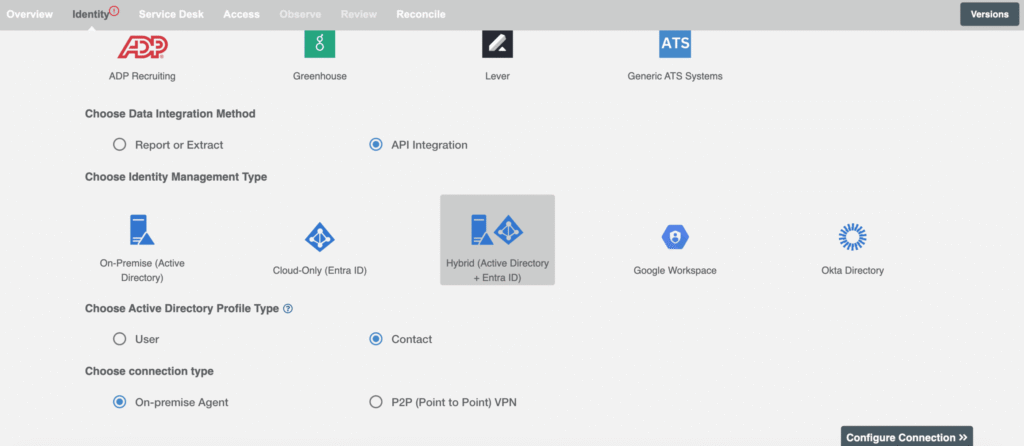
You can select Contact as the AD Profile Type during workflow setup so Hire2Retire applies Contact-specific lifecycle rules, attributes, and communication access management instead of standard employee account processing.
Selecting Contact as the AD Profile Type in Hire2Retire
What Gets Automated
Create Contact:
When a new contractor, vendor, or external worker is added in the source system, Hire2Retire can automatically create the Contact based on configured lifecycle rules.
Contacts can be created before or on the start date depending on business requirements. This helps ensure external workers receive communication access without requiring manual provisioning work from IT teams.
Update Contact:
When source data changes, Hire2Retire automatically updates the Contact record in Active Directory.
This includes updates to attributes like names, departments, managers, assignment details, or end dates. Automated updates help keep Contact data accurate and aligned with source systems throughout the lifecycle.
Delete Contact:
When an engagement ends, Hire2Retire automatically removes the Contact based on configured lifecycle rules.
Organizations can define deletion timing, future scheduling, or aging periods based on internal policies. This helps reduce stale Contact records and improves directory hygiene across AD environments.
Group Membership Management:
Hire2Retire automatically adds Contacts to supported communication groups such as Distribution Lists and Mail-Enabled Security Groups.
This ensures external users receive the appropriate communication access without manual group management. Group memberships are also cleaned up automatically when the Contact lifecycle ends.
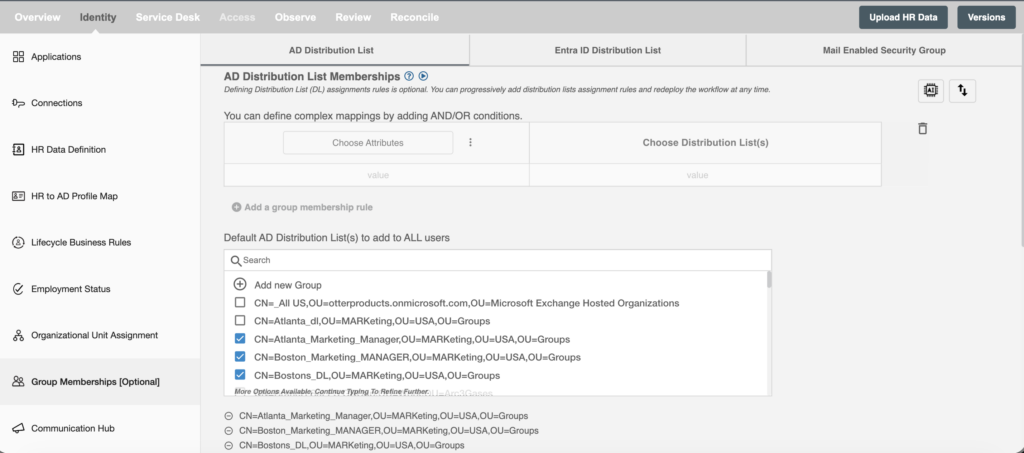
Organizations can define default communication groups or configure rule-based assignments using Contact attributes and lifecycle conditions. This helps ensure external users are added to the correct distribution lists automatically during provisioning.
Automated Distribution List and Group Membership Assignment for Contact Objects
Visibility and Control
Communication Notifications:
Hire2Retire can send notifications for Contact lifecycle events such as creation, updates, deletion, and scheduled actions. This helps IT teams, managers, and stakeholders stay informed about lifecycle activity without relying on manual follow-ups.
Service Desk Integration:
Contact lifecycle events can also trigger service desk workflows where required. Organizations can automatically create service desk tickets or trigger downstream tasks when Contacts are provisioned, updated, or removed. This helps connect identity automation with broader IT operational processes.
Supervised Mode
Organizations can also enable supervised approval controls for Contact lifecycle actions when needed. This allows IT or identity teams to review Contact creation, updates, or deletion before the action runs. It is especially useful during rollout phases, controlled environments, or when additional oversight is required for external identities.
Observability and Audit Visibility:
After deployment, teams can monitor Contact lifecycle activity through observability views inside Hire2Retire. Teams can review lifecycle processing status, historical changes, update activity, delete events, and processing outcomes to maintain visibility into lifecycle activity and review audit history when needed.
Observability View for Contact Lifecycle Activity
When This Helps the Most
Automated Contact lifecycle management is especially useful for organizations with:
In these environments, automation reduces significant IT effort and improves consistency across Contact lifecycle management processes.
Why This Matters
External identities such as contractors, vendors, consultants, and partners are now part of almost every enterprise environment. But in many organizations, these identities are still managed through disconnected manual processes.
As a result, outdated Contact records often remain active longer than necessary, communication access becomes inconsistent, group memberships are not properly maintained, and visibility into external identities becomes limited. IT teams also end up spending unnecessary time handling manual updates, cleanup work, and operational follow-ups.
Hire2Retire helps organizations bring the same lifecycle governance approach used for employee accounts to external communication identities.
With Automated Contact Management, organizations get:
This helps organizations apply the same lifecycle control and governance to external users that they already use for employee accounts.
Conclusion
With Phase 10.4, Hire2Retire expands identity lifecycle automation beyond employee accounts with Automated Contact Management for AD and Hybrid AD.
By automating Contact creation, updates, deletion, group memberships, and lifecycle visibility, organizations can reduce manual work, improve directory hygiene, and manage external identities more consistently at scale.