Managing employee access in many organizations today is still a complicated web of spreadsheets, paper trails, and delays. Workforce Identity Automation connects Human Resources (HR), IT, and Security by automating the entire process of tracking an employee’s digital profile from joining, to transferring, to leaving and removing access. Essentially, workforce identity automation provides a seamless interface between an organization’s employees and its systems, thereby allowing the organization to manage, protect, and have confidence in their employee’s digital profiles while eliminating unnecessary friction.
As the need for workforce identity automation is rapidly increasing due to rapid advances in technology, only 6% of organizations globally had their Identity Governance and Administration (IG&A) processes completely automated in a 2025 survey. This leaves 94% of organizations still relying partially or completely on manual processes to manage employee access and information. The existence of this gap presents a significant opportunity for organizations to take advantage of while simultaneously posing a considerable risk of being left behind if they fail to implement Workforce Identity Automation solutions in their business processes.
Workforce Identity Automation is designed to close the gap between Human Resources (HR) and Information Technology (IT) systems that manage an employee’s records. When a company hires a new employee or changes an existing employee’s role, there can be delays in the HR system updating the IT system with the correct employee data. This can result in delays for the new employee or incorrect access being granted. Workforce Identity Automation enables the automatic transfer of HR data into the identity management systems through a connection from HR IS to IAM, which provides a more streamlined process with minimal delays; therefore, there will be fewer missed entries or forgotten access permissions.
The manual processes that typically accompany the onboarding of new employees can cause delays in the employees receiving access to the systems and applications that they need to perform their jobs. Automating HR processes such as creating and managing a new employee’s access to applications (application provisioning) and automating the employee’s lifecycle processes can significantly shorten the time it takes for the company to onboard a new employee.
As soon as a new employee is accepted for hire, he/she will receive their access permissions within the same day and will be able to start contributing to the company sooner. Additionally, the automated processes associated with offboarding an employee allow for immediate revocation of the employee’s access to the company’s applications, thereby removing the risk of orphaned user accounts.
The governance of employees has become an increasing focus for all companies. As new regulatory requirements continue to expand and as more and more companies are holding themselves accountable for the management of their employees, Workforce Identity Automation also assists with implementing and maintaining governance through ensuring that only authorized users are granted access (based on their least privilege) and that employees’ access is reviewed timely and accurately.
Furthermore, by removing as many manual processes as possible from the granting and revoking of employee access to applications, there is less opportunity for human error. There is a lower risk of unauthorized access being granted and a lower risk of automatic access being given to terminated employees.
Organizations often face challenges when trying to scale their identity management systems. As the organization grows in size and becomes globally dispersed, using a manual process to manage people’s identities (e.g. joiners, movers and leavers) will become unmanageable. With automated workflows managing identity and access rights, the identity and access rights of every single employee can remain consistent throughout the organization, regardless of how large or complex the organization may be.
Even though the benefits of automating identity management processes are clear, many companies still resist automating. According to the 2025 Identity Governance Survey, approximately three-quarters of organizations experienced challenges integrating their legacy data management systems with other technologies (such as SaaS and Cloud) and/or using a variety of identity models.
Many organizations fear the cost and/or risk of automating their processes due to potential human error and or lack of control over the automated process.
However, there has been an increase in organizations planning to invest in automated identity security as more organizations recognize that identities are the foundation of security and compliance in the digitally enabled, hybrid, and cloud-based world.
As the evolution of modern identity platforms continues, the integration of those platforms with existing HR management systems, including cloud-based HRI systems, is becoming simpler as well. And today’s cloud-enabled identity management solutions are becoming increasingly practical, accessible, and far more efficient than the traditional manual identity management solutions.
Companies implement workforce automation on their digital assets and tend to see many positive outcomes like the following:
According to industry research, organizations leveraging HR-driven identity automation are achieving significant improvements in productivity, Security Posture, and Operational Efficiency.
There are now more and more companies adopting cloud based applications, remote working models and hybrid IT environments. In this environment, there is a tendency for identity boundaries to be extended across multiple tools and networks, which in turn creates the potential for human error in the management of access. Workforce Identity Automation provides a centrally managed, dynamically assessed and consistently governed manner of managing access to resources across various teams, locations and devices.
The operational efficiency of Human Resources (HR) and Information Technology (IT) Departments has been severely hindered due to the time-consuming nature of repetitive tasks, including onboarding paperwork, provisioning of tickets and the exit checklists of employees. By automating access management and identity workflow processes, organizations can reduce the level of operational overhead, speed up the process of onboarding, provisioning and exit of employees, giving the HR and IT teams additional capacity to focus on enhancing employee experience and developing strategy, rather than continuing to perform redundant tasks.
Organizations do not need a full transformation on day one. They can take gradual, effective steps such as:
Rapidly evolving business environments can hinder a company’s ability to hire quickly, manage identity manually, and provide workers with unrestricted access in real time. Consequently, workforce identity automation is vitally important in:
It has been reported that nearly 80% of organizations will be increasing their investment in identity security by 2025, further substantiating that identity has become an essential component of resilient businesses.
Accelerated Onboarding & Transition
With workforce identity automation in use, organizations benefit from an expedited recruitment process as well as better adherence to compliance requirements. Workforce identity automation also promotes a secure environment (i.e., identity) that is scalable as organizations continue to grow; therefore, companies do not experience a lapse in security when new hires and applications are added.
Integrating People, Processes, and Systems
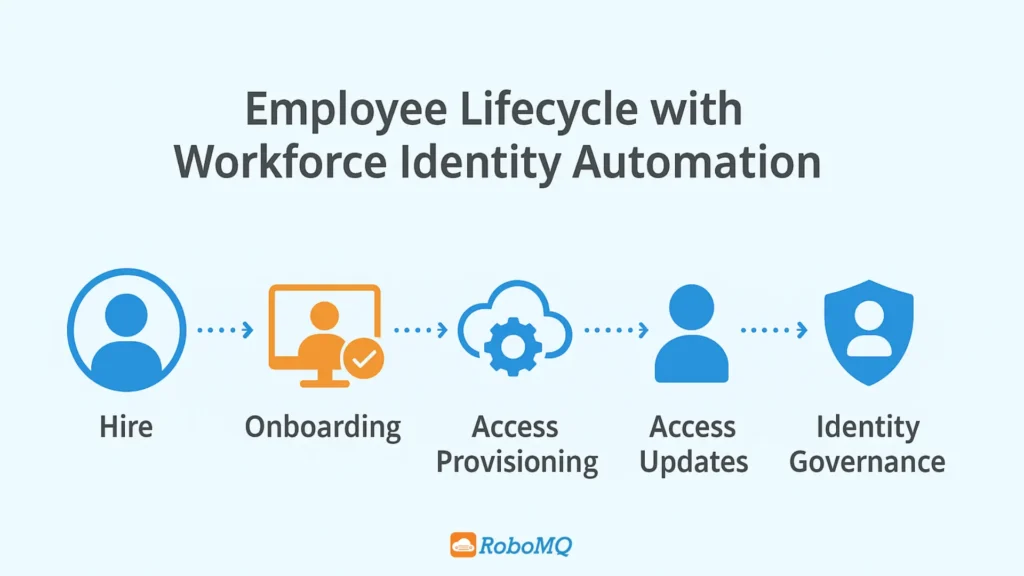
By combining the three key components of workforce identity into a complete and automated employee lifecycle, organizations gain a unified, efficient, and secure way to manage their employees from the point of hire to the point of retirement. For organizations utilizing products such as Hire2Retire from RoboMQ, workforce identity automation enables sustained growth, improved operational efficiency, and a more robust security posture over time.
It means your employee accounts like email, apps, system access are automatically created, updated, and removed as people join, move, or leave the company.
Because when HR updates don’t reach IT on time, new hires wait for access, ex-employees keep active accounts, and companies face security, cost, and compliance risks.
Automation gives new hires access from day one and removes access instantly when someone leaves, reducing manual work, delays, and mistakes.
Hire2Retire is an employee lifecycle automation platform that syncs HR data with IT systems so access is created, updated, and removed automatically.
Yes. It ensures no unauthorized or leftover accounts exist and keeps audit trails, which helps with SOC2, ISO, and internal security policies.