Hire to retire software unifies HR, payroll, and workforce operations by making HR the single point of control and executing all employee changes as one coordinated lifecycle process. HR captures and finalizes the change, the workflow layer validates it, and payroll, workforce management, identity, and financial systems are updated in a fixed sequence based on that same event. Payroll calculations, scheduling rules, access, and reporting are therefore driven by the same confirmed data at the same time. This eliminates handoffs, timing gaps, and conflicting system states, turning separate HR, payroll, and workforce tools into one operational flow.
Most large organizations do not suffer from a lack of HR technology. In fact, many enterprises have spent years refining their HRIS, payroll platforms, workforce management tools, identity systems, and financial applications. Even though each system is capable and the team knows the tools well, operational issues continue to surface in places where they should not exist.
Employees get paid incorrectly even though the data was “updated.” New hires wait days for system access despite approvals being completed. Transfers introduce reporting mismatches that take weeks to unwind. These problems are rarely caused by broken software. More often, they happen because systems operate independently, each following its own rules, timing, and assumptions.
Workforce operations are rarely simple, and they are almost never low risk. A single employee change can ripple across payroll calculations, tax treatment, benefits eligibility, scheduling rules, system access, and financial reporting. Each downstream system has its own dependencies and timing constraints, and none of them naturally wait for the others to be ready.
In many organizations, HR updates a record first. Payroll processes change later, often on a fixed cycle. Workforce management systems rely on their own identifiers and logic. And as a result, identity tools respond to different triggers entirely. Even when these platforms are technically integrated, they are not operationally aligned.
When integrations simply push data without context or sequencing, complexity does not disappear. It moves. Errors surface downstream, often far removed from the original change. This is why many integration strategies quietly fail. They assume coordination will happen on its own once data arrives. In practice, this is usually where things start to break.
Hire to retire software takes a different approach. It treats employee changes as lifecycle events that must be validated, ordered, and executed deliberately, rather than passed along as a series of handoffs.
The difference between fragmented operations and true unification lies in orchestration. Traditional integrations focus on connectivity. They answer the question, “Can System A send data to System B?” Hire to retire software answers a different question: “Should this change move forward now, and if so, in what order?”
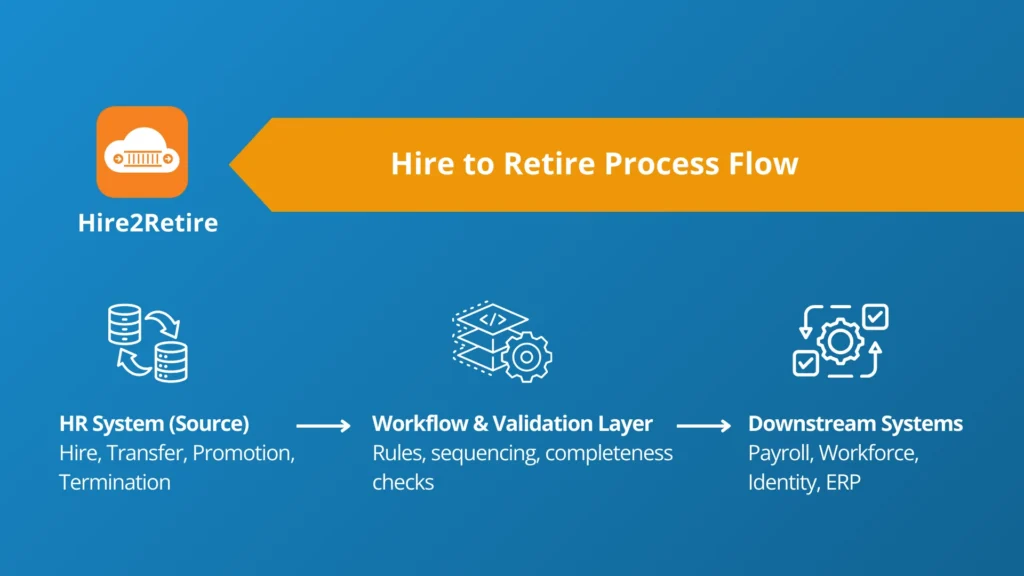
This distinction matters more than it actually is. Hire to retire software introduces a workflow layer that sits above HR, payroll, workforce management, identity, and ERP systems. This layer evaluates whether an employee event is complete, applies business rules, and determines which systems need to be updated and when. Identity management systems no longer react to partial or provisional data. They respond to confirmed lifecycle events. This is how unification actually happens, not through tighter integrations, but through controlled execution.
A centralized workflow layer validates information and enforces the right sequence of actions. The sections below walk through how this coordination actually works in practice, and why it prevents the breakdowns most organizations struggle with today.
Every successful hire to retire program starts with a clear rule: HR owns employee identity. In a unified model, lifecycle events originate in HR. The workflow layer validates those events before anything else occurs.
This hierarchy creates clarity. It ensures that downstream systems respond only to finalized data, which is essential for keeping HR, payroll, and workforce operations aligned over time.
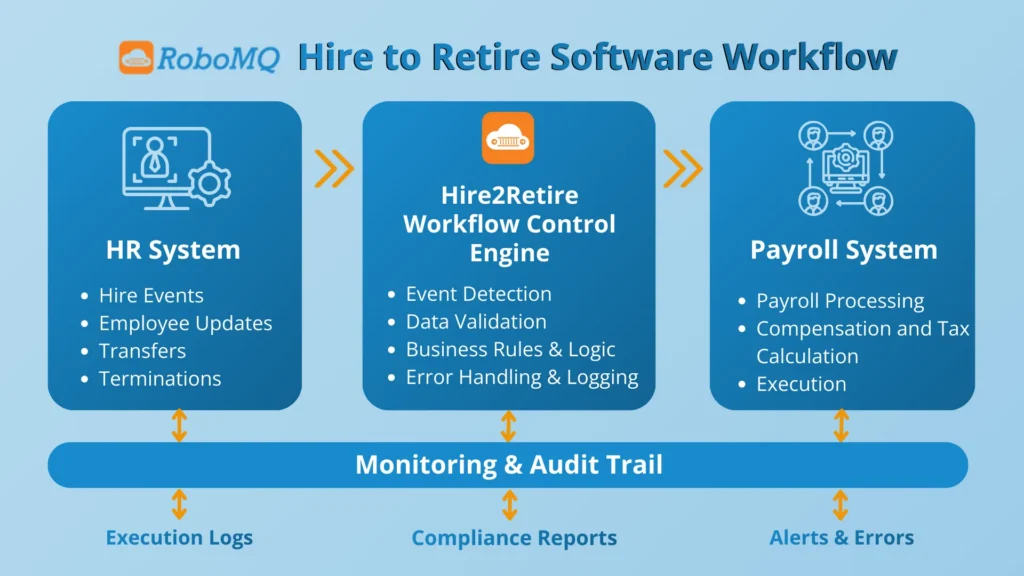
A hire to retire process flow chart makes one thing clear very quickly: order matters. Every lifecycle event begins in HR. That event might be a new hire, a promotion, a transfer, a compensation adjustment, or a termination. The workflow layer captures the change, checks that required attributes are present, applies business rules, and then coordinates downstream updates in sequence.
Payroll updates only after job and compensation details are confirmed. Workforce management systems update only after role and location data are validated. Once employment status is finalized, identity and access systems provide or revoke access. If one step fails to execute, the process stops completely. This sequencing actually prevents systems from drifting out of sync and is central to how hire to retire software unifies workforce operations.
Think of traditional integrations like a house where the plumbing and wiring are shut inside the walls. When and if something goes wrong, fixing it often means tearing far more apart than you expected. That is how traditional integrations behave in real-time environments. Logic, sequencing, and system dependencies are hardwired into point-to-point connections, which is why HR and identity systems gradually become tightly coupled and difficult to change.
Workflow orchestration follows a different method. Connectors handle the technical mechanics (such as authentication) and rate limits, while a separate workflow layer controls sequencing, validation, and decision-making. This split authorizes organizations to update or replace systems without having to redesign their hire to retire process every time the technology stack changes.
Automation forces clarity. There is no way around it. Attributes like job role, location, cost center, and pay group often mean different things across systems. Automation does not fix bad data; it just makes it move faster.
Without a rock-solid map for your definitions, you are essentially digitizing chaos. Modern hire to retire software platforms force these data silos and definitions into the light during the design phase. They demand that teams hammer out who owns what and how data transforms before the first workflow triggers. Yes, it is more work upfront, but it is the only way to trade constant manual firefighting for actual operational stability.
Onboarding is often the most visible use case, but it is rarely the most complex. The real operational challenge lies in managing change during employment across the hire to retire lifecycle. Transfers, restructures, promotions, and international moves can affect payroll, benefits, taxes, scheduling, and access at the same time.
Take a standard location transfer: it is never just a simple address change. You are essentially orchestrating a mid-air handoff between payroll records, tax jurisdictions, and benefit eligibility, all while keeping system access and schedules in sync. Hire to retire software treats this like a mission-critical sequence rather than a bulk update. By validating every step in real time, you eliminate the ghost errors that usually do not surface until the end of the quarter.
Systems do not run all the time:
What separates mature workforce operations from fragile ones is visibility. Hire to retire software logs every action across the lifecycle. It shows which steps were completed, which failed, and why. Recoverable issues are retried automatically. When human intervention is required, teams see exactly where the process stopped.
This level of monitoring turns automation into a supervised operation. Audit trails provide timestamped evidence of execution, which is critical for compliance and internal reviews. Instead of guessing that the processes might have worked, we can have proof that they did.
When implemented correctly, hire to retire software becomes more than an integration layer. It becomes an operational framework. Payroll trusts upstream data, whereas workforce teams rely on schedules and reports. IT reduces access-related risk. Most importantly, the organization replaces fragmented execution with a single, coordinated way of managing the employee lifecycle.
Unification does not come from adding more tools. It comes from enforcing ownership, sequencing complexity, and governing execution. Hire to retire software provides the structure to make that possible, turning workforce operations into a source of stability rather than friction.
Hire to retire software unifies HR, payroll, and workforce operations by controlling how employee changes move across systems, not just by integrating them. It establishes HR as the system of record, validates lifecycle events, and then orchestrates payroll, workforce management, identity, and financial updates in a deliberate sequence. Payroll runs only on finalized HR data. Workforce systems update only after role and location changes are confirmed. Access and reporting follow completed employment states. By enforcing ownership, order, and validation across the entire employee lifecycle, hire to retire software turns fragmented tools into a single, coordinated operating model.
Yes, and that is the point. It sits on top of the systems you already use and coordinates how they behave together. You do not replace HR or payroll. You make them work as one process instead of separate tools.
Transfers are rarely simple updates. They often affect payroll, benefits, taxes, and reporting at the same time. Hire to retire software breaks the change into steps and runs them in sequence, so every system reflects the same reality at the same time.
Without visibility, automation becomes a guessing game. When something fails, teams usually find out too late. Monitoring and logs show exactly what happened and when, which makes it easier to fix issues and prove compliance.
Most HR integrations just move data and stop there. They assume the rest of the process will work itself out. In reality, that is where things break. Hire to retire software controls how employee changes move across systems and in what order, so payroll, workforce, and access stay aligned instead of drifting apart.
Because systems do not wait for each other. Payroll might process a change before role data is final, or workforce tools might update based on incomplete information. Sequencing forces each step to finish before the next one starts, which prevents errors that usually surface much later.