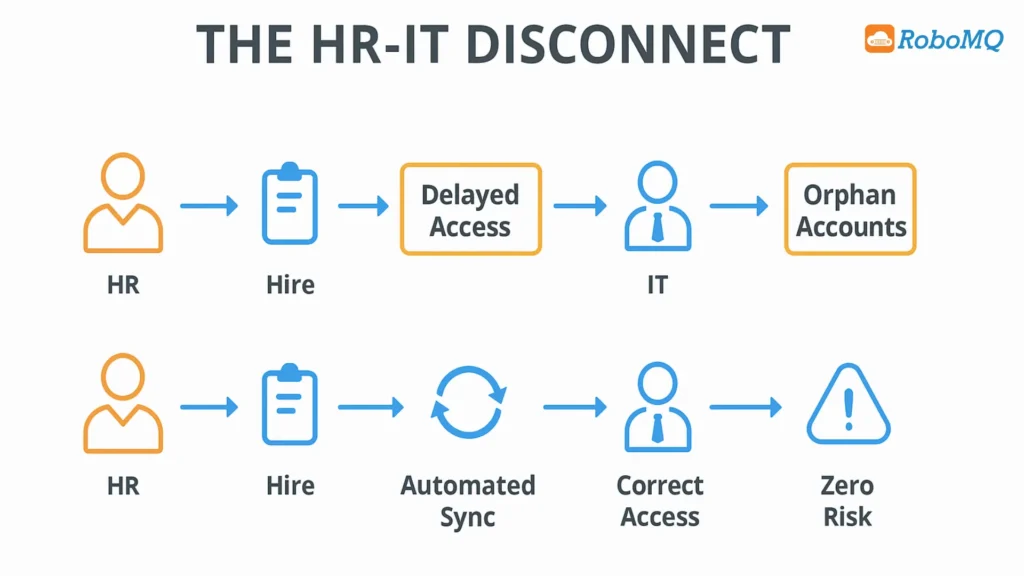
Most companies believe their employee onboarding and offboarding process is smooth. HR updates the records, IT creates or removes access, and everything works as expected. At least that is what leaders assume. The truth is very different.
There is a hidden gap between HR and IT. It becomes visible only when something goes wrong. A new employee who cannot log in on day one. A former employee who still has an active account. A contractor who left six months ago but can still open email. These problems are not minor mistakes. They are signs of a bigger issue called the HR IT disconnect.
This disconnect is not caused by lack of effort. Both teams work hard. The root problem is simple. HR and IT systems do not talk to each other. Data is updated in one place and forgotten in another. Employee changes do not reflect everywhere they should. Every small mismatch becomes a high-risk situation over time.
The Disconnect Creates Slow and Frustrating Onboarding
When HR marks someone as hired, they expect the new employee to start work immediately. But if HR systems and IT directories are not connected, nothing happens until IT manually creates all accounts. IT waits for tickets or emails. Sometimes details are missing, unclear, or delayed.
The result is not surprising. New employees join and spend their first week waiting for access to basic tools. It lowers motivation and makes managers unhappy. HR gets complaints. IT tries to fix things in a hurry. The new employee gets a weak start instead of a strong and confident beginning.
A slow start does not just affect productivity. It affects how new hires feel about their job, their team, and the company. First impressions matter.
The HR-IT Disconnect Does Not Stop at Onboarding
Many companies assume that once access is created, there is nothing more to worry about. In reality, most risks start after onboarding.
People move between departments, change roles, get promoted, go on leave, or leave the company. If the data is not synced across systems, access does not match their current status. Either access is missing when it is required or it stays active long after it should be removed.
For example:
Someone moves from Finance to Sales but keeps access to financial reports.
A contractor finishes work but IT never gets the update to disable login.
An employee leaves the company but still has access to shared drives and cloud apps.
An intern’s temporary access never expires, and no one notices.
Every one of these situations increases the security risk.
The Hidden Security Danger That No One Notices
The biggest danger caused by the hr-it disconnect is active access for people who should no longer have it. These are called orphan accounts, but most people never look for them. They stay in systems quietly, sometimes for months or years.
A forgotten account can still open files, emails, personal information, payroll records, and confidential documents. If someone tries to misuse it, there may be no alert. Even worse, hackers often look for old unused accounts because they are less monitored.
According to the Cloud Security Alliance 2025 “State of Cloud and AI Security” report, 27 percent of organizations say weak identity hygiene, including orphan accounts, is one of the main causes of cloud-related security breaches.
Security teams often discover the orphan accounts only during an audit or after a breach. By then, it is too late.
Compliance and Audit Issues Due to Missing Data Sync
Modern organizations need to follow strict controls to protect employee information and keep access clean. The hr-it disconnect makes this very difficult.
During audits, companies often cannot clearly answer questions such as:
Who has access to what?
When was access granted or removed?
Why does a former employee still have a valid account?
Which contractor accounts are still active?
Even if there was no bad intention, the organization fails the audit because records do not match. This leads to penalties, audit delay, loss of trust, reputational damage. Leadership teams usually learn about the disconnect only when an audit reveals it.
The HR-IT Disconnect Also Affects Cost and Productivity
The cost of unused access is not only a security problem. It also impacts budgets. Every active user account cost money, whether it is used or not. Licensing tools like Microsoft 365, Salesforce, Slack, and other enterprise applications are expensive. Companies often learn that they are paying for access that nobody uses because the user left months ago.
When HR and IT are not fully aligned, the company pays for software seats that should be cancelled, application accounts that should be disabled, and cloud storage that should be freed. This waste is silent and ongoing. It becomes a huge number over the course of a year.
Why Companies Keep Ignoring the HR-IT Disconnect?
Everyone sees the symptoms. Slow onboarding, confused access, messy exits, extra manual work, and security worries. Yet many companies accept them as “normal.” They assume these problems will always exist.
There are a few reasons:
HR and IT both believe the other team will fix it
There is no single owner of the employee lifecycle
No one has full visibility across all systems
Manual processes feel easier than change
But the longer a company waits to fix the hr-it disconnect, the bigger the risks become.
What Leaders Should Really Focus On?
The true question is not how access is created or removed. The question is whether employee data is synced in real time across every system. If not, the organization is exposed.
A mature and safe employee lifecycle must include:
Account creation at the moment HR submits a hire
Automatic role change when HR updates a title or department
Instant removal of access when HR marks an exit
Central visibility across all accounts and apps
No manual work to fix data mismatches
Automation is the most practical solution. It removes human dependency and makes access accurate at all times.
How Hire2Retire Fixes the Problem?
RoboMQ’s Hire2Retire solves the hr-it disconnect by automating the entire employee lifecycle from HR systems to IT directories and applications. When HR updates employee records, the changes update automatically across Active Directory, Azure AD, email, and enterprise applications.
No missed onboarding. No outdated access. No orphan accounts. It removes manual work, improves employee experience, protects data, and gives the company complete control over identity and access.
The best part is that the process is continuous. Every update in HR always reflects across every connected system without anyone creating tickets or sending reminders.
Final Thought
The hr-it disconnect is not just an inconvenience. It creates real financial loss and exposes companies to security risks. Every delay, every mismatch, and every forgotten account becomes a possible failure point.
The smartest and safest way forward is simple. Connect HR to IT through automation. When employee data flows correctly, everything else falls into place.
It means HR and IT systems do not update employee information at the same time. HR may mark someone as hired, moved, or exited, but IT may not get the update instantly. Because of this, access may be delayed or stay active longer than it should.
When HR and IT are not fully aligned, some people end up keeping access even after they leave or change roles. These active accounts become a gateway for cyberattacks and data breaches because no one is monitoring them.
The most effective solution is automation. When HR updates employee information, those changes should immediately update in Active Directory, Azure AD, email, and applications. This removes human dependency and keeps access accurate at all times.
Pricing depends on the number of employees and the number of connected HR and IT systems. It is designed to be flexible for small, mid-size, and large organizations. Explore the Hire2Retire pricing.
Yes. RoboMQ offers a live demo where you can see exactly how Hire2Retire automates onboarding, role changes, and offboarding. This helps you understand how it works in real scenarios and how it can solve the HR IT disconnect for your company.
Swati Gole
Swati Gole is a Marketing Specialist at RoboMQ. She blends creativity with strategy to craft meaningful brand experiences. With a background in digital marketing and communications, she creates stories and campaigns that connect with people and drive growth across web, social, and new-age digital platforms.
Swati Gole
Swati Gole is a Marketing Specialist at RoboMQ. She blends creativity with strategy to craft meaningful brand experiences. With a background in digital marketing and communications, she creates stories and campaigns that connect with people and drive growth across web, social, and new-age digital platforms.
Our website uses cookies. By continuing to browse the website you are agreeing to our use of cookies. For more information on how we use cookies and how you can disable them, please read our Privacy Policy. I Accept.