Running a business is all about efficiency. Monitoring all your devices, IoT sensors, gateways, systems, and applications is a monumental task that is often anything but efficient, especially when integrating collaboration tools like Facebook Workplace with enterprise systems. With RoboMQ Mission Control you get one platform to monitor and control all of your Internet of Things (IoT) devices to help you save time and money.
RoboMQ Mission Control is essentially a device manager which allows you to easily monitor and control the full life cycle of IoT devices including:
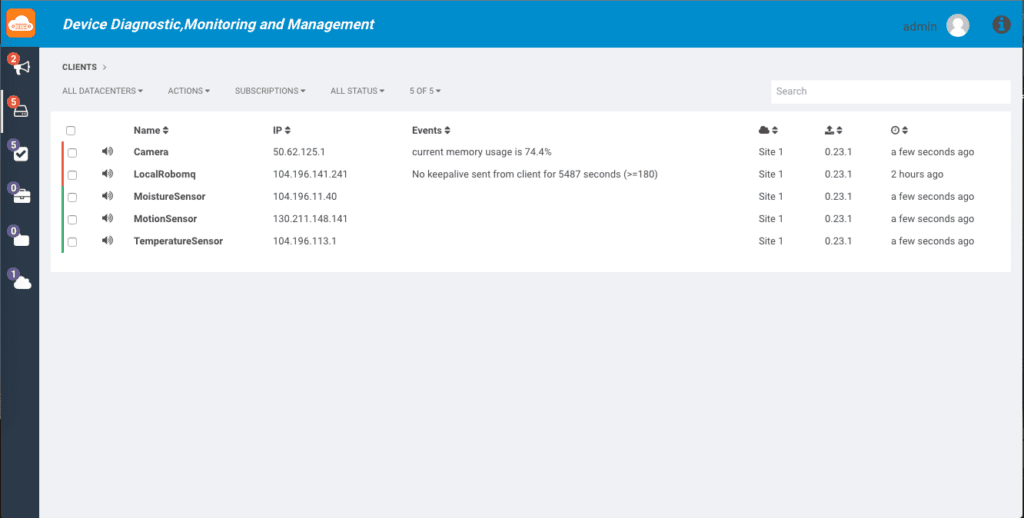
- -Bootstrapping
- -Registration
- -Security and Role Based Access Control (RBAC)
- -Health checks
- -Scheduled and on-demand diagnostics
- -Alerts and notifications
- -Firmware upgrades
- -Remote wipe off
- -And more
This set-up is all well and good, but how can you make sure that all the IoT sensors are working properly? What do you do when there’s a software update needed on the sensors? What if you want to change the settings on the sensors? How do you add new IoT sensors to the existing infrastructure? Having a maintenance team manually complete these tasks on each device is one option, albeit a slow and costly one that is not scalable. Manpower can only do so much before technology needs to step in. With RoboMQ in charge of your IoT devices you won’t need to have your workers doing this type of tedious and repetitive work, similar to how Hire2Retire platform automates employee lifecycle processes.
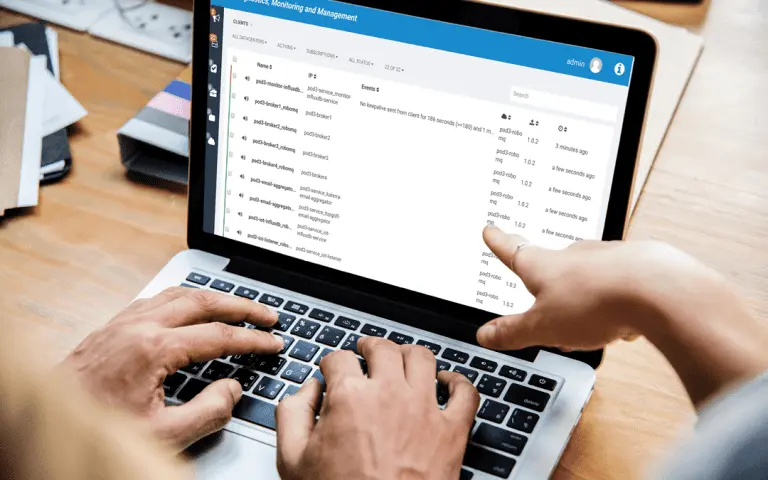
RoboMQ devices are built in Docker containers. This means your RoboMQ devices are shipped pre-installed with the Mission Control device manager clients and are ready to work right out of the box. As soon as they are turned on for the first time, devices will register themselves and become part of your trusted device network, after completing the Authentication, Authorization, and Auditing (AAA) process. Think of it like turning on your cell phone, and how it registers with the carrier network. Once the RoboMQ Device manager validates the identity and the ownership, the device will show up on the Mission Control Dashboard. Optionally, a device registration email/SMS notification or a custom business process can be executed when the devices activate on your IoT device network for the first time.
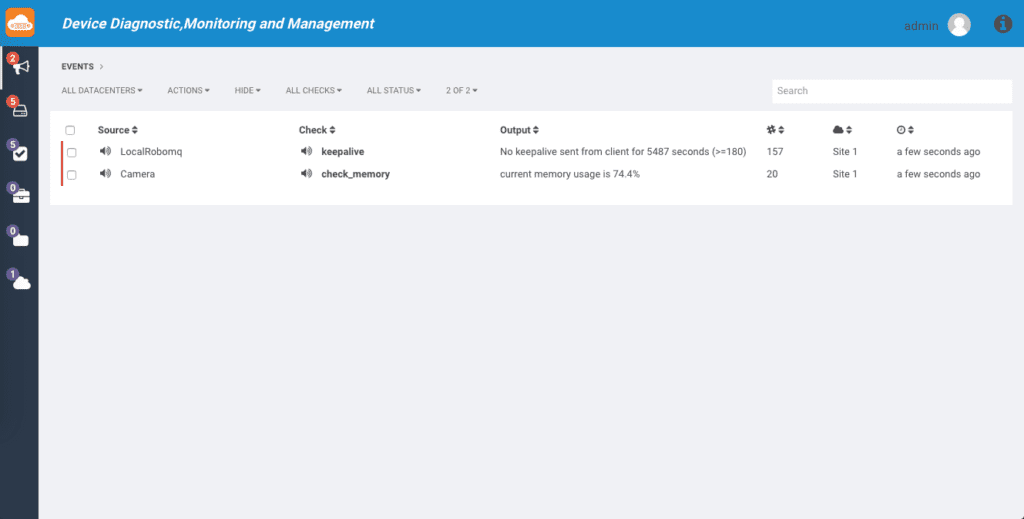
Only authorized users are allowed to access the dashboard and view status of devices. On the control panel, you can configure a set of pre-defined or custom health checks and monitors to run on your devices, or a subset (or sub-network) of your IoT Devices. Scheduled checks and commands are automatically issued to a specific group of devices at a pre-defined interval to monitor devices’ health and operating state.
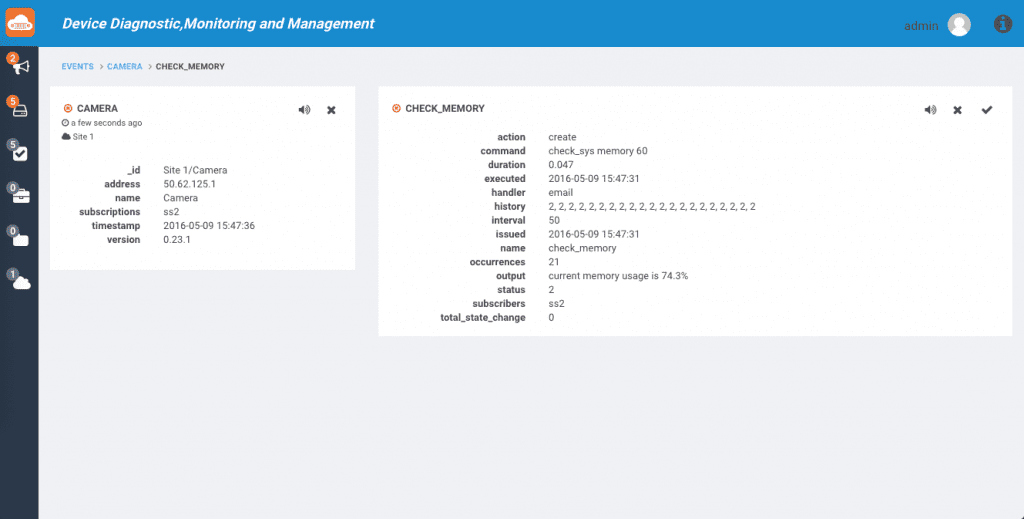
Due to our Microservices Architecture, data transformation and enrichment is made easy. Upon the collection of data from the devices and IoT sensors, a microservice can be deployed to perform a variety of well-defined tasks, such as limit memory capacity. If a device’s memory usage is higher than 60%, a ticket could be created, and an alert email/SMS could be sent to the maintenance team.
This one single platform with a very simple dashboard gives you full control of your devices. Monitoring health, collecting data, and executing commands could not be easier. Want to give it a try? Reach out to us at [email protected] or sign up for a free trial on our website.