Organizations spend millions on security technology and still face identity-based breaches. Why? Because PAM SIEM integration is considered an endpoint, when it should actually be the starting point. When Privileged Access Management (PAM) and Security Information and Event Management (SIEM) come together, they form a highly effective detection layer.
Detection, however, does not equal prevention. That gap is where breaches live. This guide provides information on how PAM SIEM integration increases visibility on privileged activities. It also explores how platforms like Hire2Retire extend this foundation by automating identity lifecycle controls to reduce risk before it reaches detection systems.
Before diving into why integration between PAM and SIEM is important, let us take a step back and understand their purpose.
The Privilege Access Management system (PAM) manages and monitors elevated privileged accounts such as system administrators, service accounts, and database owners. This is because privileged accounts are the main targets of attackers because gaining access to any of these means that they have entered the entire environment. They set access policies, log all activities, and impose access controls.
Security Information and Event Management (SIEM) logs events from all parts of your infrastructure, including endpoints, applications, cloud infrastructure, and networking systems. They work to detect suspicious activity by correlating data and serve as the nerves of security operations. Identity monitoring within the SIEM framework makes this possible.
Before diving into why integration between PAM and SIEM is important, let us take a step back and understand their purpose.
The Privilege Access Management system (PAM) manages and monitors elevated privileged accounts such as system administrators, service accounts, and database owners. This is because privileged accounts are the main targets of attackers because gaining access to any of these means that they have entered the entire environment. They set access policies, log all activities, and impose access controls.
Security Information and Event Management (SIEM) logs events from all parts of your infrastructure, including endpoints, applications, cloud infrastructure, and networking systems. They work to detect suspicious activity by correlating data and serve as the nerves of security operations. Identity monitoring within the SIEM framework makes this possible.
When combined, PAM and SIEM systems produce a much more robust detection capability. PAM systems log all privileged sessions, including information about who logged into which systems, for how long, and what was done with commands. This information is then fed to SIEM, which compares the privileged session data with baseline behavior patterns, permissions, and other environmental activities.
This produces a better privileged access security context by making the correlation between logging in at two in the morning and then a PAM session accessing a financial database with data transfer without issuing any tickets. The system will flag this as unusual activity, prompting an investigation by an analyst.
Another aspect where PAM SIEM integration provides massive benefits is in improving audit preparedness. Standards such as SOX, HIPAA, and ISO 27001 demand evidence from companies of being able to manage privileged access effectively. Having both solutions integrated means producing detailed logs of privileged accesses.
PAM SIEM integration allows for:
There is no doubt that there are many ways in which PAM SIEM integration increases detection capability. However, it still has certain limitations:
PAM SIEM integration reacts to threats only after a user gains access. If access is provisioned due to a role change or an error, PAM SIEM flags it but does not assess its necessity. The threat occurs before the system detects it.
IT administrators may assign users more privileges than needed. Neither SIEM nor PAM detects these discrepancies during initial access provisioning. They identify gaps only when problems arise.
One common problem in identity-based attacks is orphaned accounts. In case the deprovisioning process is delayed or neglected altogether, employees will have access to the system despite leaving the company. Even though the PAM SIEM integration identifies any activity performed via these orphaned accounts, nothing can be done about it.
Without centralized identity governance, the same person can exist as multiple accounts across systems. This is due to old accounts not being deleted, new accounts being created for different roles, or contractors’ accounts being left active when they depart. Integration between PAM and SIEM only analyzes each identity separately. It will not be able to identify duplicate identities, check for contradictory accesses, and mark that as a potential threat.
The whole process of PAM and SIEM integration is heavily dependent on the accuracy of the input data about identities. If all joiner, mover, and leaver procedures are managed manually via tickets, emails, and spreadsheets, then mistakes and lags are expected. This means privileged access management based on manual management leads to the usage of outdated or incorrect data by SIEM.
Once the user moves from one team to another or receives an additional level of privilege, it is unlikely that the access rights will expire automatically. The integration of PAM with SIEM keeps monitoring the existing access pattern even though the employee got a new role. As a result, access privilege accumulation goes unnoticed, and it will be detected only through the audit conducted some time afterward.
With the help of SIEM integration with PAM, companies can develop an efficient logging system. However, logs do not prove that the accessed data was accessed for justifiable reasons. Compliance with the laws, including SOX, HIPAA, and ISO 27001, implies not only logging but also lifecycle management, which is required to make sure that access was initially appropriate.
Organizations with the most secure identity posture have one thing in common – changes in access occur automatically, initiated by events from HR. At the point an employee is hired, their HR role initiation starts the automated provisioning process on all connected platforms. If they move departments, then their old access rights are immediately terminated and new ones granted. Should they terminate employment, then the same HR-based de-provisioning will take place.
Hire2Retire takes care of it. Within the initial stages of improving PAM SIEM integration, organizations require a platform that sits upstream of any form of monitoring. Hire2Retire, which is RoboMQ’s identity lifecycle automation solution, allows organizations to connect their HR systems directly to their IT infrastructure. In doing so, HR joiner, mover, and leaver events are directly responsible for access events on Active Directory, cloud services, and PAM vaults.
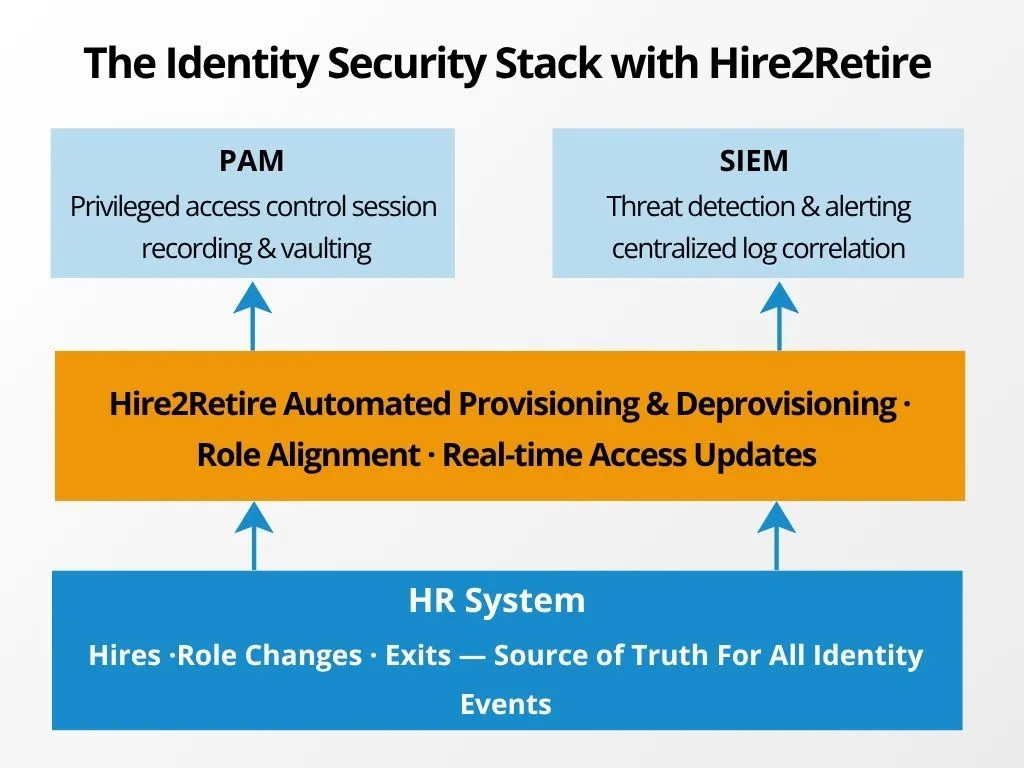
PAM SIEM Integration becomes critical for organizations that want to secure their identities, but the integrity of this process relies entirely on the quality of the identity data. Access misconfiguration, orphan accounts, and late account deactivation open up vulnerabilities that no technology can mitigate.
Hire2Retire fills these gaps with its identity management platform that works in real-time, ensuring your PAM SIEM integration functions as intended. Ready to see it in action? Book a demo with our experts today.
PAM helps to protect and monitor privileged accounts that are the highest-risk access points in any company. PAM grants control over the ability to use certain resources, implements such policies as password vaulting and just-in-time access, and creates all session logs required by SIEM for analysis.
SIEM collects logs from your network to detect patterns of activity that indicate the presence of any suspicious activity. SIEM will help you correlate information between systems, such as privileged access outside working hours and unauthorized data transfers.
Integrating PAM and SIEM will make it possible for your security team to get more complete alerts, investigate them faster, and have a unified audit trail of all actions performed by users. If your company works in a heavily regulated market, integration is crucial to meet all compliance requirements.
Neither solution can do anything related to account provisioning, which means that there will still be accounts without owners, access rights that may be used maliciously, and employees with access to resources even after leaving your company. Identity lifecycle management fixes these problems.
Hire2Retire enables communication between HR systems, IT infrastructure, and PAM platforms. This allows automatic provisioning and de-provisioning of access to resources based on information coming from HR systems. Such automation eliminates orphaned accounts and privilege creep, increasing the accuracy of the results.