Every organization handles Joiners, Movers, and Leavers. But very few manage them well. As workforces become more distributed, SaaS-heavy, and fast-moving, joiner mover leaver automation to identity is no longer just an option. It is a necessity. Identity is no longer a static IT object. It is a dynamic representation of an employee’s role, responsibilities, and access, one that must change in real time as people move through the organization.
Yet most enterprises still treat identity as a slow, manual process. According to industry research, fewer than 4% of organizations have fully automated their core identity workflows, and nearly 60% still handle provisioning and offboarding manually. This gap between workforce reality and identity execution creates systemic risk, not just inefficiency.
This is why JML automation is not about convenience. It is about enforcing identity correctness at scale. When identity does not move at the same speed as people, governance breaks. In this blog, we examine why traditional JML processes fail, what true HR-driven identity looks like, and how modern enterprises can operationalize joiner, mover, and leaver events as real-time, governed identity workflows.
When identity does not keep up with HR events, organizations are left with increased security exposure, higher compliance risk, slower onboarding and role transitions, growing manual bottlenecks for IT teams, and a consistently poor employee experience.
This is why joiner mover leaver automation to identity workflows is no longer a “nice-to-have.” It is a foundational requirement for modern workforce governance and a core pillar of identity governance automation.
Every identity change starts with an HR event. A new hire is recorded, role or department change is approved, and a termination date is set.
From HR’s perspective, these are simple status updates. But from an identity and access perspective, each of these events should trigger a cascade of actions:
The challenge is that these two worlds, HR and IT, often operate on different timelines, tools, and priorities.
HR systems record changes. IT systems execute changes. When these two are not tightly integrated, identity becomes stale, inaccurate, and risky.
A common expectation from HR is that the new hire should be ready on Day 1.
For that, IT must create the digital identity, assign the correct manager, and place the user into the appropriate organizational units. Then, it should provision access to the right applications and licenses, configure MFA, SSO, and security policies, while allocating the required devices and resources often under tight timelines and with little room for error. This is exactly where joiner mover leaver automation to identity becomes critical.
When this is manual or ticket-driven, delays are inevitable. The employee spends their first day or week just waiting.
Movers are often more complex than joiners.
When an employee moves to a new role, it’s not just a title change. Old privileges must be revoked, new access granted, group memberships updated, data visibility adjusted, org charts refreshed, and multiple systems synchronized, all seamlessly. So, the transition feels effortless for the employee and invisible to risk.
Without automation, most organizations add access but forget to remove it. This leads to privilege creep which is one of the most common root causes of insider risk.
Leaver events are the most sensitive.
When an employee leaves, whether voluntarily or involuntarily, IT has to act quickly and precisely. Accounts must be disabled at the right moment, access revoked, licenses recovered, and critical data secured. Ownership of files and mailboxes needs to be reassigned, and any active sessions terminated, ensuring the organization stays secure and business continuity is maintained.
Any delay here directly increases the organization’s exposure to insider threats, data leaks, and regulatory violations.
Despite the risks, many enterprises still rely on highly manual JML processes:
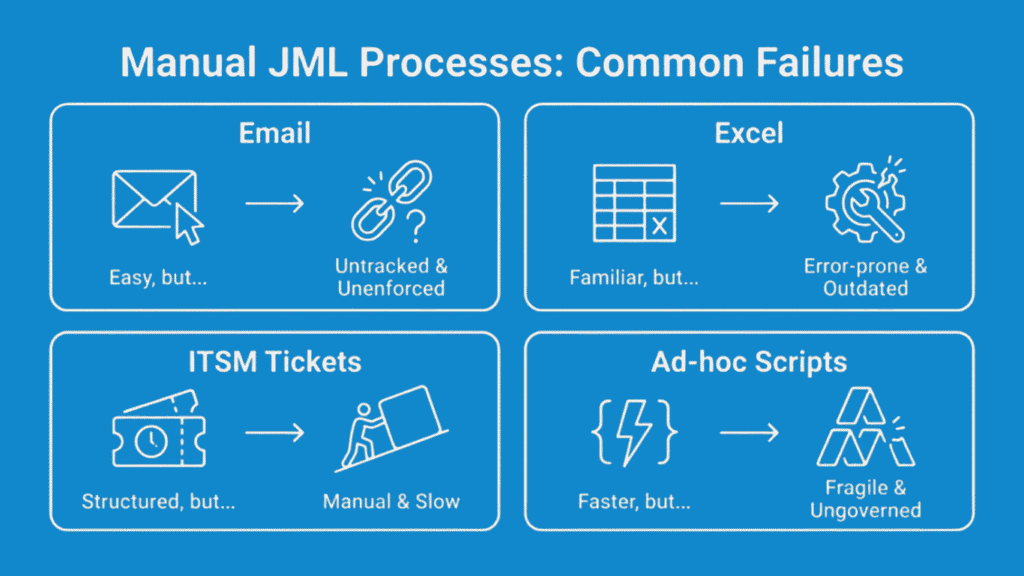
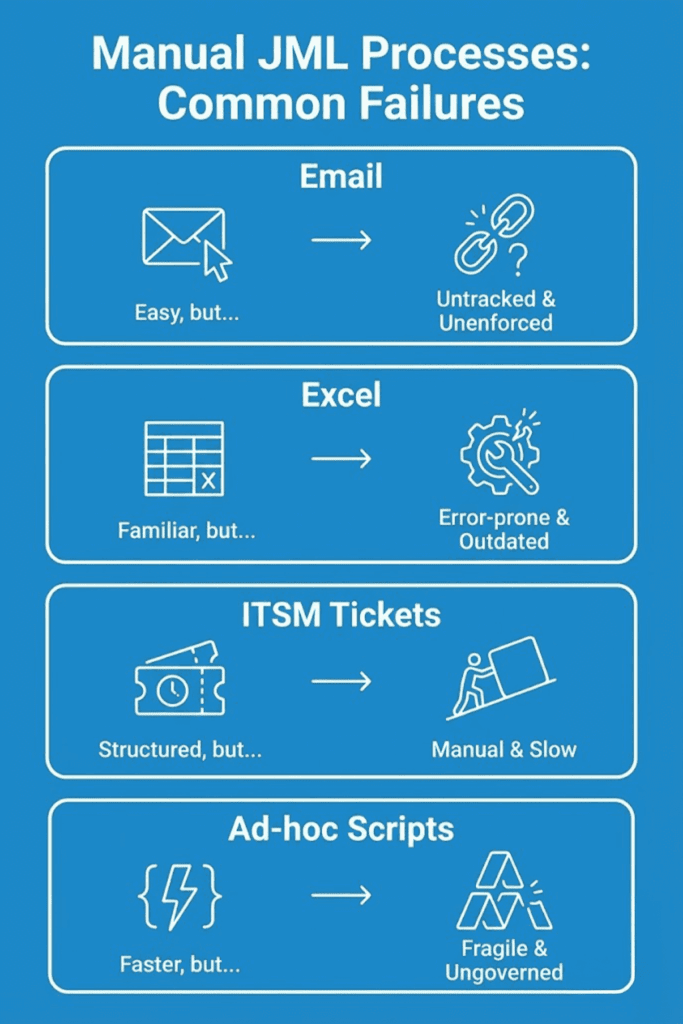
Gartner predicts that 30% of enterprises will automate over half of their network activities by 2026, reflecting a broader shift toward automation in IT and identity processes.
True joiner mover leaver automation to identity is not about replacing emails with scripts. It is about building a system where workforce changes automatically trigger identity actions, consistently, securely, and at scale.
RoboMQ’s Hire2Retire is designed specifically for this purpose: to operationalize HR-driven identity by treating HR events as real-time triggers for identity lifecycle execution.
In most organizations, HR already captures every major workforce event, including new hires, transfers, promotions, department changes, leaves of absence, and terminations. Each of these moments represents a shift in what an employee should be able to access, making HR data a trigger point for real-time identity and access updates.
Hire2Retire integrates directly with HR and ATS systems, consuming worker data via APIs or secure extracts. As soon as a change is recorded, the identity lifecycle is triggered.
This eliminates the dependency on:
Identity now follows workforce reality automatically. This is the foundation of HR-driven identity.
When a Joiner event is detected, Hire2Retire automatically creates the employee’s digital identity. It generates usernames, email addresses, and UPNs based on predefined rules. It assigns the correct manager, places the user in the appropriate organizational units, and applies consistent naming and formatting standards.
For Movers, identity attributes such as title, department, manager, location, and others are updated in real time. These changes don’t remain isolated. They cascade automatically across connected systems, ensuring that access, visibility, and permissions always reflect the employee’s current role.
This is how modern JML workflows should operate, continuously, not episodically.
In Hire2Retire, access is not manually assigned; it is derived. Using attributes such as department, role, location, and employment type, dynamic access rules determine which groups, licenses, and applications a user should receive. This enables automatic access assignment for Joiners, real-time privilege adjustments for Movers, consistent enforcement of least privilege, and the elimination of privilege creep.
When attributes change, access changes with them. This is joiner mover leaver automation to identity in practice; governance embedded directly into execution.
Hire2Retire integrates with over 200 systems through its SCIM connectors, enabling:
This means:
No tickets. No scripts. No delays. This level of execution is what makes joiner mover leaver automation to identity operationally real, not just theoretical.
Leaver workflows are where automation delivers the highest security value. Hire2Retire supports precise, policy-driven offboarding through timed deactivation (for example, on the employee’s last working day at 6 PM), multi-time zone enforcement, and immediate termination for sensitive exits.
It automatically recovers licenses, removes group memberships, deprovisions application access, and invalidates active sessions, making sure no access lingers beyond the moment it should.
This ensures that no access lingers beyond the moment it should. This is not just automation; it is identity governance automation executed with precision.
Not everything should be fully automatic. Hire2Retire integrates with ITSM platforms like ServiceNow to support ticket creation, approval workflows, asset requests, order guide execution, and catalog-based provisioning. This ensures that identity-driven changes are not only automated but also operationally governed. It bridges the gap between identity automation and real-world IT processes.
Automation without visibility creates risk. Hire2Retire provides full change logs, detailed attribute tracking, and complete access modification history. It also offers built-in approval workflows, consistent policy enforcement, and scheduled reporting.
This makes compliance a natural byproduct of execution, not a separate, manual effort layered on afterward. This is what true joiner mover leaver automation to identity looks like.
Many identity failures trace back to a single root cause: fragmented data ownership. When HR records say one thing and identity systems reflect another, governance collapses. Hire2Retire enforces a simple principle: if HR owns workforce reality, HR as a source of truth must drive identity reality. This requires timely updates, accurate attributes, clear ownership, and strong cross-functional alignment.
When HR and IT operate as true partners, identity becomes predictable, secure, and auditable. This is the core of automated JML workflows and HR-driven identity.
Organizations implementing joiner mover leaver automation to identity with Hire2Retire consistently report:
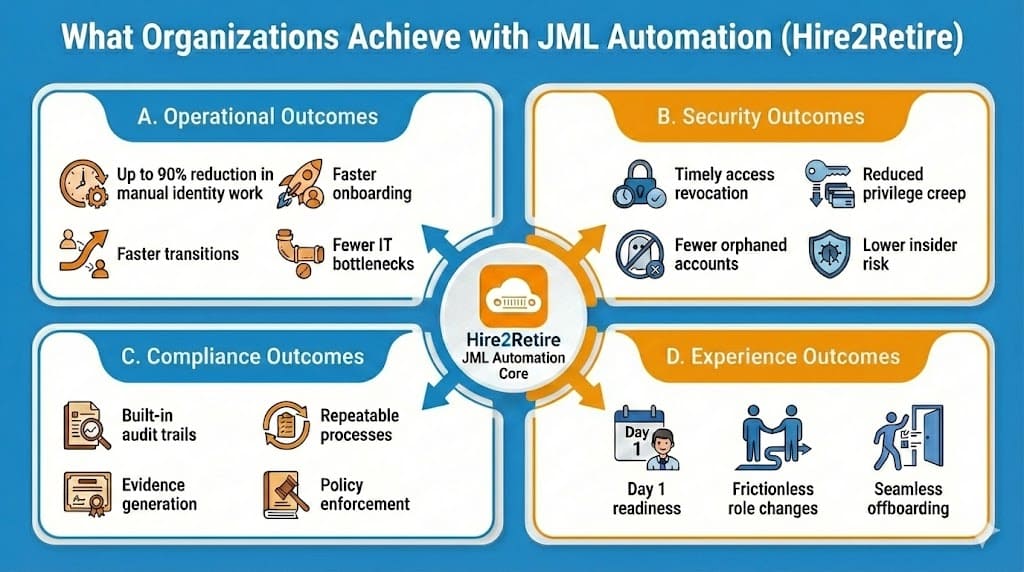

Joiner, Mover, and Leaver events are not just HR processes. They are identity events. When identity fails to reflect workforce reality, security weakens, compliance erodes, productivity slows, and trust begins to wear away.
Hire2Retire ensures that every workforce change is executed as a governed identity action, automatically, consistently, and securely, through joiner mover leaver automation to identity. Because identity should never lag behind people.
Traditional IGA focuses on certifications, periodic reviews, and heavy governance. JML automation focuses on real-time identity execution triggered by HR events. Hire2Retire complements IGA by ensuring that identity is always current using HR as a source of truth.
Automation amplifies both the quality and the flaws in data. Hire2Retire includes validation, approvals, and exception handling, but HR-IT alignment is critical. Clean HR data is the foundation of secure identity governance.
Yes. Hire2Retire supports hybrid AD, Entra ID, Okta, Google Workspace, and mixed IAM stacks. JML automation is designed to operate across hybrid and multi-cloud identity environments.
Every change is logged, traceable, and reportable. You get built-in evidence of who had access, when, why, and how it changed, without manual reconstruction.
Hire2Retire is no-code and workflow-driven. Most organizations go live in 6–10 weeks, depending on complexity and integrations.

Nitesh Durgude is a marketing specialist with 6+ years of experience in the content industry and an engineering background. He specializes in SaaS and business-focused content, creating blogs and videos that simplify complex topics into practical, easy-to-understand insights.
Nitesh Durgude is a marketing specialist with 6+ years of experience in the content industry and an engineering background. He specializes in SaaS and business-focused content, creating blogs and videos that simplify complex topics into practical, easy-to-understand insights.