A new hire’s desktop is ready on day one, their access rarely is!
New hires wait days for the right access because admins have to allocate access based on ITSM or email requests, or simply allocate needed entitlements and access based on tribal knowledge and their own judgment. Peer Based Predictive Entitlements takes an AI and ML approach to solve this problem by making data-driven decisions guided by the tribal knowledge embedded in the existing IdP (Identity Provider) and applying the least privilege and security posture sensitivities of the organization.
In a nutshell, Hire2Retire looks at what entitlements an incoming employee’s peers have and recommends entitlements within the boundaries of the organization’s policies and parameters, through the application of sophisticated, advanced AI/ML models. This enables you to provide your new hires a “Superior First Day at Work,” and for role transitions to have baselined entitlements in place even when deterministic RBAC or ABAC assignment rules aren’t codified.
The Problem with Joiners and Movers Waiting on Access
Every access delay comes with a cost. A new hire not able to log into core systems on day one will not only cost his productivity, but also his first day at work impression and experience. An employee who moved departments still carrying old access, without receiving new entitlements will not only be blocked from doing his job, but he will also still be sitting on entitlements that nobody is tracking anymore. Multiply this across every new hire and promotion in a year, and you will get a sea of help desk tickets and manager escalations. With this traditional set up, access landscape keeps drifting further from policy with each passing month.
Most organizations deal with these situations by including more guesswork in their access assignment process, rather than tightening the process. An admin looks at the organization chart, finds a profile that looks similar and copies their access. It works until it doesn’t. In case, the peer they copied from is over provisioned, or the org chart didn’t reflect a recent change, new hire can inherit wrong access. None of this is documented, consistent, or holds up when an auditor flags why a particular employee has this entitlement.
Peer Based Predictive Entitlement Assignment with Hire2Retire
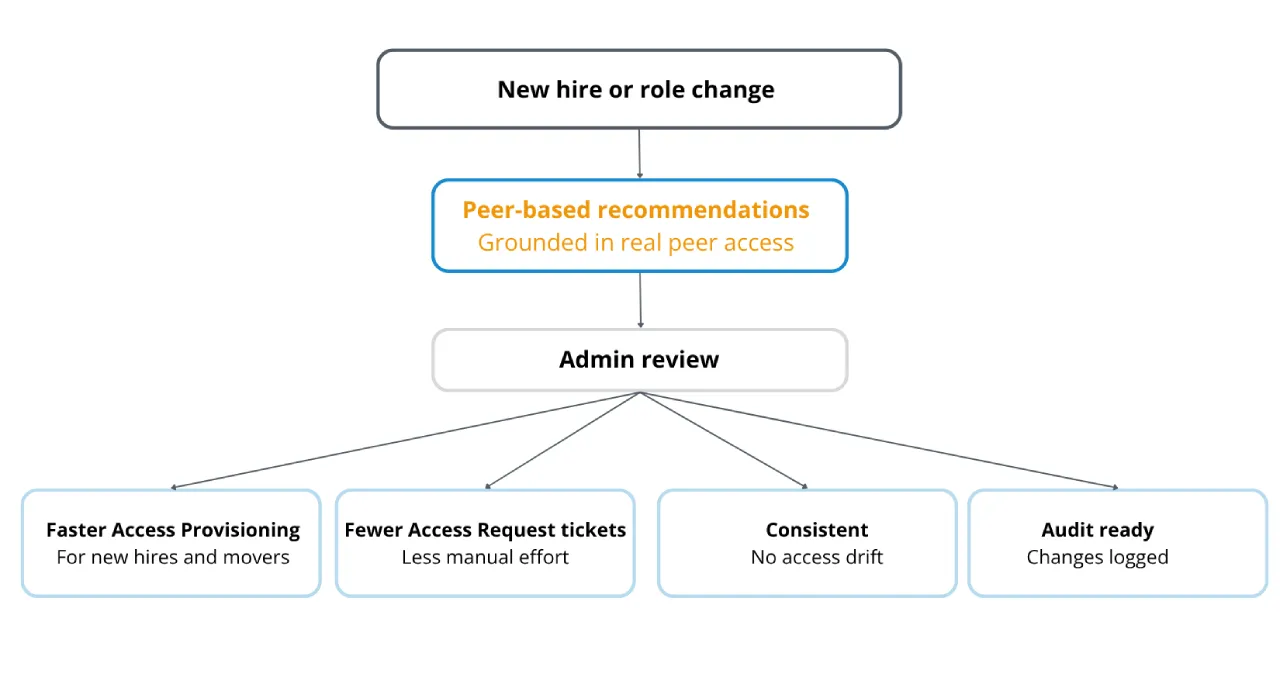
Peer Based Entitlements replaces guesswork with data-driven recommendations by advanced AI/ML models. When someone joins the organization or changes role, Hire2Retire reads through the tribal knowledge already embedded in the existing Identity Providers, what entitlements their peers hold and turns it into recommendations calibrated to the organization’s least privilege and security posture sensitivities. This model works even when deterministic Role-Based Access Control (RBAC) or ABAC rules haven’t been codified for a role yet, so baselined entitlements are ready regardless of how mature the formal access model of organization is.
Since different organizations follow different level of caution, Hire2Retire supports peer-based recommendation in three ways.
No matter which approach an organization chooses, the recommendations reflect real, current patterns of access across the organization.
Peer-based entitlements model is not made from copy pasting one person’s access, rather drawn from the whole peer group, filtered through whichever privilege model the organization has chosen to enforce. Whenever old access has to be reassessed against what the new role requires, like joiner or mover scenario, peer-based entitlements predictions simplify access management. The outcome is “Superior First Day” experience for new hires and structured role transition, instead of a backlog of access requests.
Stay in control of Entitlement Assignments
Since every recommendation goes through a review step before the AI- recommended assignments are written to Active Directory, or any other Identity Directory that organization uses, admins can still remain in control. As organizations build confidence in the model’s performance, they can move to Auto-pilot mode, but that is a maturity decision that organization makes deliberately, not a default they are locked into from day one.
Business value of Peer-based entitlements predictions
Peer-based entitlement assignment results in faster onboarding, fewer manual access requests, and consistent privilege and access across similar roles instead of drifting over the time. While the cost savings and productivity improvement are significant on their own, it also improves new hire onboarding experience, leading to better new hire retention and employee satisfaction. IT and security teams have to spend less time manually adjudicating access requests and be more confident in what’s provisioned matches the policy.
Hire2Retire turns your team’s own entitlement patterns into ready-day-one recommendations, reviewed by admins, powered by AI, and built for organizations that haven’t codified every RBAC rule yet. Talk to us to see it on your own directory.
Frequently Asked Questions (FAQs)