In many organizations, the employee identity lifecycle, including onboarding, role changes, and termination, still requires manual processing. When an employee is hired or changes jobs, the HR department must notify IT. They may send a service desk ticket, use Excel to track access, or communicate via email or phone. Each IT administrator then has to create new accounts and assign the proper access for the new hire.
IT personnel are under a lot of pressure. More often than not, they forget to revoke access after an employee leaves. This creates a bad Day 1 experience for the new hire. It also results in a huge amount of administrative work for very simple tasks. Additionally, it increases the risk of data breaches.
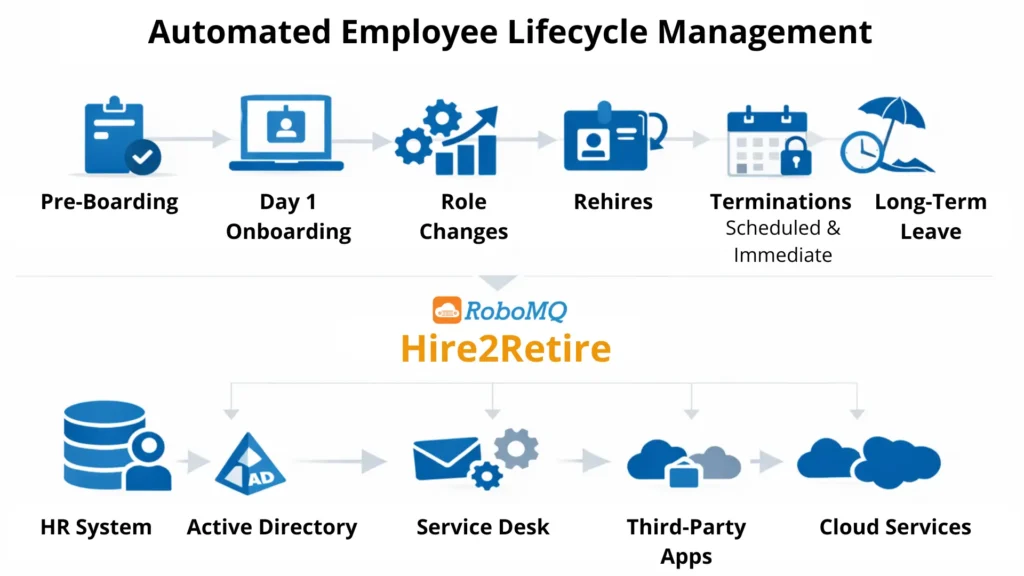
Managing an employee’s identity, access, and permissions in a given organization is referred to as employee lifecycle management. Employee identity is created when they begin their employment; when an employee’s “job” changes, his or her access is updated, and lastly, the access to an employee’s identity will be removed when that employee leaves the organization permanently or goes out on long-term leave. The idea of being able to apply changes to employee identity and access to multiple systems at the same time is made possible by utilizing real-time employee HR data that is being tracked through the employee lifecycle process.
Termination workflows include group removal, license removal, mailbox conversion to shared mailboxes, OneDrive ownership transfer, auto replies, mail forwarding, and scheduled data deletion.
Managing the employee identity lifecycle manually places heavy dependency on HR-to-IT handoffs. Typically, when HR creates an employee’s profile, the first step for an IT administrator is to log in to the employee’s onboarding application and log the employee into the appropriate applications in order for them to provide their required access. All of this needs to happen very quickly, generally within a few hours or less, in order to avoid unnecessary delays for the employee.
The majority of companies require HR to use service desks or email as the primary means for requesting identity-related activities. These types of requests are routed through either service desk tickets or email requests by IT administrators, and, as a result, the IT administrators need to utilize scripts or rely on ad-hoc automation to complete these tasks.
A survey presented during this session stated that approximately 87% of those surveyed create a service desk ticket to provide onboarding and offboarding services. Additionally, Hire2Retire can leverage AI to suggest entitlements: 89% of people with the job title Product Manager were found to be consistently assigned to a specific security group, which can now be automated using rule sets. This level of reliance on manual processes creates delays in creating user accounts, and the inadvertent failure of the service desk administrator can create inconsistent processes and procedures.
A job candidate’s first day may be filled with frustration if they show up on their first day to find that their IT personnel did not prepare any of their employee accounts, laptop computers, or email and application access to enable them to be productive. Therefore, ideally, all items will be made available to a new employee prior to their first day by ensuring that their Active Directory account, email account, group memberships, access to third-party applications, and visibility in the organization chart are created and activated.
In addition, the cost for IT administrators to create and activate accounts, set up access rights and provide status of the accounts created and activated, and subsequently create a deprovisioned account at termination incurs a significant administrative cost to the organization, which in turn creates a security risk and reputational risk due to terminated employees retaining access beyond the point in time required for the company to comply with regulatory obligations.
Hire2Retire is a software application that provides a means to create, update and maintain an employee’s identity based on the record in a company’s human resources management software. This approach centralizes control of the employee identity lifecycle using HR as the system of record.
A Company’s Human Resources Management System is considered the definitive source of employee information. In addition to employee information stored in the human resources management (HRMS) software, any updates to the employee’s identity due to lifecycle events (e.g., hiring, role changes, name changes, etc.) will be automatically updated in all related identity management systems within the organization.
Therefore, in terms of creating an employee’s identity based on when they are hired and when they receive an identity for use with all of an employee’s job-related systems, Hire2Retire accomplishes the following:
The purpose of Hire2Retire is to streamline and enhance all aspects of the employee identity lifecycle management in a way that is simple, efficient, and cost-effective.
The Hire2Retire platform can automate all HR-related requests and activities, as well as automatically supply access to Enterprise applications when new team members join. Automated workflows associated with core HR functions (e.g., Laptop Provisioning) can also be integrated into the Hire2Retire workflow to facilitate immediate processing of employee requests and actions.
Hire2Retire is not restricted to any one industry, therefore the functionality provided by the platform could be used to improve how organizations perform employee lifecycle processes.
Hire2Retire will automatically provision employee Identities and Access, and it can automatically integrate with other Human Resources Systems, as well as enable near real-time data transfer between all systems associated with an employee. In addition, Hire2Retire can schedule events based on the employee’s local time zone for precise lifecycle handling.
The service desk (3rd Party & Service Desk) integrates into Hire2Retire with many different service desks like ServiceNow or Freshservice through SMTP-based ticket creation (as well). Third-party app provisioning is also supported via native connectors, REST APIs, and Azure Marketplace applications.
Hire2Retire tracks all employee identity lifecycle management changes, whether made by employees or administrators, on an employee-by-employee basis, including changes in attributes (previous and current) as well as changes to their access/group membership, etc.
Scheduled reports can also be generated on a regular basis (e.g., daily, weekly, monthly) and can be sent automatically via email. Audit data is exportable to any of the AWS S3, MySQL, or Azure Blob storage solutions and may also be used for compliance purposes, including SOC 2 and ISO 27001 compliance.
Hire2Retire also provides proactive error notifications if updates fail or data is not received from HR systems.
Communication Hub features include custom, data-rich email templates for different lifecycle stages, notifications to managers, and conditional content based on department or location.
Hire2Retire is classified by Gartner as a ‘Lightweight’ Identity Governance and Administration (IGA) platform covering almost 90% of the range of requirements typically encountered by organizations.
Product support and Evolution:
Some of the alternative products include basic HR systems that offer a directory sync that rely on custom scripts, as well as third-party vendors available through many HR Marketplaces. These alternative solutions often require significant coding and constant maintenance.
The Hire2Retire solution is a complete, “do-it-yourself” solution that has built-in functionality. By automating identity creation, access changes, and terminations directly from HR data, organizations can reduce manual effort, improve Day 1 readiness, and maintain consistent access controls throughout the employee lifecycle.
The Hire2Retire Platform integrates with virtually all HR Systems through API or extract. Systems such as on-premises Active Directory (AD), Entra ID, Hybrid (AD), Exchange Online, SharePoint Online, Service Desk Platforms, and other third-party applications.
No. The Hire2Retire Platform is 100% no-code and self-service. However, you can create additional data transformations using similar logic to Excel.
Hire2Retire provides functionality to support both on-schedule and immediate terminations. With Hire2Retire you can easily remove access rights, clean up licenses, handle mailboxes and create asset workflows. Learn more about Hire2Retire’s through our webinars.
Yes. The Hire2Retire Platform supports Employees, Contractors and Seasonal Workers.
Hire2Retire provides detailed audit trails, reporting and exportable data to help support compliance and audits.