If you are wondering how to automate HR processes without disrupting everything you've already built, this guide is for you!
Let’s be honest. If your HR department is still stuck in a spreadsheet, hunting for signatures, doing manual payroll calculations, and organizing interviews via email, you’re not doing HR. You’re doing paperwork. As your business grows, so does the complexity. With more employees, more rules to comply with, more data to handle, and more potential for making expensive mistakes.
All this falls onto a team that’s already overworked. There’s a point where going faster doesn’t do the trick anymore. The only solution left is to work smart. Automating your HR functions frees up your team to stop acting like mere bureaucrats and allows them to become true partners, giving your company the tools to grow and thrive.
In this guide, we’ll discover how to automate HR processes and the role of Hire2Retire to achieve this objective more efficiently.
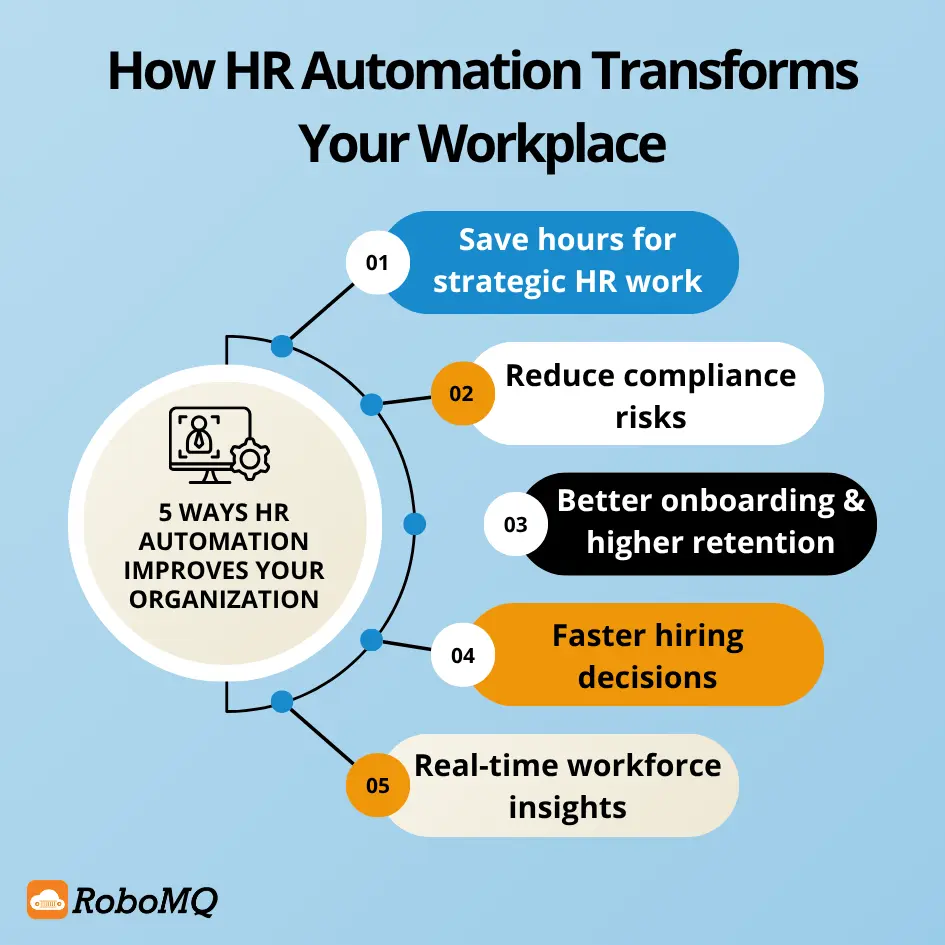
Before understanding how to automate HR onboarding process, let’s understand why. Businesses must know that their HR team can’t handle a growing workforce manually and drive strategy simultaneously. HR automation resolves this issue.
In fact, 60% of HR professionals report saving at least 10 hours per week after implementing HR automation tools. The use of modern technology to streamline processes not only saves you time but also helps you stay safe. Specifically, HR automation can offer you the following benefits:
It becomes evident that knowing how to automate HR processes is not just advantageous but essential.
Most companies know they need automation, but they don’t know how to go about it. Fortunately, you don’t need to automate everything all at once; you just need to follow these seven steps. Here’s how to automate HR processes in a structured manner to achieve desired outcomes.
The first step towards HR automation is an audit. Map all the repetitive activities your HR team performs and interview them. Ask one simple question: “What do you do weekly that seems wasteful and repetitive?” List the processes, identify their weak points, and find where mistakes occur the most frequently.
Vague objectives will not help you. Be clear. Do you want to reduce the number of days to hire a new employee from 45 to 20? Or do you want to remove all payroll errors? Clearly defined objectives enable measuring progress.
Not everything needs to be automated simultaneously. Focus your attention on processes that will produce visible results and will be completed in the shortest possible time. The payroll calculation and onboarding processes are usually good places to begin because they involve repetition and are visible to employees.
This is the most important decision you will make during the whole process. The right HR automation tool should be compatible with your existing software, scalable for your team, compliant with the relevant regulations, and easy to use by your HR staff.
This is where Hire2Retire comes into the picture. It’s a no-code lightweight IGA tool that streamlines the entire lifecycle of your employees in one integrated system. This helps organizations automate onboarding and offboarding while simplifying workforce management. Hire2Retire is compatible with your existing HRIS, dealing with multinational compliance issues, and giving you real-time workforce analytics without any technical hassles.
Do not implement the process to everyone in the organization at once. Begin by introducing the automation system in a single department. Analyze its performance within an actual business setting, solve any problem areas, and then roll out the process to other departments. A limited-scale approach will lead to fewer errors.
The success of technology lies in the hands of the users. No matter how great an HR automation system is, it won’t be able to deliver its benefits if your team lacks the knowledge on how to work with it or even distrusts it.
Spend time providing training before deployment and develop easy-to-understand process documentation for future reference. You can even find internal supporters who fully understand the value of automation and who can lead others through the change process. The problem is not the technical implementation but the human factor.
Automation without metrics is simply guessing. Set up clear KPIs such as hiring time, payroll accuracy, employee happiness, and HR cost per employee before going live. Revisit these quarterly, collect feedback, and continue to improve them. Successful automated HR companies regard automation as a dynamic process rather than a static one.
Now that we know how to automate HR processes, let’s take a closer look at where automation has the most impact:
It’s not necessary to have a consultant on site or conduct an audit to understand whether your HR processes are running effectively. Some signs may appear at all times during daily activities. In case your company has experienced any of the problems listed below, you should consider implementing HR automation.
HR automation isn’t a future-state initiative for large enterprises with unlimited budgets. It is something you can achieve today, and those who do so now will have a true competitive advantage. It starts with identifying where your HR processes lose you the most time and building upon that.
And once you are ready to move forward with selecting an HR automation platform that covers the entire employee lifecycle without using ten different solutions. We hope you got the answer to the question, “how to automate HR processes?” If you are ready to take that next step, Hire2Retire is built exactly for this. It automates your entire employee lifecycle. Book a demo with our experts today and see firsthand how Hire2Retire can transform the way your HR team operates.
In many cases, it takes between 3 to 6 months to implement the solution, depending on the amount of processes that require automation and how complex your existing systems are. Initiating a pilot project in one department can dramatically shorten this timeframe and reduce disruption.
Certainly not! Instead, it frees up HR specialists’ time to focus on strategic activities such as developing talents, building corporate culture, and planning the company’s workforce activities that directly affect business performance.
Absolutely! The best HR automation platforms cover regional laws and requirements, currency conversion for payroll purposes, and localization of employee data, thus saving businesses a lot of time and effort. In addition, such solutions allow you to meet all necessary compliance criteria easily and quickly.
What makes Hire2Retire unique from its competitors is that Hire2Retire can automate and control all stages of an employee’s lifecycle through a single application, from recruitment and hiring, through payroll, to performance evaluation and exit. Most HR automation software solutions specialize in one or two areas of HR management. However, Hire2Retire is a comprehensive HR solution, offering customized workflows for various HR operations.
It all comes down to transparency and clear communication. Explain to employees that you introduce automation in order to get rid of low-value and repetitive tasks. Involve HR specialists in the choice of a platform and its implementation; this way, they will feel like owners and not threatened by the changes. Once employees realize that their pain points are addressed, they usually turn into advocates for the system.

Read More about How to Automate HR Processes and enhance your business strategy.