Summary: Employee role changes create hidden identity risks because new access is added, but old access is rarely removed. Over time, this privilege creep silently expands the attack surface, and periodic reviews catch it too late. Hire2Retire eliminates identity risks during role change through its Mover automation, automatically revoking old permissions, assigning new role-based access, and updating group memberships the moment a change is recorded in your HR system. No manual tickets. No delays. No accumulated risk.
Imagine the last time you saw someone from your group get a promotion or transfer to another group. Was their old identity access removed? Or did they continue to have all that same access, i.e., active, unused, and growing ever greater in scope? For most organizations, the answer is the second one. Identity risks during role change are one of the most common and least reported security problems enterprises face today. The problem isn’t external attackers breaking in. It’s internal access that was never cleaned up. Every role change that leaves old permissions in place adds to that exposure, and in most organizations, those changes happen every day.
Identity risks during role changes rarely appear overnight. Instead, they build over time through a few common gaps in access management.
When employees change roles, receive promotions, or move between departments, they’re often granted new access to perform their current responsibilities. Yet, their previous permissions aren’t always removed.
As a result, employees gradually accumulate access from multiple roles throughout their tenure. Over time, they gain access to more systems and higher levels of privilege than their current role requires. This phenomenon, known as privilege creep, increases security risks and makes it harder to maintain least-privilege access.
Employee accounts are inherently trusted because they have a history of legitimate activity and approved access. When these accounts become over-privileged, they create a larger attack surface. If an account is compromised or misused, the impact can be significant because the user may still retain access to systems, applications, and data that are no longer relevant to their role. Since the activity appears legitimate, identifying unusual behavior becomes more challenging.
Role transitions often leave behind service accounts, access tokens, shared credentials, or project-specific permissions that are no longer actively managed. Without a clear owner or regular review process, these orphaned accounts can remain active for long periods, creating blind spots in the organization’s identity security posture and increasing the risk of unauthorized access.
Many organizations still rely on manual processes to communicate employee role changes between HR and IT teams. As a result, access updates are often delayed.
An employee may begin working in a new role before their permissions are properly adjusted, leaving them with either excessive access or insufficient access to do their job effectively. These delays introduce unnecessary security and compliance risks while creating operational inefficiencies.
The good news is that these challenges aren’t caused by people; they’re caused by disconnected processes. By automating identity lifecycle management and synchronizing HR and IT systems, organizations can ensure that access changes happen accurately, consistently, and in real time.
RoboMQ’s Hire2Retire is a no-code, lightweight IGA platform that connects your HR system directly to Active Directory, Entra ID, Okta, and Google Workspace. When a role change is recorded in your HRIS, Hire2Retire detects the event and responds automatically, updating identity, access, and privileges in near real time. No ticket. No delay. No accumulated identity risks during role change. Here is exactly how Hire2Retire handles each dimension of identity risks during role change:
When an employee’s role changes in the HR system, Hire2Retire automatically updates their security group assignments, Organization Unit placement, and permissions based on the new job function. Old group memberships from the previous role are removed. New ones aligned to the current role are assigned. This enforces least privilege access at the point of transition, not weeks later during a quarterly review.

Hire2Retire uses predefined profile mapping templates to translate HR attributes directly into identity platform configurations. Job title changes, department moves, and reporting structure updates all flow through structured mapping logic, including primary identifiers like Employee ID to maintain consistency. Role-based access to SaaS applications and resources is adjusted automatically using RBAC or ABAC rules, ensuring that third-party application access always reflects the employee’s current responsibilities.
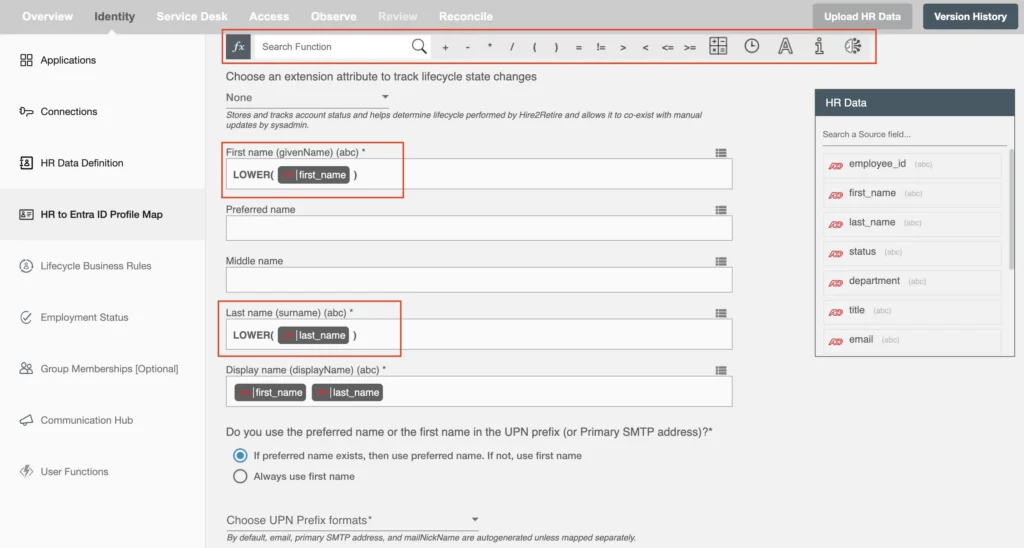
Hire2Retire implements dedicated Mover rules that govern exactly what happens during a role transition. These rules are triggered automatically by event conditions sourced from HR or ATS platforms, a job title change, a department update, or a manager reassignment. Mover rules include:
Each rule is customizable to support organizational exceptions and escalations, so complex role transitions do not fall through the gaps.
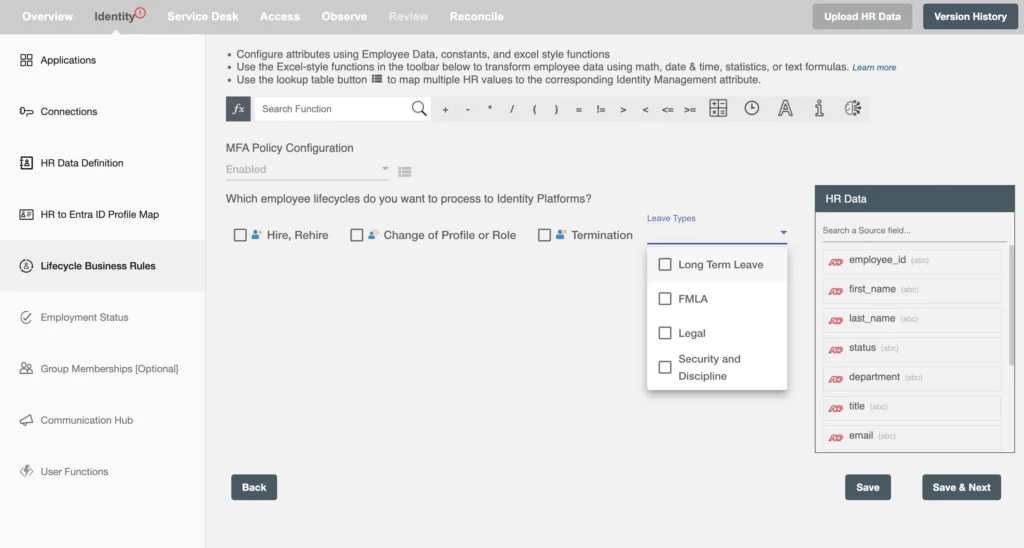
Not all role changes are straightforward. Hire2Retire handles transitional employment states. This includes employees on long-term leave, contractors with temporary status, and future hires, using date logic and status fields from HR data. A termination effective date in the future triggers a countdown-based offboarding workflow.
A return from leave triggers re-provisioning based on the employee’s current role at the time of return, not their role when they left. This ensures identity risks during role change are addressed across every type of transition, not just standard promotions and lateral moves.
Every change Hire2Retire makes during a role transition is logged automatically, capturing what changed, when it changed, what triggered it, and what the outcome was. This creates a complete, auditable record of every identity decision tied to a role change. Compliance teams generate reports on demand rather than assembling evidence manually before each audit.
Hire2Retire integrates with 26+ HRIS systems including Workday, SAP SuccessFactors, ADP, UKG Pro, and Oracle HCM. It connects with 500+ SCIM connectors for third-party application access. Organizations using Hire2Retire avoid 60 to 70% of sysadmin costs, provide a Superior First Day at Work experience to new hires, and meet compliance requirements under SOC 2, HIPAA, and ISO 27001, with identity risks during role change managed continuously, not periodically.
Identity risks during role change are not dramatic or visible. They are quiet. They build one role change at a time, one missed permission removal at a time, until an employee holds access that spans half the organization and nobody can explain why.
The fix is straightforward: stop managing role-change access manually. Connect your HR system to your identity infrastructure and let every HR event drive an automatic, policy-driven identity update. That is what Hire2Retire delivers, and it is what eliminates identity risks during role change before they accumulate into a security incident. Ready to see how Hire2Retire handles role changes in your environment? Book a demo with our experts today.
New hires start with a clean access profile. Terminations trigger a clear removal process. Role changes do neither, they add new access without removing old access. Over multiple transitions, this compounds into a permissions footprint that far exceeds what any current role justifies.
Identity risks during role change are the cause, i.e., new access gets granted without removing previous access. Privilege creep is the outcome, i.e., the accumulated excess permissions that build up over multiple transitions. Every unmanaged role change contributes to privilege creep over time.
When a role change is recorded in the connected HRIS, Hire2Retire propagates the update to Active Directory, Entra ID, Okta, and Google Workspace simultaneously in near real time. Group memberships, permissions, and profile attributes are updated across all platforms based on the same HR event, no platform falls behind.
Hire2Retire processes identity changes based on HRIS data as the source of truth. If an HR record is incorrect, the identity update will reflect that. Hire2Retire supports data mapping, transformation, and conditional logic to catch common data quality issues before they propagate to identity platforms.
Yes. Hire2Retire categorizes employment statuses into active, inactive, and transitional states. Transitional status, project assignments, contractors, employees on leave, triggers conditional rules based on dates and employment type. When the assignment ends or an employee returns from leave, Hire2Retire automatically re-evaluates their access based on their current role at that point in time.