User identity management and security have become a critical challenge for organizations. Identity security posture management (ISPM) has emerged as a promising approach for building stronger identities against rising cyber threats.
The concept of ISPM encompasses tools and techniques designed to continuously monitor and enhance the safety of user identities and access control for computer systems. The primary objective of identity security posture management is to ensure that only authorized users have access to critical resources, thereby minimizing potential risks.
This guide provides information on what identity security posture management is, why it is important for businesses today, and how businesses can identify and solve potential identity security problems before they cause a breach.
Identity security posture management (ISPM) is a security practice focused on continuously evaluating and improving how identities are managed across an organization’s systems. Its purpose is to identify and reduce identity-related risks, such as excessive permissions, misconfigurations, or compromised accounts, before they can be exploited.
Identity security posture management tools help security teams gain visibility into identity risks across hybrid and multi-cloud environments. They examine how users, applications, and services access systems and data. Based on these, they highlight issues like over-privileged accounts, weak authentication policies, or misconfigured access controls. By supporting least-privilege access and automating certain remediation tasks, these tools help organizations reduce risk while maintaining secure access for both human users and machine identities.
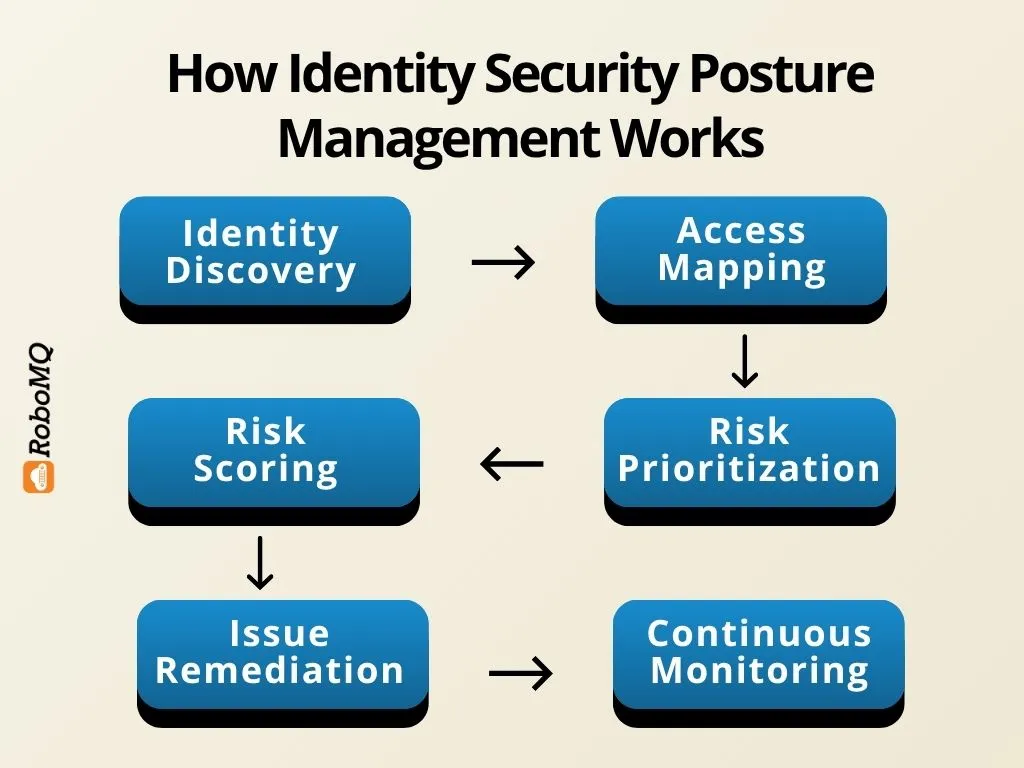
In practice, identity security posture management operates as an ongoing process rather than a one-time task. Security teams use it to discover identities across their environment, understand how permissions are assigned, identify areas of risk, and monitor changes over time. The process typically works as follows:
80% of breaches use compromised identities and there are three core reasons why identity risks are increasing so much:
To understand how unmanaged lifecycle transitions amplify these risks financially, the analysis in reducing identity management costs with JML automation is worth reading.
Not all identity risks look like obvious threats. The most dangerous one’s blend into normal operations. Here are the six that demand attention:
| Risk Type | What it Looks Like | Why it's Dangerous |
|---|---|---|
| Over-privileged accounts | Finance / ERP | Fraudulent vendor payments |
| Post AR Payment + Reconcile AR Ledger | Accounts Receivable | Payment skimming |
| Developer Access + Production Deployment | IT / DevOps | Bypassing quality checks |
| Access Provisioning + Access Certification | IAM / IGA | Self-approving elevated access |
| Journal Entry + Journal Approval | Accounting | Manipulating financial records |
Most organizations already have IAM, IGA, PAM, and CIEM in place. ISPM does not replace any of these. In fact, it sits above all these and answers the one question that none of these answers individually: Is your identity environment safe right now?
The most common identity security risks are silent ones, including unreviewed permissions, forgotten accounts, and accesses no one thought to check. Here is how to identify them before they are exploited by a hacker:
You can’t manage what you can’t see. Find all the identities in your environment, including employee accounts, contractor accounts, service accounts, API keys, machine accounts, etc. This is the starting point for any identity security posture management program, which is the foundation of identity risk detection.
Permissions are often much broader than intended. For example, a user may be a member of a group that gives them admin rights, but nobody intended them to have those rights. Create a complete permission map of all the systems they can access to find those unexpected access paths.
The identities that should be fixed first are those with high privilege, no MFA, and those with long inactivity times. Continuously scoring all your identities keeps your priority queue up to date instead of stale.
Some risks appear when different permissions are combined. For example, if the same user can both submit a payment request and approve it, that creates a clear opportunity for fraud. These types of issues often go unnoticed because each permission may seem harmless on its own. Identity security posture management tools help identify these segregation of duties conflicts early, allowing organizations to address them before they turn into real security or compliance incidents.
Shadow admins are users who have effective admin access but are never on any privileged account list. They get their admin access through nested group memberships. They’re hiding in plain sight, but you can only find them by analyzing the complete access graph, not just the top-level account list.
Identity risk can change quickly. When an employee changes roles, a new application is introduced, or temporary access is not removed on time, permissions can drift away from what was originally intended. Instead of waiting for the next scheduled access review, organizations should monitor these changes as they happen. Setting real-time alerts for events such as new admin privileges, privilege escalations, or access to sensitive data helps security teams respond immediately and prevent small changes from turning into larger security risks.
Detecting identity security risks is only the first step. The next step is implementing the right strategies to fix and prevent them.
Don’t wait until the next scheduled review. If an identity has more permissions than it needs for its role, remove them right away. Keep an audit trail to make it easier to spot permissions that are creeping back in.
Remove old and inactive accounts immediately. If an identity belongs to someone who left the organization or a system that no longer exists, remove it. Disable the account. End all active sessions. Then delete the account after a brief review period. Every active service account should have an owner who is responsible for it.
Every account without MFA protection is an open door. Start with your privileged accounts and then roll out MFA protection across the organization. Turn off old authentication methods that bypass MFA. These are the most common entry points attackers use in phishing and brute force attacks.
Passwords that have not changed in years, API keys that don’t expire, and service account password reuse are all risks. Automate credential rotation for service accounts and machine identities. Set expiration for API keys and enforce them without exception.
The most powerful way to prevent identity risk from building up is to ensure that every account change, whether a new hire, a role change, or a departure, occurs automatically based on what your HR system says. In most companies that automate user provisioning and deprovisioning, both “orphaned account” and “privilege creep” risk are greatly reduced, since no identity change depends on a manually created IT ticket.
This is exactly what Hire2Retire by RoboMQ does as a solution for identity posture management. When someone joins a company, the right accounts are created for them. When someone’s role changes, permissions are updated for them. When someone leaves, all their accounts are de-provisioned instantly, everywhere, without any manual intervention and without any “back door” left behind.
Manual access reviews often take a lot of time, produce inconsistent results, and are frequently delayed when teams are busy. Automated certification workflows make this process more reliable by identifying the right identities and permissions for review, requiring approval from the appropriate stakeholders, and removing access that cannot be properly justified. This helps organizations maintain cleaner access controls without relying on slow, manual processes.
After remedying the identity risk, continue to monitor it as part of a strong identity security posture management strategy. Ensure that the permissions remain appropriate, MFA is still enabled, and the account remains deprovisioned. Continuous monitoring through identity security posture management is the key element that distinguishes a temporary fix from a long-term solution.
As discussed throughout this guide, identity security posture management is not something that is done once and checked off the list. Threat actors are constantly probing the gaps that open between audits: old user accounts, forgotten permissions, and missing MFA. These gaps appear constantly, and the only way to stay ahead of them is to continuously manage identity risk.
Organizations that handle this well usually share one common approach: they connect every identity-related change to their HR system. When someone joins, changes roles, or leaves the company, every connected system updates automatically. There are no manual steps, forgotten tickets, and accounts left behind.
Hire2Retire by RoboMQ automates the entire employee identity lifecycle, from the first day to the last, so your identity posture stays clean, accurate, and audit-ready without constant manual work from your team.
Ready to see how it works? Book a demo of Hire2Retire today and discover how HR-driven identity automation helps close the security gaps that put organizations at risk.
Identity security posture management focuses on fixing structural weaknesses like misconfigured access, excessive permissions, and weak authentication before attackers can take advantage of them. Identity Threat Detection and Response (ITDR), on the other hand, focuses on detecting and responding to attacks that are already underway. Both are important. Strong posture management reduces the chances of attacks succeeding, while ITDR handles the ones that still slip through.
Annual reviews are no longer enough. Today’s best practice combines continuous automated monitoring for high-risk changes with formal human-reviewed certification cycles every quarter or every six months. The goal is to catch access drift as soon as it happens—not months later.
Yes, and they should. Service accounts, API keys, and machine identities often have powerful permissions but receive far less oversight than human accounts. A mature identity security posture management solution includes both human and non-human identities in a single unified view.
ISPM directly supports access control and least-privilege requirements found in frameworks like SOC 2, ISO 27001, HIPAA, and NIST CSF. Continuous monitoring also simplifies audits because you always have up-to-date, documented evidence of your access governance.
When a termination is recorded in the HR system, Hire2Retire automatically deprovisions all associated accounts and removes group memberships across connected systems. There are no manual steps, no tickets to track, and no forgotten accounts left active. Every offboarding process is immediate, clean, and fully documented.