Modern enterprises control tens of thousands of user accounts from various cloud platforms, SaaS apps, internal systems, and even third-party applications. As users switch job functions, contractors join, and new applications are introduced, permissions tend to multiply uncontrollably.
The problem here is obvious and critical. Most data breaches happen because employees have more permissions than necessary. Too many permissions create an unnecessarily large attack surface, making audits and regulatory requirements harder to comply with. This is why least privilege access has become a foundational security principle for Zero Trust architectures, identity governance programs, and compliance initiatives.
In this guide, we’ll explore how least privilege access reduces security and compliance risks and how RoboMQ Hire2Retire helps organizations enforce it automatically throughout the employee lifecycle.
Key Takeaways
The least privilege access model ensures that users, applications, and systems have access only to those privileges that are essential for them to do their tasks. The idea behind least privilege access is straightforward, i.e., give users, applications, and systems just enough access to be able to do things efficiently.
For instance:
With the implementation of least privilege access policies, users cannot have access to critical resources such as databases, server infrastructure, or administrative systems unless granted. This model ensures that there is no overexposure and hence minimizes the risks.
The implementation of least privilege access allows organizations to ensure that unnecessary permissions are avoided, minimize exposure to cyber risks, and exercise stricter control over sensitive assets and data. The following is a list of five advantages of this security measure:
Each additional permission can be perceived by hackers as another avenue to penetrate organizational systems. Thus, the practice of limiting users’ accesses only to necessary systems and data can greatly minimize the exposure to cyber risks.
Users’ permissions usually increase when they change departments or receive a promotion. Hence, the least privilege approach ensures that such permissions become obsolete and prevents users from having too much access.
If hackers obtain access to a particular user’s account, they will not be able to go beyond the scope of permissions of this account and access other resources and systems.
Employees and any other parties associated with the organization should be granted access only to those resources necessary for their operations.
Several compliance frameworks mandate that companies implement policies for controlling access to sensitive information. The implementation of the principle of least privilege enables companies to control access, maintain clear audit trails, and achieve compliance with standards like SOX, HIPAA, ISO 27001, and NIST.
The manual maintenance of these controls can prove difficult, particularly in companies where there are high turnovers of employees. Technologies like Hire2Retire make the job easier through identity lifecycle management to ensure access is based on employee positions and least privilege.
Companies recognize the importance of least privilege access; but many struggle to achieve it. Some common obstacles are:
Such problems result in an inconsistency in access assignment and continuous privilege creep. It is necessary to have automated means capable of matching privileges to changing employee positions and organizational needs to implement least privilege access successfully. Identity lifecycle automation provides a solution to such problems.
When organizations do not properly enforce least privilege access principles, permissions gradually build up over time. Employees switch departments, gain new responsibilities, or acquire temporary access permissions that are never revoked. Such a situation is often referred to as privilege creep. Privilege creep poses several risks related to security:
As per the IBM Cost of a Data Breach Report, the average cost per breach is rising continuously worldwide, thus making it increasingly important to focus on proactive access management. Least privilege access helps in reducing these risks, as only authorized persons are allowed access to sensitive data.
Least privilege access is difficult to implement manually, particularly for companies that experience frequent workforce turnover, use multiple applications, and have complex access requirements. Hire2Retire streamlines this task by automating access throughout the employee lifecycle.
Hire2Retire takes its cues from the company’s HR systems, ensuring that user access remains synchronized with employee information as it changes over time. Whenever an employee joins, moves to another role, transfers to a new department, or leaves the company, Hire2Retire automatically adjusts access to maintain proper least privilege controls.
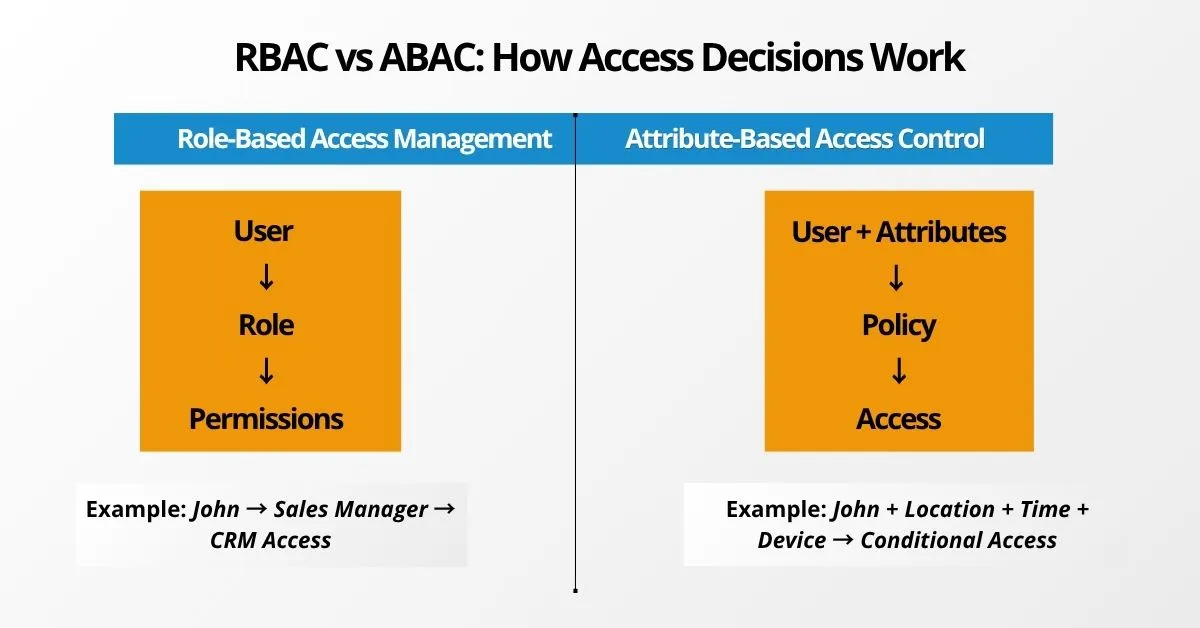
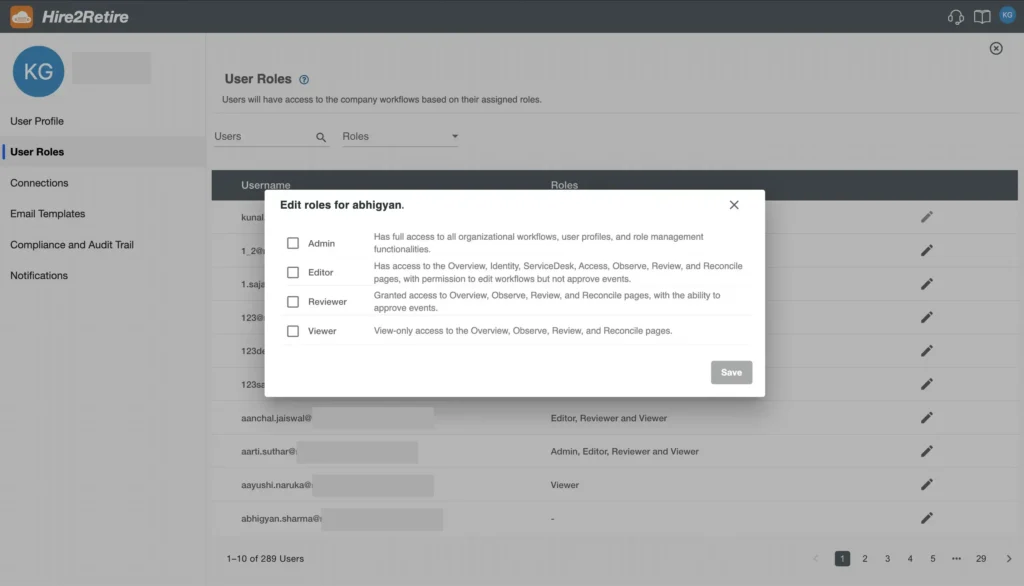
Hire2Retire uses both role-based access control (RBAC) and attribute-based access control (ABAC) for enhancing access control. Each user is granted default access controls depending on the role, whereas attributes like department, location, and nature of employment facilitate fine-grained access control in accordance with business requirements.
The result? Users gain access based not only on their role but on the business environment, providing more accurate least privilege access.
Hire2Retire keeps your identity management always in sync with your workforce by integrating seamlessly with the HR platforms your team already relies on, including Workday, ADP, UKG Pro, SAP SuccessFactors, BambooHR, Paylocity, and Paycom. Every hire, transfer, role change, or departure automatically triggers the right access updates-no manual effort, no delays, no security gaps.
Most traditional IGA platforms depend on predefined roles, policies, and access rules to determine who gets access to what. In reality, however, these rules often exist as institutional knowledge spread across teams, making them difficult to document, maintain, and scale.
As a result, administrators frequently rely on manual judgment when provisioning access, often granting permissions based on a similar employee’s profile. While convenient, this approach can unintentionally introduce excessive access and contribute to privilege creep over time.
Hire2Retire addresses this challenge with AI and machine learning-driven entitlement prediction. By analyzing identity provider (IdP) data and access patterns across the organization, the platform can intelligently recommend appropriate access based on how similar users perform their jobs.
The system helps identify:
Administrators remain in control and can:
By combining machine learning with identity governance, Hire2Retire transforms least privilege from a static, rule-based process into a continuously improving access management strategy, reducing the effort required to maintain complex RBAC and ABAC policies.
One of the biggest threats to least privileged access is privilege creep. Hire2Retire addresses this through automated lifecycle management.
The employee lifecycle starts before an employee joins your organization. During the pre-hire phase, Hire2Retire allows you to automatically provision user identities, assign base access based on their role, and prepare systems for the onboarding process. This ensures proper access is enabled for new hires upon joining, without any unneeded access being assigned.
On the first day of work, Hire2Retire lets businesses automatically provision approved access based on the most recent data available within your HR system. Role changes, transfers to other locations or departments, and other changes are all incorporated into access provisioning to ensure users get the needed access right away.
Should your employees undergo internal transfers, such as changing roles, business unit, or department, Hire2Retire will update their access permissions accordingly. The system will strip old access based on old roles and assign new permissions as required by their new job.
As soon as you terminate an employee, Hire2Retire starts the offboarding process. All user accounts are disabled, open sessions terminated, and application and software access revoked to ensure your company’s security and compliance standards are maintained at all times.
Least privilege implementation is not just about limiting user privileges. Least privilege access control involves implementing a collection of mechanisms that will allow users to get proper access, but for as long as required, not longer than that.
RBAC is typically implemented as the first measure in most least privilege solutions. Permissions are not distributed individually but are associated with certain roles created according to job responsibilities.
For example, all Finance Managers should have access to financial reporting tools, whereas Customer Support Representatives should use CRM tools. This approach ensures consistency and prevents users from getting extra permissions, as well as simplifying administration.
RBAC may work perfectly well in some cases, but most organizations need a more flexible approach to access control. ABAC can provide even finer-grained access management and rely on such attributes as department, location, employment category, business unit, and manager or non-manager positions.
As an example, we could refer to employees who have identical job titles but different departments or locations. With ABAC, they could have appropriate permissions according to their attributes.
Not all users always need access to privileged accounts. In some scenarios, high-level access is needed only temporarily, for a certain project or task.
JIT access allows access for certain periods of time and revokes it once the time limit has been reached. This decreases the number of persistent privileged accounts and consequently also reduces risks related to this issue, without hindering employees from being productive.
Access permissions should not be treated as a “set it and forget it” exercise. User behavior, business needs, and security threats constantly evolve. Continuous monitoring provides companies with the opportunity to detect abnormal login activities, permission changes, and breaches of regulations, among other things.
People change jobs, switch departments, gain new responsibility levels, or leave the organization. In such scenarios, access rights might become obsolete rather fast. Conducting regular reviews allows organizations to make sure whether employees still require access to certain resources. Eliminating unnecessary rights will not only avoid privilege escalation but will also provide additional security to the company.
Not granting access is only half of what is required. Keeping access rights active for employees who have changed their roles or left the company poses additional security risks to businesses. Deprovisioning automatically closes access immediately after employees either leave the job, switch jobs, or end a contract. This way, organizations can keep the access rights relevant to their employees’ duties and eliminate any unused accounts.
Together, these components create a continuous least privilege framework that helps organizations reduce security risks, improve compliance, and maintain tighter control over access across their entire technology environment.
Least privilege access is no longer a choice. With growing cloud adoption, hybrid workforce needs, and increasing regulatory obligations, having control over access is critical in managing risks. The problem isn’t the lack of understanding; it’s enforcing the approach.
Hire2Retire delivers an answer to that problem using HR-driven automation, role-based and attribute-based access controls, automation of provisioning and de-provisioning, and more. By doing so, Hire2Retire offers a new generation of least privilege access control solutions. If you’re interested in enhancing your identity security posture while decreasing manual workload, Hire2Retire can help with least privilege access control.
The company should review user access rights at least once every quarter and right after each change of position, transfer, and termination to avoid piling up unnecessary privileges.
The least privilege approach involves providing only necessary access, whereas Zero Trust is a security framework that requires ongoing validation of users, devices, and apps before any access.
Organizations can use time-bound approvals and just-in-time access controls that automatically revoke elevated permissions after a predefined period.
Hire2Retire uses HR-driven automation, RBAC, ABAC, AI-powered entitlement recommendations, and automated provisioning/deprovisioning to ensure users receive only the access required for their roles.
Yes. Hire2Retire provides audit-ready reports, identity timelines, entitlement tracking, outlier detection, and governance dashboards that help organizations demonstrate compliance with SOX, HIPAA, HITRUST, ISO 27001, and NIST requirements.
Least privilege access improves compliance by ensuring users only have access to the data, applications, and systems required for their roles. This reduces the risk of unauthorized access, supports regulatory requirements, simplifies audits, and helps organizations demonstrate stronger access controls.