Your firewall is robust. Your passwords are tough. Your perimeter security is strong. However, somewhere within your company, that ex-sales representative who is now an operations manager still has access to every customer contract that was processed two years ago. The developer who got called in on an overnight fix to keep things up and running in production mode six months ago still has root server access. The recruiter who helped during your company’s last audit can get into the payroll database anytime.
No one planned this. No one saw it coming. That is precisely what makes privilege creep so scary. It does not come knocking at your front door. It sprouts from within your own walls, permission by permission. By the time you realize it’s there, it’s often too late. Here in our blog, we will take you through what privilege creep is, why it happens, and its consequences. We will also discover how Hire2Retire prevents privilege creep.
Why Privilege Creep is a Serious Security Risk
Even though privilege creep appears to be nothing more than an access management problem, it poses considerable security, regulatory, and operational risks for companies.
Privilege Creep in Practice: Real Department Examples
The following examples help understand the concept of creeping privileges in everyday business activities:
Privilege Creep vs. Least Privilege: Key Differences
The solution to privilege creep in security is enforcing the Principle of Least Privilege (PoLP), giving employees only the exact access their current role requires, nothing more.
How to Avoid Privilege Creep
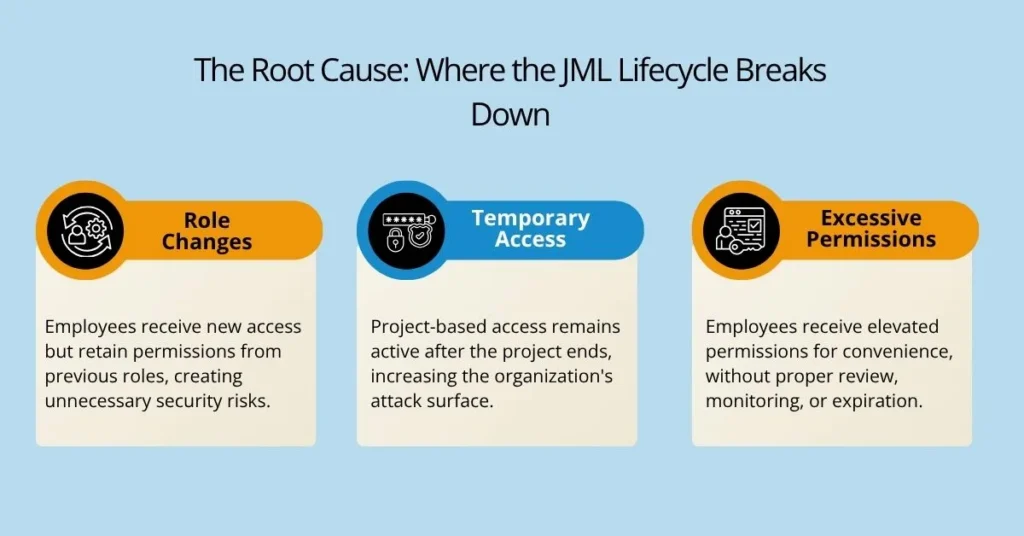
Before understanding how to avoid privilege creep, let’s understand its root cause:
How Hire2Retire Stops Privilege Creep at the Source
The problem with all these strategies above is that they require manual actions to work, creating tickets in the IT system, reviewing permissions manually, updating spreadsheets, and so on. They are subject to human errors, while people often forget about it until something bad happens. Studies show that 74% of security breaches involve a human action, such as clicking a phishing link, using weak passwords, or making an access-related mistake.
And here is where Hire2Retire comes to play. Hire2Retire is the no-code Identity Governance and Administration (IGA) platform by RoboMQ. It is designed to automate the entire process of managing users’ identity during the employee’s entire lifecycle, from onboarding to offboarding. Here’s how Hire2Retire actively prevents privilege creep:
1. The HR System as Your Single Source of Truth
Hire2Retire integrates directly into your existing HR system, including Workday, ADP, SAP SuccessFactors, UKG, BambooHR, and 20+ more, and makes it the source of truth. The second the HR system record is changed, Hire2Retire recognizes the change and acts based on it. No need to open tickets with IT or send e-mails about changes from managers.
2. HR-Driven Role Updates
If an employee moves to a new position, for example, due to promotion or transfer, Hire2Retire immediately detects the update in HR records and automatically removes any permissions associated with the former position from the new role while granting permissions needed for this new role. This breaks the privilege creep process.
3. Dynamic RBAC & ABAC Enforcement
Hire2Retire uses Role-Based Access Control (RBAC) along with Attribute-Based Access Control (ABAC) to enforce the Principle of Least Privilege automatically. The access decision is made dynamically based on live attributes, i.e., the current department, job role, location, and employment status. Employees can’t retain their former role permissions since the system actively manages any discrepancies between HR and current access.
4. Automatic Deprovisioning
If an employee leaves, through resignations, terminations, or the end of the contract, the system disables user accounts, revokes the software license, terminates active sessions, and removes any group membership instantly. Not leaving any dormant accounts or credentials for bad actors to exploit.
5. No-Code Workflow Logic
With Hire2Retire’s drag-and-drop logic, IT and HR departments can build business rules and assign HR profile attributes to Active Directory groups, Entra ID, and Google Workspaces. There is no coding or developer required. It guarantees least privilege access enforcement in each department and every location globally.
6. Built-In Audit Trails for Compliance Reporting
With Hire2Retire, an audit trail of every identity event, including who had access, when access changed, and why, is automatically maintained. With such a built-in audit trail, it’s easy to prove SOC 2, ISO 27001, HIPAA, and other framework compliance. Security teams can catch access anomalies before they lead to data breaches.
Final Thoughts
Privilege creep can quietly increase security and compliance risks as employees accumulate access they no longer need. The best way to prevent it is to automatically update access whenever roles change. With HR-driven automation, organizations can enforce least privilege, reduce risk, and ensure access always aligns with current job responsibilities. Hire2Retire makes this possible by automating access changes across the entire employee lifecycle.
Frequently Asked Questions (FAQs)