






The ongoing growth of remote work and digital transformation is influencing widespread adoption of multiple software solutions to streamline operations. Yet small-scale and legacy organizations are struggling to keep up with growing automation and collaboration needs.
Why? It’s because each new system introduces additional login credentials and access permissions. And managing these permissions manually is tedious and error-prone, which exposes organizations to cyberattacks.
A Baker Donelson report estimates the average global cost of a data breach in 2025 at USD 4.44 million. To reduce this risk, organizations need strong identity and access management (IAM) solutions such as Hire2Retire that secure user identities and govern access to critical resources.
In this blog, we will cover what IAM is, how it works, and the key features enterprises should review before choosing an IAM tool.
What is Identity and Access Management (IAM)?
Identity and Access Management (IAM) is the cybersecurity framework that manages, provisions, and protects digital identities across cloud and on-premises environments. With IAM, you can control the authentication (who is signed in) and authorization (has permission) to access resources, sensitive data, and critical systems.
It makes sure that the right users have the right access to the right resources at the right time, strengthening security and administration for an organization.
Why Identity and Access Management (IAM) is Needed
Manually managing user identity and access across cloud, on-prem, or hybrid systems creates risks like:
-
Unauthorized access and data breaches
-
Credential theft and unmonitored activity
-
Permission creep and insider threats
-
Compliance violations
-
Operational bottlenecks
As security regulations tighten and controlling data access becomes more critical, businesses should replace tedious tasks with IAM tools to resolve the above-mentioned threats.
What are IAM Tools
While Identity and Access Management (IAM) is the framework, IAM tools are tangible products or applications that enterprises use to verify identities, manage passwords, and control access in real time.
Core Capabilities of IAM Solutions
IAM solutions like Hire2Retire provide the following core functionalities to enterprises:
-
Identity Management: Helps manage and track user identities and access permissions associated with them.
-
Identity Federation: Allows users with existing passwords in either your organization’s network or with a social identity provider to access your system.
-
User Provisioning and Deprovisioning: Enables you to create, manage, or delete user accounts, including specifying the level of access and permissions they will get.
-
User Authentication and Authorization: Confirms that the user is who they claim to be and verifies they have the required level of permissions to access the tool.
-
Access Control: Determines who has access to which resource by defining user roles and permissions, validating compliance adherence.
Key Features of Modern IAM Tools
Now that we know what IAM tools’ core capabilities are, let’s take a look at the features that protect your organization’s digital assets.
-
Multi-Factor Authentication (MFA): It adds an extra layer of security to confirm that only authenticated users have access to enterprise systems. It combines at least two factors (such as biometric data or OTPs) to authenticate a user. This drastically reduces the risks of unauthorized access, even if the password gets compromised.
-
Single Sign-On (SSO): It uses a centralized identity provider (Google, Okta, or Azure AD) to issue an encrypted token for connected apps, which allows users to access multiple applications with one set of credentials. This eliminates the need to repeatedly log in, improves security, and reduces password fatigue
-
Role-Based Access Control (RBAC): It is a security mechanism that provides access permissions to users based on their role and responsibilities within the company. That means interns will not have the same permissions as associates, and associates will not have the same permissions as managers.
-
Password Management: It acts as a secure vault for all users’ digital keys, allowing them to securely create, manage, and store their credentials. This feature also enforces password complexities and expirations to strengthen security.
-
Risk-Based Authentication (RBA): It is an adaptive security measure that analyzes different factors like location, device, IP address, and time to calculate a risk score for each login attempt. In case of high-risk scenarios, RBA triggers additional authentication steps to maintain user convenience and robust security.
-
Audit Logs and Reporting: Identity and Access Management (IAM) tools use audit logs and reporting features to track user activities. This feature provides clear visibility into attempted and successful access for generating compliance-ready reports for standards like HIPAA, GDPR, and SOC 2.
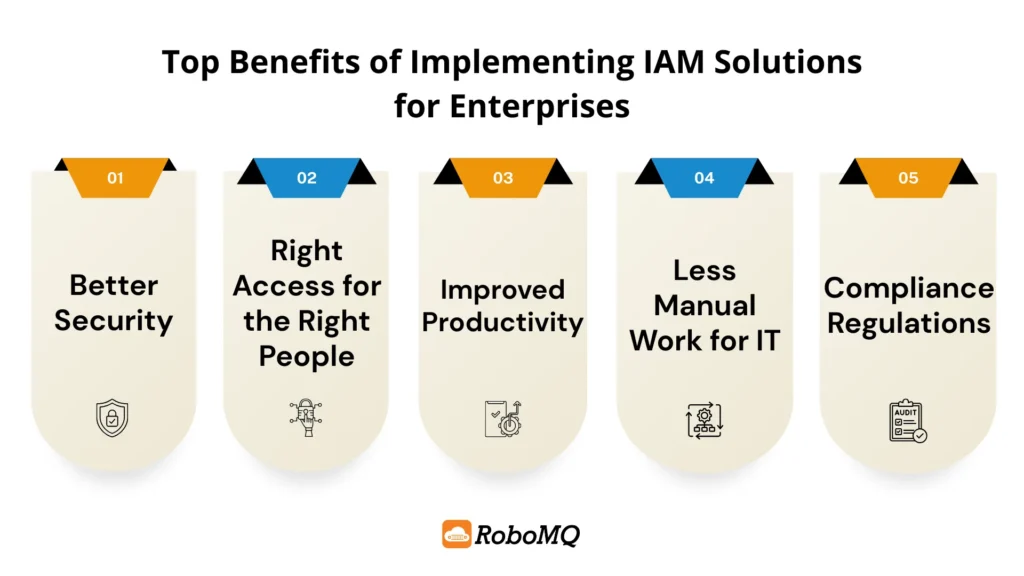
Top Benefits of Implementing IAM Solutions for Enterprises
Implementing IAM solutions provides a variety of benefits to the organization, some of which are listed below.
-
Better Security: Integrating IAM tools significantly reduces the risk of data breaches by ensuring only authorized users have access to organizational assets. Its features, like MFA and SSO, give users the ability to verify their identities using more than just passwords.
-
The Right Access for the Right People: IAM platforms provide the ability to create and enforce access privileges and rules for users. This capability helps guarantee that the users only have access to the resources they need to perform their job roles.
-
Uninterrupted Productivity: IAM features like unified user profiles and SSO make it easier to maintain both security and ease of access for employees across multiple environments or systems without requiring multiple logins.
-
Less Manual Work for IT: IAM tools automate tasks like monitoring access logs, resetting passwords, and unlocking accounts. This reduces the manual workload from the IT department, allowing them to focus on other critical tasks.
-
Compliance Regulations: Without IAM, IT teams monitor every entity with access to their system, making it a time-consuming process. On the other hand, IAM systems automate the entire process, which makes auditing and reporting faster. It also allows organizations to prove that access to sensitive data is governed properly.
How to Choose the Right IAM Platform
Selecting the right identity and access governance platform should be based on your organization’s needs and technical environment.
Start by identifying how many users, identities, and roles the system should support. Then, determine the devices, services, and applications users will need to access.
Next, check whether that platform supports your infrastructure (cloud, on-prem, or hybrid) and has pre-built or open API integrations to connect with major business applications.
You should also evaluate whether the IAM solution supports your long-term business goals.
IAM Tools and Technologies
Identity and Access Management (IAM) platforms integrate with a variety of tools and technologies to secure authentication and authorization for enterprises. Key IAM technologies include:
-
OpenID Connect (OIDC): OIDC improves OAuth 2.0 (an authorization framework) by adding an identity aspect to it. It allows encrypted tokens with user information (like name, email, date of birth, and photo) to be sent between identity and service providers for secure access.
-
System for Cross-Domain Identity Management (SCIM): SCIM is an open standard protocol that automates user provisioning and employee lifecycle management between identity and service providers like Okta, Azure AD, and third-party apps. It uses REST APIs and JSON to eliminate manual user management across different applications.
-
Security Assertion Markup Language (SAML): SAML creates identity fabrication between cloud services and external identity providers (IdPs) to enable Single Sign-On (SSO). Once the user is authenticated, SAML notifies other apps that the user is a verified entry, making it possible to grant secure access in different contexts.
Where Hire2Retire Fits
While other IAM tools in the market focus primarily on identity and access authentication, Hire2Retire takes IAM to the next level by automating the whole Identity and Access Governance. Learn more about how Hire2Retire integrates identity governance for enterprise platforms.
By synchronizing HR systems with directories and third-party business applications, Hire2Retire automatically provisions, updates, and deprovisions user access in real time based on HR updates.
This approach reduces the risk of orphaned accounts and over-privileged access, resulting in fewer insider threats and identity risks.
Conclusion
As the need for secure resource access across platforms grows, the importance of identity and access management (IAM) becomes indispensable. Enterprises that implement IAM solutions strengthen access controls, prevent data breaches, and maintain compliance with regulatory standards.
Hire2Retire can be a powerful step for businesses looking to modernize their identity strategy as it automates access provisioning, enforces consistent security policies, and enables better visibility into user access while streamlining employee onboarding and offboarding processes. If you’re still exploring what IAM vs IGA really means in practice, that primer can help clarify the broader strategy. Or, dive deeper into enterprise-grade IGA solutions to see how governance capabilities support compliance and risk management.
Frequently Asked Questions (FAQs)
Identity governance and administration (IGA), Access Management (AM), Privileged Access Management (PAM), and Active Directory Management are the four pillars of IAM that assures right users have appropriate access to required resources.
IAM is important for organizations because it protects them from data breaches by managing user identities and enforcing least-privileged access to prevent cyberattacks.
While IAM focuses on real-time user access controlling for operational security, Identity Governance and Administration (IGA) handles the long-term compliance, policy, and lifecycle management within a company.
Yes, identity and access management play a crucial role in cybersecurity by providing a framework of processes, tools, and policies to allow verified users to access the enterprise’s crucial data.
Microsoft Entra ID, Okta, AWS IAM, Hire2Retire, and OneLogin are a few examples of leading identity and access management tools.
Priyanshi Sharma
Priyanshi Sharma is a Marketing Specialist at RoboMQ with over six years of experience in B2B content creation. She specializes in transforming complex technical concepts into clear, compelling narratives that resonate with business audiences.
Priyanshi Sharma
Priyanshi Sharma is a Marketing Specialist at RoboMQ with over six years of experience in B2B content creation. She specializes in transforming complex technical concepts into clear, compelling narratives that resonate with business audiences.
Read More “How To” Articles
The ongoing growth of remote work and digital transformation is influencing widespread adoption of multiple software solutions to streamline operations. Yet small-scale and legacy organizations are struggling to keep up with growing automation and collaboration needs.
Why? It’s because each new system introduces additional login credentials and access permissions. And managing these permissions manually is tedious and error-prone, which exposes organizations to cyberattacks.
A Baker Donelson report estimates the average global cost of a data breach in 2025 at USD 4.44 million. To reduce this risk, organizations need strong identity and access management (IAM) solutions such as Hire2Retire that secure user identities and govern access to critical resources.
In this blog, we will cover what IAM is, how it works, and the key features enterprises should review before choosing an IAM tool.
What is Identity and Access Management (IAM)?
Identity and Access Management (IAM) is the cybersecurity framework that manages, provisions, and protects digital identities across cloud and on-premises environments. With IAM, you can control the authentication (who is signed in) and authorization (has permission) to access resources, sensitive data, and critical systems.
It makes sure that the right users have the right access to the right resources at the right time, strengthening security and administration for an organization.
Why Identity and Access Management (IAM) is Needed
Manually managing user identity and access across cloud, on-prem, or hybrid systems creates risks like:
- Unauthorized access and data breaches
- Credential theft and unmonitored activity
- Permission creep and insider threats
- Compliance violations
- Operational bottlenecks
As security regulations tighten and controlling data access becomes more critical, businesses should replace tedious tasks with IAM tools to resolve the above-mentioned threats.
What are IAM Tools
While Identity and Access Management (IAM) is the framework, IAM tools are tangible products or applications that enterprises use to verify identities, manage passwords, and control access in real time.
Core Capabilities of IAM Solutions
IAM solutions like Hire2Retire provide the following core functionalities to enterprises:
- Identity Management: Helps manage and track user identities and access permissions associated with them.
- Identity Federation: Allows users with existing passwords in either your organization’s network or with a social identity provider to access your system.
- User Provisioning and Deprovisioning: Enables you to create, manage, or delete user accounts, including specifying the level of access and permissions they will get.
- User Authentication and Authorization: Confirms that the user is who they claim to be and verifies they have the required level of permissions to access the tool.
- Access Control: Determines who has access to which resource by defining user roles and permissions, validating compliance adherence.
Key Features of Modern IAM Tools
Now that we know what IAM tools’ core capabilities are, let’s take a look at the features that protect your organization’s digital assets.
- Multi-Factor Authentication (MFA): It adds an extra layer of security to confirm that only authenticated users have access to enterprise systems. It combines at least two factors (such as biometric data or OTPs) to authenticate a user. This drastically reduces the risks of unauthorized access, even if the password gets compromised.
- Single Sign-On (SSO): It uses a centralized identity provider (Google, Okta, or Azure AD) to issue an encrypted token for connected apps, which allows users to access multiple applications with one set of credentials. This eliminates the need to repeatedly log in, improves security, and reduces password fatigue
- Role-Based Access Control (RBAC): It is a security mechanism that provides access permissions to users based on their role and responsibilities within the company. That means interns will not have the same permissions as associates, and associates will not have the same permissions as managers.
- Password Management: It acts as a secure vault for all users’ digital keys, allowing them to securely create, manage, and store their credentials. This feature also enforces password complexities and expirations to strengthen security.
- Risk-Based Authentication (RBA): It is an adaptive security measure that analyzes different factors like location, device, IP address, and time to calculate a risk score for each login attempt. In case of high-risk scenarios, RBA triggers additional authentication steps to maintain user convenience and robust security.
- Audit Logs and Reporting: Identity and Access Management (IAM) tools use audit logs and reporting features to track user activities. This feature provides clear visibility into attempted and successful access for generating compliance-ready reports for standards like HIPAA, GDPR, and SOC 2.
Top Benefits of Implementing IAM Solutions for Enterprises
Implementing IAM solutions provides a variety of benefits to the organization, some of which are listed below.
- Better Security: Integrating IAM tools significantly reduces the risk of data breaches by ensuring only authorized users have access to organizational assets. Its features, like MFA and SSO, give users the ability to verify their identities using more than just passwords.
- The Right Access for the Right People: IAM platforms provide the ability to create and enforce access privileges and rules for users. This capability helps guarantee that the users only have access to the resources they need to perform their job roles.
- Uninterrupted Productivity: IAM features like unified user profiles and SSO make it easier to maintain both security and ease of access for employees across multiple environments or systems without requiring multiple logins.
- Less Manual Work for IT: IAM tools automate tasks like monitoring access logs, resetting passwords, and unlocking accounts. This reduces the manual workload from the IT department, allowing them to focus on other critical tasks.
- Compliance Regulations: Without IAM, IT teams monitor every entity with access to their system, making it a time-consuming process. On the other hand, IAM systems automate the entire process, which makes auditing and reporting faster. It also allows organizations to prove that access to sensitive data is governed properly.
How to Choose the Right IAM Platform
Selecting the right identity and access governance platform should be based on your organization’s needs and technical environment.
Start by identifying how many users, identities, and roles the system should support. Then, determine the devices, services, and applications users will need to access.
Next, check whether that platform supports your infrastructure (cloud, on-prem, or hybrid) and has pre-built or open API integrations to connect with major business applications.
You should also evaluate whether the IAM solution supports your long-term business goals.
IAM Tools and Technologies
Identity and Access Management (IAM) platforms integrate with a variety of tools and technologies to secure authentication and authorization for enterprises. Key IAM technologies include:
- OpenID Connect (OIDC): OIDC improves OAuth 2.0 (an authorization framework) by adding an identity aspect to it. It allows encrypted tokens with user information (like name, email, date of birth, and photo) to be sent between identity and service providers for secure access.
- System for Cross-Domain Identity Management (SCIM): SCIM is an open standard protocol that automates user provisioning and employee lifecycle management between identity and service providers like Okta, Azure AD, and third-party apps. It uses REST APIs and JSON to eliminate manual user management across different applications.
- Security Assertion Markup Language (SAML): SAML creates identity fabrication between cloud services and external identity providers (IdPs) to enable Single Sign-On (SSO). Once the user is authenticated, SAML notifies other apps that the user is a verified entry, making it possible to grant secure access in different contexts.
Where Hire2Retire Fits
While other IAM tools in the market focus primarily on identity and access authentication, Hire2Retire takes IAM to the next level by automating the whole Identity and Access Governance. Learn more about how Hire2Retire integrates identity governance for enterprise platforms.
By synchronizing HR systems with directories and third-party business applications, Hire2Retire automatically provisions, updates, and deprovisions user access in real time based on HR updates.
This approach reduces the risk of orphaned accounts and over-privileged access, resulting in fewer insider threats and identity risks.
Conclusion
As the need for secure resource access across platforms grows, the importance of identity and access management (IAM) becomes indispensable. Enterprises that implement IAM solutions strengthen access controls, prevent data breaches, and maintain compliance with regulatory standards.
Hire2Retire can be a powerful step for businesses looking to modernize their identity strategy as it automates access provisioning, enforces consistent security policies, and enables better visibility into user access while streamlining employee onboarding and offboarding processes. If you’re still exploring what IAM vs IGA really means in practice, that primer can help clarify the broader strategy. Or, dive deeper into enterprise-grade IGA solutions to see how governance capabilities support compliance and risk management.
Frequently Asked Questions (FAQs)
Identity governance and administration (IGA), Access Management (AM), Privileged Access Management (PAM), and Active Directory Management are the four pillars of IAM that assures right users have appropriate access to required resources.
IAM is important for organizations because it protects them from data breaches by managing user identities and enforcing least-privileged access to prevent cyberattacks.
While IAM focuses on real-time user access controlling for operational security, Identity Governance and Administration (IGA) handles the long-term compliance, policy, and lifecycle management within a company.
Yes, identity and access management play a crucial role in cybersecurity by providing a framework of processes, tools, and policies to allow verified users to access the enterprise’s crucial data.
Microsoft Entra ID, Okta, AWS IAM, Hire2Retire, and OneLogin are a few examples of leading identity and access management tools.
Priyanshi Sharma
Priyanshi Sharma
How to Streamline Employee Onboarding and Offboarding Process & Save Hidden Costs
What Is Identity Governance and Administration and Why Do Your Access Controls Depend on It?
A Practical Guide to Birthrights and Least Privilege Entitlement Management