The modern workplace is changing rapidly. Organizations are now managing hybrid work models, new online tools, and remote collaboration platforms. While that increase is positive, it also creates challenges. One of the foremost challenges is who has access to whatever, when and for how long. With no management, things get messy and risky quickly. This is where IAM automation comes in. It changes the way organizations manage employee access, and transforms a slow, manual process into a streamlined, secure and reliable design that can scale with the organization.
Why Manual Identity and Access Management No Longer Works?
In many organizations, identity and access management is still handled, manually. HR adds a new hire to a spreadsheet, IT sets up their accounts, and managers approves access. Often these steps are done independent of each other, and potentially days apart. This creates issues. There’s delay, room for error, and security risk. For example, according to a 2024 report from Gartner, 40% of all data breaches are attributed to access management issues, as little as a single past employee account that is forgotten about, or a single account set up with the incorrect permission can lead to a significant security incident.
Manual workflows also create delays in daily work. Employees might wait several days for the systems and tools they need. The HR teams spend much of their time trying to get updates on the status of systems while the IT team is fixing the errors instead of focusing on projects that improve the business outcome.
Clearly, the traditional processes are not appropriate for companies that want to be secure, efficient, and competitive.
What IAM Automation Brings to Modern Enterprises?
IAM automation is more than a technology, it is a more tactical way to enable management of employee access, that better enables their time and reduces errors and fosters trust and confidence throughout the organization.
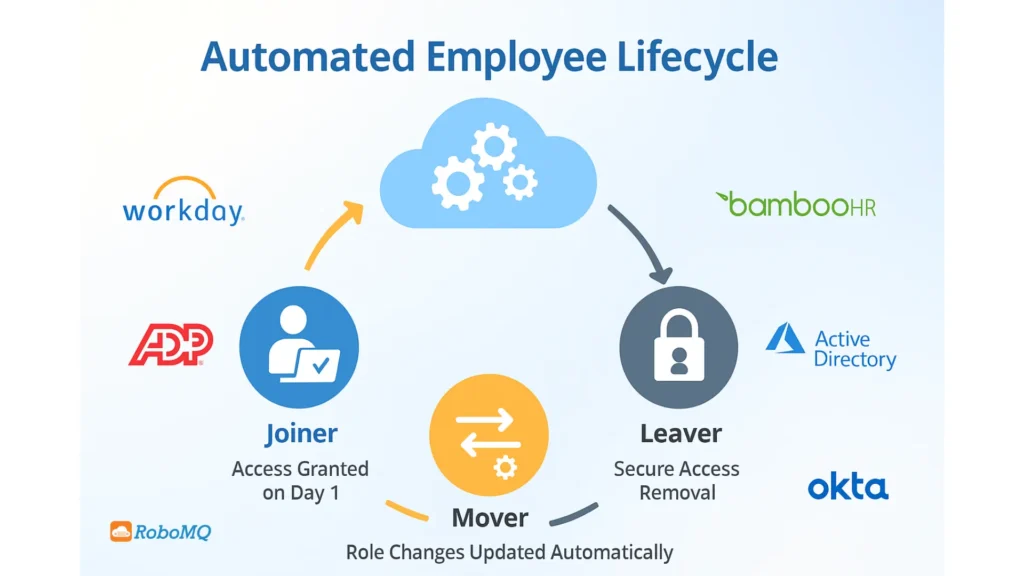
Automation interoperability connects HR systems, IT directories, and business applications so that employee accounts and access is automatically managed and provisioned, for the entire employee lifecycle, from the day the employee begins till the time they separate.
For example, when HR marks an employee hired, promoted, or separated the system will automatically provision or remove systems access across multiple systems. This removes the need of manually submitting tickets and to not have proper follow-up. Each employee receives a specific role access and expires old or unneeded access immediately.
This degree of effort reduces workload for the employee, and IT and HR teams. This increase of ease of work reduces security of mistakes and delays.
From Hire to Retire: Automating the Employee Lifecycle
In a company organization, employees will each go through three stages: Joiner, Mover, and Leaver. IAM automation puts all of this into motion seamlessly.
This all can be done in isolation while staying consistent, managing compliance, and ensuring that the HR and IT department are not stressed, and everyone knows the right person has the correct access at the right time.
Benefits of IAM Automation: Security, Compliance, and Efficiency
As organizations grow, managing who is accessing what becomes more difficult. IAM automation is a way for organizations to keep in control when changes are made in an employee’s HR system will automatically be reflected in an IT system.
Simplifying User Provisioning and Deprovisioning
Using automation simplifies user account creation and removal. This involves fewer errors, less manual effort, and addresses issues with abandoned or forgotten accounts, which can sometimes open up security vulnerabilities. You only provide employees with access for their jobs, and not more than that. This strengthens security and makes it easier to comply with regulatory statutes such as SOC 2, ISO 27001, or GDPR. It also makes your life easier during audits, as everything is written into your access log and easy to audit and prove.
Enhancing Access Governance with Visibility
IAM automation offers clear visibility into all accounts and access changes, from the moment an employee was added to the time the access has been revoked. This helps organizations demonstrate adherence to security and compliance protocols as well as identify and respond to unusual and inappropriate activity, limiting exposure to human error or advancing malicious attack variables. It also supports ongoing application access review processes, ensuring that access permissions are regularly verified and certified across all systems.
Efficiency and ROI
IAM automation doesn’t only increase security but also gives organizations time and money back. In the 2024 IBM Security Report, organizations who had automated IAM processes saw onboarding time reduced by 65% and IT service tickets decrease by 70%.
This is due to having fewer manual steps and more seamless processes. Employees were able to start working on day one without waiting for access. Human resources and IT teams spent less time fixing problems and more time on projects to grow the business.
The more efficiency not only saves money but improves employee experience as-a-whole. When people have what they need when they need it, they can spend their time doing their jobs instead of making sure they can get into an app.
Streamlining Identity Management with Hire2Retire
Automation frees up HR and IT to focus on what really matters! HR teams can focus on improving employee experience and engagement instead of doing the same administrative task. IT teams can focus on innovating, upgrading technology, and supporting business growth instead of getting stuck on manual access requests.
Together, automation builds a workplace where technology enables employees rather than entangles them! Employees can focus on doing their best work without having to manage their access, and HR and IT teams can spend their time building a connected, efficient, and secure organization.
RoboMQ’s Hire2Retire is designed to streamline identity management by integrating HR systems with IT directories – producing a single automated process to manage every step in the employee lifecycle. By adopting modern IGA solutions, organizations can ensure that identity governance, access policies, and compliance practices are consistently applied while reducing administrative overhead.
By integrating platforms such as Workday, ADP or BambooHR with systems like Active Directory or Azure AD or Okta, Hire2Retire guarantees that accounts and permissions have the most current information. New employees have access on day one, role changes are updated automatically and departing employees are disabled safely.
Automation helps curb delays, ensures consistent employee data across systems, and ensures access is aligned with actual business need. Regardless of whether employees work remotely or in-person, Hire2Retire is a seamless and trusted process.
RoboMQ doesn’t simply manage accounts, it creates an environment of confident and secure working. Automation of administrative work creates efficiencies while increasing security and compliance.
In conclusion, IAM automation isn’t a luxury anymore – it is a requirement. Businesses that want to remain secure, effective, and competitive need automated identity management. With RoboMQ’s Hire2Retire, companies can connect HR and IT systems, eliminate delays, and ensure that access is accurate and secure. Employees have what they need when they need it, HR and IT teams save time, and the organization is more efficient and secure.
Frequently Asked Questions (FAQs)