Employee’s work life within an organization can be understood through the idea of a lifecycle. It begins at the point when one is recruited and ends when the person decides to part ways with the organization. What lies between these two ends are phases such as orientation, exposure, role changes, growth, and eventually exit or retirement. Properly managing this progression is not solely the concern of the HR department. It impacts the operations of the IT department, control of access, security of data, compliance with rules, and the overall employee experience.
Despite this, numerous companies still manage such functions in isolation. HR updates employee records, IT teams process access requests manually, and security teams often react only after a security incident. Such a disconnected approach leads to delays, errors, and security breaches.
This explains why the hire to retire method is extremely important. In this blog, we discuss the hire to retire meaning, the hire to retire stages, and the hire to retire benefits for companies of any size, and how RoboMQ Hire2Retire helps connect HR, IT, and security through automation.
So, what is hire to retire? Hire to retire is the term used to describe the entire journey of an employee within an enterprise from the time the employee is hired till he/she leaves the enterprise. It includes recruitment, onboarding, mobility, development, and separation.
Instead of handling each phase individually, hire to retire sees the entire employee journey as one continuous process. In theory, any change of employee status should instantly send the correct signals to different systems for execution of relevant actions. Organizations that get a clear definition of hire to retire often end up with better control of employee data, managing system access and security throughout the employee lifecycle.
One way of looking at hire to retire in HR is to view HR as the main base of the employee lifecycle. Information about critical aspects of employees such as their job functions, departments, locations, supervisors, and employment status is kept in HR systems. This data is used to make payroll and benefits decisions, grant IT access, and ensure compliance. Therefore, from the point of view of HR, the hire to retire lifecycle covers:
Hire to retire in HR, however, goes beyond mere administration. It is a vital contributor to employee engagement, retention, and sustained high productivity.
When people ask what is hire to retire process, they basically want to know what concrete actions are taken after the changes to an employee are made in different systems. A hire to retire process seamlessly integrates HR modifications with actions in IT and security systems. This way, it becomes the only source of truth and eliminates the use of emails, spreadsheets, and tickets to drive actions manually. Broadly speaking, the hire to retire process comprises:
At each step, the idea is that employees get the right tools and access exactly when they need them and that access is withdrawn as soon as it is no longer justified.
| Aspect | Manual Hire to Retire | Automated Hire to Retire |
|---|---|---|
| Trigger Source | Emails, spreadsheets, tickets | HR system as source of truth |
| Provisioning Speed | Delayed, dependent on IT response | Real-time or near real-time execution |
| Access Accuracy | Prone to human error | Rule-based, policy-driven accuracy |
| Role Changes | Manual updates across multiple systems | Automatic updates across integrated systems |
| Offboarding | Risk of missed deprovisioning | Immediate access revocation |
| Compliance | Difficult audit tracking | Automated logging and audit trails |
| Security Risk | High risk of orphaned accounts | Reduced risk through centralized control |
| Scalability | Difficult to scale | Easily scalable across systems |
A hire to retire process flow chart represents the core structure of a hire to retire architecture, showing how employee lifecycle events move through different systems. Usually, the steps are:
With a well-defined hire to retire process flow chart, an organization can easily standardize the processes, do away with the manual steps, and reduce the waiting time.
Hire to retire is not just about starting and finishing the chapter with an employee. The complete lifecycle comprises several interlinked stages that influence both the employee experience and the success of the business.
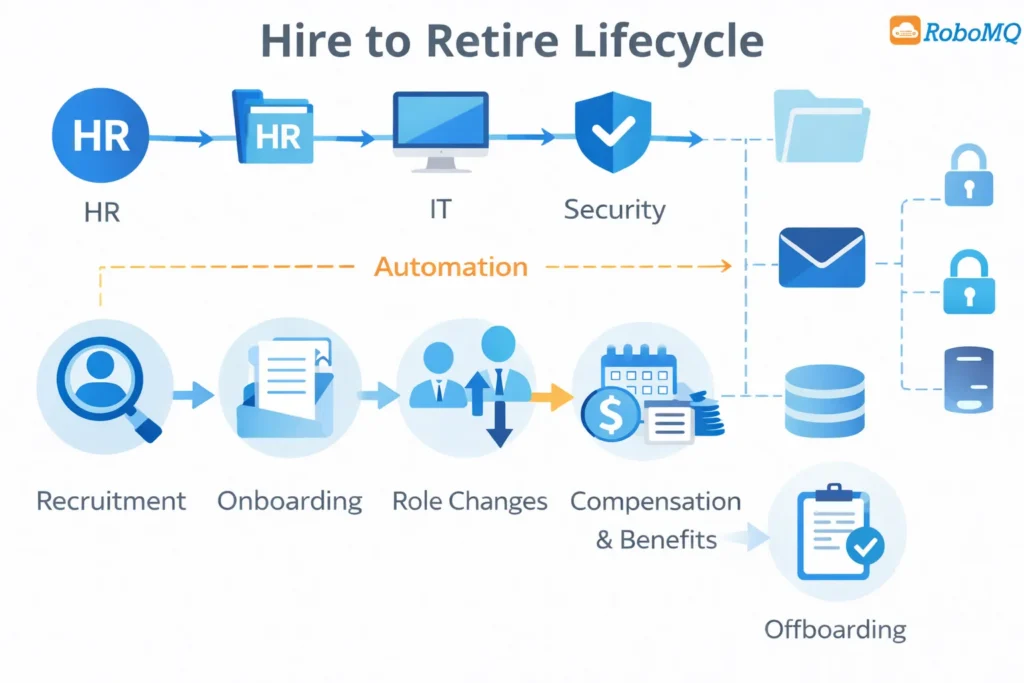
This phase includes activities such as sourcing, interviewing, evaluating, and finally offering a position to the candidate. Clearly defined roles and a well-structured hiring process generally lead to fewer early dropouts and a better long-term fit.
The onboarding phase defines the entire employee journey. According to recent industry statistics, companies that have a formal onboarding program manage to retain more employees and get them productive much sooner. At this stage, employees must have all the necessary resources at hand, such as system access, training, and clear-cut expectations.
Performance management is a process of setting goals, coaching, evaluating, and acknowledging employees’ work. Giving employees feedback regularly helps them understand the company goals and also know what skills they need to improve.
Learning is a major element of employee loyalty. Research shows that employees tend to stay with companies that invest in their growth and development. Thus, attending training, earning certifications, and being provided with career development opportunities are important factors in the hire to retire cycle.
Salary revisions, incentives, employee recognition, and benefits not only affect the employee’s mood but also their health. Explaining salary decisions to employees in a transparent and honest manner is the best way to build trust.
When employees are motivated, they perform at their best and are less likely to leave. Talent retention becomes easier when employees are engaged through team building activities, employee recognition, and providing work, life balance.
Succession planning is about preparing the company for its next leaders. It requires identifying and developing employees with the potential to lead so that the company maintains continuity and stability.
Offboarding includes performing exit interviews, transferring knowledge, settling accounts, and preparing for retirements. It also covers the quick removal of access.
Knowing what hire to retire implies is essentially realizing that all these phases are interrelated and need to collaborate.
Manual management of the lifecycle cannot scale in today’s digital environments. Research in the industry reveals that compromised credentials were involved in approximately 22% of breaches, making up one of the leading causes of unauthorized access. Additionally, the global average cost of a data breach is $4.88 million, underscoring why accurate access control throughout the hire to retire lifecycle is a critical business priority.
Automation guarantees that any change in employee status will be updated in the various systems immediately. Thus, the possibility of human error is minimized, compliance is enhanced, and security posture is reinforced.
Without a doubt, the biggest hurdle in the Hire to Retire process is the lack of coordination between different departments. While HR manages employee data, IT oversees systems and access, and security ensures governance and risk control. When these teams operate in isolation, gaps in hire to retire security and compliance are inevitable. RoboMQ Hire2Retire bridges these departments by treating HR as the source of truth and automating joiner, mover, and leaver events across identity systems and applications strengthening security, compliance, and operational control across the entire workforce lifecycle.
This method is just as beneficial for small and medium, sized businesses wanting to cut down on manual work as it is for large enterprises juggling complex environments.
AnchorSix, an IT outsourcing company with over 1,500 employees, is one real-life example of hire to retire. Before automation, AnchorSix was bogged down with manual onboarding, offboarding, and access provisioning processes that not only slowed down the business but also increased security risks.
New Hire: In the past, new hires had to wait several days for their access because the IT department had to manually prepare accounts. Once RoboMQ Hire2Retire was implemented, provisioning was done automatically based on HR data. New staff members had access to systems from day one, eliminating delays and reducing manual work.
Role Change: Previously, changing roles involved numerous approvals and manual updates, which increased the workload for IT and made it easier to have overprovisioned access. Using Hire2Retire, a change in the HR role automatically led to a change in access. Permissions were correctly removed and added without manual effort.
Exit: Offboarding was heavily reliant on manual follow-ups, which caused the creation of orphaned accounts and non-compliance situations. With Hire2Retire, simply deactivating an employee in HR immediately stopped access in all integrated systems, thereby enhancing security and simplifying audits.
Quantified Result: Automating employee lifecycle and identity management with RoboMQ Hire2Retire allowed AnchorSix to cut IT provisioning and lifecycle management-related expenses by 60% while maintaining security compliance and smooth onboarding.
This real example shows how hire to retire automation not only improves operational workflow but also delivers measurable business impact.
In the absence of a well-defined hire to retire process, organizations end up with lifecycle events that are disjointed between HR, IT, and security teams, which creates operational and compliance gaps. Major issues include:
All these security, employee experience, and operational efficiency issues stem from the problems listed above. This is the main reason why hiring to retiring is more than just knowing what it means. Also, it is essential for organizations to implement automation for it across the systems.
The automation of the hire to retire process through hire to retire software benefits almost every team in the organization:
Basically, any company that hires employees and provides them access to corporate IT systems can benefit from RoboMQ Hire2Retire.
So, what is hire to retire all about? It is about viewing the employee lifecycle as a seamless journey where HR data triggers IT and security workflows without the need for a manual intervention. With RoboMQ Hire2Retire, enterprises can perform onboarding work faster, make internal mobility simpler, enact secure offboarding, lessen the risk of operational failures, and even upgrade the employee experience.
Today’s hire to retire in a digital workplace is more of a necessity than a choice.
No. While HR initiates most employee changes, hire to retire also involves IT and security teams. Every hiring, role change, or exit affects system access, compliance, and data security.
Without a structured approach, companies may face delayed onboarding, employees keeping access they no longer need, inactive accounts remaining active after exit, and audit challenges.
Joiner, mover, leaver focuses mainly on access changes during hiring, role changes, and exits. Hire to retire covers the broader employee journey, including performance, engagement, compensation, and long-term workforce planning.
Yes. RoboMQ Hire2Retire is designed to integrate with popular HR systems, directories, and cloud applications. It connects systems so employee updates flow automatically without replacing existing tools.
Hire2Retire maintains a clear record of access provisioning and revocation based on HR events. This helps organizations demonstrate who had access, when it was granted, and when it was removed.