Quarterly access reviews are meant to make sure that users have access to their current jobs. However, the biggest risk to access in companies does not happen when these reviews are taking place. It happens between these reviews. When people switch roles, they get many permissions, and when the people in charge are not paying attention, until the next review is scheduled. This creates a problem. We call it access review gaps. These gaps are not because the reviews are not done well. They happen because there is a problem.
The people in charge follow a schedule, but things that can go wrong happen all the time. It is very important to know where these gaps happen and how to fix them. This is a part of having a good identity governance program. Identity governance programs need to understand access review gaps and find ways to close them.
A user access review is a process that companies use to check if the people who work for them have access to things. It is like asking a question: Does this person really need to have access to this thing?
A user access review makes sure that only the people who are supposed to have access to things can get to them. It does this by looking at what people can access on all the systems and programs. Companies do this so they can find out if someone has access to things they should not have and fix it before something bad happens to the company.
A user access review is important because it helps keep the company safe and makes sure that people are doing their jobs correctly. There are four main reasons to conduct a user access review:
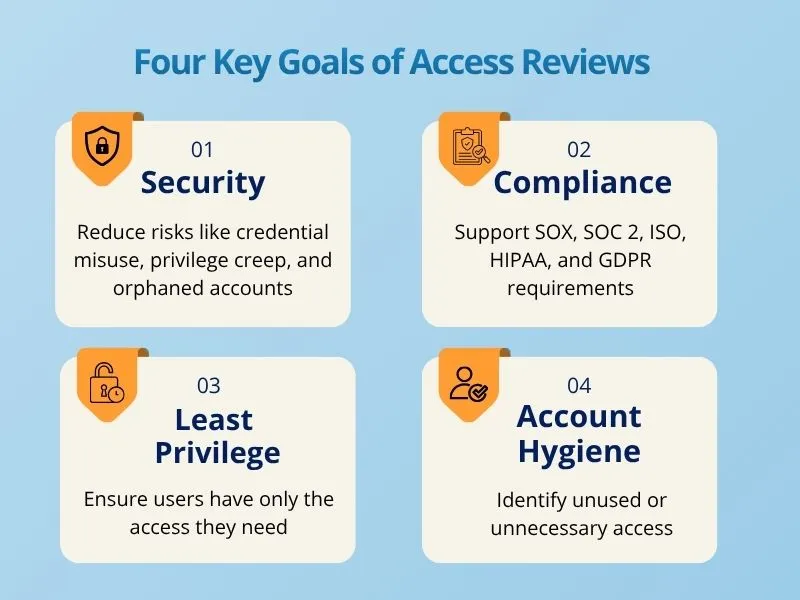
While performing regular user access reviews is essential, the process must be supported by an efficient solution. However, when done in conjunction with a proper user access review tool, these activities can be optimized.
Internal mobility is a normal part of business operations. Employees get promoted, transfer between departments, and join different projects. From an identity governance perspective, these transitions are among the most sensitive moments in the access lifecycle and are the most likely to expose access review gaps. A role change immediately affects what a user should be permitted to access.
Permissions that were appropriate in a previous role may no longer be necessary. New responsibilities typically require additional privileges. If governance does not respond at the same pace as these changes, the result is compounding risk. This is where identity governance risks start to build quietly, well before the next scheduled review.
When people change jobs, it can be hard to keep track of what they can and cannot do. There are some reasons why this is a problem.
The first reason is that when someone gets a job, they get new privileges to go with it. They usually do not lose the privileges they had in their old job right away. This means that they have a lot of access to things. We call this access layering.
It is like having a lot of roles all added together. When someone moves to a job, they get new privileges. They still have the old ones, too. So over time, they have more access than they need for any one job. It is hard to notice this when we look at what people can do every month. This is because we are looking at all the jobs they have had, not the one they have now.
Access cleanup needs coordination between systems and teams. HR records get updated in one place. Identity platforms get change events in another place. Application owners may have to approve access changes. These steps do not always happen at the same time. Teams often keep access active while giving permissions for the new role.
It is not always clear who is responsible for removing access. This is especially true in environments with application ownership. Even short delays create exposure. If a role change happens shortly after a certification campaign closes, those old privileges can stay active for months before the next review finds them.
Role changes usually mean getting access for a short time. Employees get privileges when working on projects. Managers give permissions to help during a transition. In emergencies, special access is given to fix problems fast. These extra privileges are often needed away. The issue is that they are seldom taken away once the urgent need is gone.
Over time, they become part of a user’s access and add to long-term privilege buildup. When combined with access and slow deprovisioning, temporarily elevated access greatly increases access review gaps.
Quarterly access reviews check what permissions users have at one point in time. Managers get tasks to review user access and confirm if it is still okay. When the review is done, governance stops until the review. The main problem is that access risk changes every day. Role changes happen all the time. When people get promoted, move to a team, or get assigned to a new project, it changes what access they should have across the organization long before the next review.
The issue with reviews is that they only look at a snapshot of access. They miss the risks that pop up between reviews. If an employee changes roles after a quarterly review, they might still have old privileges for weeks or months until the next review. Here is the main issue with access reviews:
Access risk goes up when something changes, not when a review happens.
Before diving into the best practices, here is a quick look at the types of access reviews your organization should have in place.

When followed properly, such best practices will enable access reviews to be performed efficiently, repeatedly, auditable, and effective in reducing privilege escalation and insider threats.
A proper access review process must begin with establishing an appropriate policy, which includes the objectives of the review, frequency of the review, scope of the review, and stakeholders involved in performing access reviews. Combine this with RBAC to ensure that all user access privileges are mapped to job roles right from the beginning.
The manual review process requires substantial time and resources, while it suffers from errors that become more frequent during large-scale operations. The IGA and IAM solutions automatically discover access data while they build breach detection systems and send notifications to reviewers, which decreases operational work and establishes stable review procedures. Automated systems fail to deliver complete solutions. The department heads, together with their managers, security teams, and compliance officers, must participate in the process because their business expertise helps to evaluate access requirements for every job.
Not all accounts carry the same level of risk. The system requires more frequent and detailed account evaluations for privileged accounts, administrator accounts, and users who access sensitive or regulated systems compared to standard accounts. The organization needs to conduct monthly evaluations for high-risk accounts and quarterly assessments for standard accounts. The system identifies dormant accounts through regular scheduling, which also stops privilege creep from becoming undetected.
The value of access reviews depends on organizations implementing their findings. The organization must document all current access rights together with change requests and approval records, and the date of approval and reviewer comments. This is because this documentation will meet audit requirements and create a record for any future investigations. The organization must eliminate or modify excessive permissions as soon as they become known. The longer unneeded access rights stay active, the higher the risk of an incident.
Scheduled reviews capture a point-in-time snapshot. Continuous monitoring tools fill the gap by detecting suspicious behavior, login anomalies, and privilege escalations as they happen. Reviewers need additional training sessions, which will help them assess permissions correctly while implementing the least-privilege principle throughout their work.
Access reviews must become part of onboarding and offboarding processes through role-based access provisioning, which starts on the first day and stops at the moment of exit. The structured checklist guarantees complete execution of all steps from least privilege verification to stakeholder sign-off.
Organizations need a system that can detect role changes in real time without waiting for the next certification period to begin, because this system needs to close access review gaps. RoboMQ’s Hire2Retire is a lightweight identity governance platform built for exactly this. It connects with 26 HRIS systems to provide real-time employee lifecycle event synchronization, which updates Active Directory, Entra ID, Okta, and Google Workspace systems. When a role change is recorded in your HR system, Hire2Retire responds automatically:
Governance requirements of organizations that conduct regular certification assessments become more comprehensive through the Application Access Review and Access Certification functions of Hire2Retire. When a reviewer rejects an entitlement, access is removed automatically, eliminating the deprovisioning delays that widen access review gaps. Campaign owners and reviewers receive automated notifications to keep governance timelines on track.
With its Workforce360 feature, Hire2Retire provides governance teams with a centralized platform that displays every employee’s access information through their identity and HR and privilege data while providing 50+ filters to enable accurate current information for both periodic reviews and continuous monitoring. The results speak for themselves:
Hire2Retire delivers an event-driven governance system that enables enterprises to resolve access review gaps without bringing on additional staff or requiring more frequent assessments.
Even organizations with established IAM systems continue to face persistent challenges when they conduct access reviews. The process of identifying challenges requires direct solutions that create actual security improvements that exceed basic compliance needs.
The first challenge requires organizations to spend excessive time and resources on their manual reviews, which need to examine hundreds of thousands of users who possess multiple access rights. The process of reviewing applications creates real reviewer fatigue, which leads to decision makers making quick yet incorrect approval choices.
Solution: You can use IGA solutions that automatically fill access information while detecting irregularities and creating solution suggestions. The process decreases the need for manual work, and it enables reviewers to dedicate their time to making critical decisions instead of handling standard verification tasks.
Most enterprises manage access through various applications, which include cloud platforms and their existing systems that maintain different access control methods. The absence of a central view results in access reviews displaying disorganized and inconsistent patterns. The access rights of one system conflict with the results of a review process that validated access rights in another system.
Solution: The systems need to be integrated into a single governance platform, which will streamline data management. The organization benefits from a unified view because it enables easier identification of overprovisioning problems while detecting privilege creep across multiple systems and applying standardized review processes.
Reviewers often face difficulties in assessing permissions because the existing role definitions do not comply with their actual functioning and administrative requirements. The reviewer automatically approves a permission request when they lack knowledge about its specific access rights because this process results in excessive access being granted.
Solution: Maintain up-to-date records of access inventories together with current role definitions. The reviewers need contextual details, which include information about other users who have the same access rights and the business reasons for those access rights. Better context leads to better decisions and less over-permissive access.
User access reviews are no longer just a compliance requirement. Organizations require user access reviews as their primary security control, which protects systems in environments where workers continuously change their system access during complex cloud operations and as regulations change over time.
The system functions correctly only when it displays the current access status of the organization instead of showing a 90-day-old access status. Organizations that treat access reviews as a security practice rather than a compliance exercise see measurable results: fewer risk gaps, better audit preparedness, and stronger governance across the identity lifecycle.
Achieving this requires automation, clear policy, and event-driven provisioning, which is exactly what RoboMQ’s Hire2Retire delivers. Ready to close access review gaps in your organization? Book a demo with our experts today.
Access review gaps refer to unmonitored exposure between any scheduled governance activity. Access certification gaps exist during the time between official quarterly certification tests, which assess entitlements. The two issues share a common solution because scheduled governance cannot detect risks that occur throughout time.
A defined expiration date for temporary project access is required. Once the project has been completed, access must also be removed at that time and should not be queued until the next scheduled review. If your identity platform can’t automatically expire access, you have a governance gap to resolve.
User access review checklists must include present access mapping information, and required role-permission associations, all orphaned accounts from former employees, all users with privileged access, all accounts that have not been used for 90 days, and the multi-factor authentication status of vital systems. Any access that cannot be tied to a current business need should be remediated immediately.
Poor access reviews leave former employee credentials active, allow excessive permissions to accumulate, and let compromised accounts go undetected for months. The situation develops into an immediate threat, which brings together three security elements: data breaches, insider threats, and compliance violations. Organizations lose all risk awareness because they fail to conduct their required security assessments between operational periods.
The system detects employee role changes together with department transfers and employee terminations, which it tracks through your linked HRIS system, and it provides updates that operate almost in real time. The system removes previous role access the moment a user ends their employment, while it grants them new access rights which follow role-based access control rules. Your access posture remains correct throughout all phases of the employee lifecycle and does not depend on scheduled access assessments.