Identity governance and administration, or IGA, is not just a term anymore; it has become a critical priority for enterprises to survive. As digital transformation increases, organizations face the challenges of managing an increasingly complex web of user identities. Be it employees, vendors, contractors, or third-party apps; companies now need to secure their hybrid and multi-cloud environments.

But, before we get into that, we first need to understand what is Identity Governance and Administration, and why it has become a pressing priority of organizations worldwide.
Identity Governance and Administration (IGA) is a branch of IAM that deals with security and risk management for enterprises. It helps in ensuring the right people have the right access to the right resources at the right time, and for the right reasons.
At an executive level, Identity Governance and Administration exists to answer four critical questions:
1. Who has access to what across the enterprise?
2. Why do they have that access?
3. Is the access appropriate given their role, risk profile, and regulatory obligations?
4. Can the organization prove this to auditors, regulators, and the board?
IGA combines identity lifecycle management, access governance, policy enforcement, and auditability across cloud, on-premises, and hybrid environments.
Unlike traditional Identity and Access Management (IAM), which focuses on authentication and access enablement, IGA focuses on oversight, control, and accountability. It is a fundamental cybersecurity strategy for enterprises working towards securing their important data and information. For CIOs and board level members, IGA is a priority because it addresses 3 major risks for their business:
74% of breaches involve privileged access misuse or compromised identities, according to industry breach reports. Orphaned accounts, excessive access, and role creep significantly expand the attack surface, making them susceptible to data theft.
Compliance regulations such as ISO 27001, SOC 2, GDPR, HIPAA, and APRA CPS 234 cannot be met without proper access governance. As most companies just prioritize manual access controls, their policies fail audits due to lack of traceability, evidence and time stamps on activities.
According to data, enterprises that have poor identity governance policies carry a higher risk of excessive access across their internal systems. The data shows that their employees have 30-50% more access than they should. Manual provisioning and deprovisioning play a major role in granting and removal of access in a timely manner. This increases IT workload, slows onboarding for new joiners, and boosts security risks during termination or offboarding.
IGA directly reduces these risks by introducing policy-driven, auditable, and automated governance controls.
At its core, Identity Governance and Administration (IGA) provides insight and control over identities and access rights assigned to employees by the enterprise to perform their tasks. Rather than focusing only on granting access, IGA also ensures that enterprises know who should have access, why they have it, how long they should retain it, and whether it remains necessary as business and operational requirements change.
IGA functions can be divided into 5 parts, including:
In simpler terms, IGA works as a closed-loop identity management system that integrates identity data from HR platforms, IdPs, IT systems, cloud services, and business applications. These details are then processed into a single consolidated view that allows organizations to tackle access management that would otherwise remain fragmented and unmanaged. This single view is critical for identifying excessive high-risk access that should not be there with the employees and would stay the same if done manually.
User identity lifecycle management is the foundation of IGA. It governs how identities are created, modified, and removed as individuals move through the organization. From Joiner (onboarding) to Mover (role or department change) and Leaver (offboarding) helps organizations manage the identity lifecycle. Data insights show that access risks peak during role changes and offboarding; IGA helps in reducing these risks. When effectively implemented, it integrates with HR systems and uses them as the source of truth for identity management. Furthermore, it triggers access changes based on lifecycle events and ensures to enforce least privilege every step of the way. Organizations with automated lifecycle governance typically reduce access-related incidents by 40–60% and cut onboarding time from days to hours.
Once identities and access entitlements are centralized, IGA applies policy-based governance. Additional access and entitlements are no longer assigned to everyone based on informal requests. Instead, policies define acceptable access apart from the ones assigned as birthright, based on job roles, business functions, regulatory requirements, and risk thresholds. These policies enforce least privilege by design, ensuring that users receive only the access necessary to perform their responsibilities.
Access requests with IGA are then governed through structured workflows that create a balance between operational efficiency with risk control. When a user requests access, IGA solutions automatically validate the request with defined policies, check duties rules, and risk indicators. Low-risk access is approved automatically, while higher-risk requests are sent to the chosen business or compliance stakeholders. Throughout this process, every decision is documented, creating an audit trail that helps you keep compliant and follow regulations.
Provisioning entitlements and their removal is done through automation, which reduces the chances of manual errors. As new employees join, move within the organization and leave, access is adjusted in real-time based on pre-defined lifecycle processes. This proves extremely beneficial in organizations that are large and are a part of highly regulated industries.
IGA does not stop once access is granted. Continuous monitoring ensures that access remains appropriate over time. Regular access reviews, also known as certifications, require managers and application owners to formally attest to the validity of user access. Modern IGA platforms enhance this process by providing business context, highlighting anomalies, and prioritizing reviews based on risk rather than volume. This transforms access reviews from a compliance burden into a meaningful governance activity.
IGA provides enterprise-wide reporting and analytics that checks access data and offers business-relevant risk insights. Senior leaders and management are offered visibility into who has access to critical systems, where policy violations exist, and how access risk is changing over time. This enables them to make informed decisions, supports audit and regulatory requirements, and aligns identity governance with broader security and risk management strategies
In practice, identity governance and administration work best when it is treated as an ongoing program rather than a one-time implementation by organizations. As they keep on adopting new technologies, expanding into new markets, or undergoing mergers and restructuring, IGA ensures that identity and access governance scales with the business, without introducing unnecessary risk or operational friction.
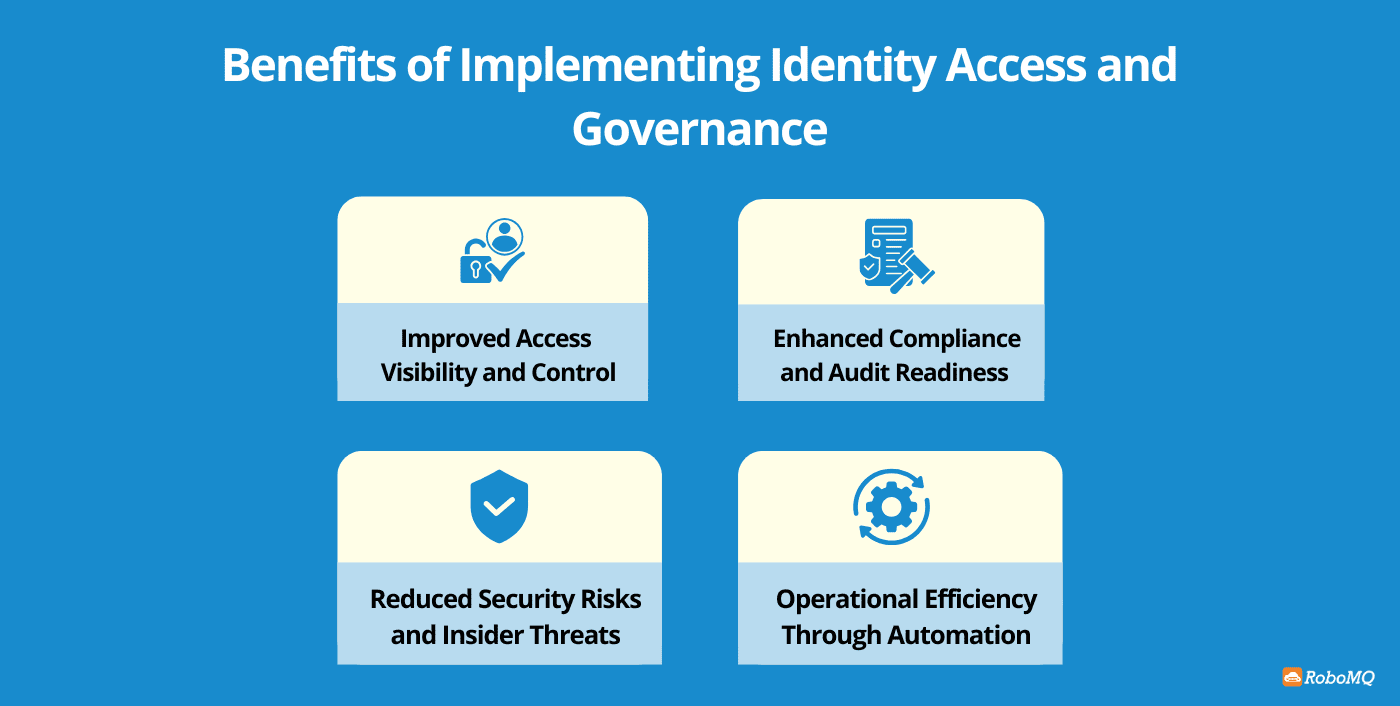
Identity Governance and Administration (IGA) solutions are only effective when they are implemented as an added governance layer within an organization’s existing security ecosystem. It does not replace existing security controls but strengthens them by streamlining policy, visibility, and accountability across employee identities and access management.
As enterprises start adopting more cloud services, SaaS applications, and distributed work models, security architectures become increasingly divided. IGA solves this challenge by acting as a central point of governance, ensuring that access decisions made across different platforms are in line with business requirements, risk tolerance, and compliance.
IAM systems are generally used to check users and ensure access is correct at runtime. They answer the question: “Can this user log in?”
IGA adds another layer of security to IAM by answering a more important question: “Should this user have access in the first place?”
IGA integrates with IAM platforms to check access before it is granted and after it is provisioned. It ensures that the identities created in IAM are pulled from the right sources such as HR systems. Furthermore, it also checks if the access is assigned on the basis of approved roles and not manual decisions.
When role changes or employment is terminated, IGA shares access updates across the integrated IAM systems, reducing the risk of excessive access and orphaned accounts. From CIO and CTO’s perspective, it helps in ensuring that access management is supported by auditable documentation, validating their decisions during audits and investigations.
Privileged access is one of the biggest risk areas in enterprise security. PAM solutions control how privileged access is used, monitored, and recorded. However, without IGA, enterprises often don’t have information on why access was granted and whether it is still justifiable or not.
When IGA is integrated with privileged access management, it helps in governing the lifecycle of privileged entitlements. It makes sure that the access workflows go through proper approval channels and are time-bound. These access reviews make sure that the privileged entitlements are checked by technical owners and not just IT administrators.
This helps in reducing the risks of privilege creep and insider threats significantly. It also provides senior management with the opportunity to check and govern the workflows.
Enterprises today operate on many cloud and SaaS applications, many of which are provisioned outside the traditional IT processes. This manual provisioning increases the speed of approvals but introduces governance gaps in the longer run.
IGA solutions integrate with these platforms and applications to provide a centralized visibility across all environments. With these solutions, governing access requests, role assignments and reviews becomes consistent, regardless of where the application is hosted.
IGA plays a strategic role in supporting security operations and enterprise risk management. By monitoring access and identifying risks, like dormant accounts, excessive entitlements and policy violations, IGA offers valuable insights to security teams.
When integrated with SIEM and other risk platforms, IGA helps contextualize security alerts with identity data. This allows security teams to prioritize incidents based on the risk profile of the user involved, rather than treating all access risks equally.
For senior leadership, this integration improves the organization’s ability to detect and respond to identity-driven threats.
One of the biggest benefits of IGA alignment is getting the enterprise ready for compliance and audits. Compliance regulations need evidence of effective access governance; something IGA is created for.
IGA solutions integrate with GRC tools and reporting workflows to provide:
This reduces the effort for audit readiness, lowers the risk of compliance findings, and enables organizations to respond confidently to regulatory inquiries.
While IGA delivers better security, compliance, and operational benefits, it is seen that organizations encounter challenges when they implement IGA into their legacy systems. Some of these challenges are technical, and others are simply related to the organization’s inability to change.
Understanding these challenges is critical for senior management, as unsuccessful IGA initiatives often lead to security risks and data theft. Below, we have listed the top challenges faced by organizations when implementing IGA.
Most organizations using legacy environments have multiple identity repositories which are not in sync with each other. Overtime, these lead to inconsistent identity data and compliance failures.
On the other hand, IGA relies on a single source of truth to check user roles, their entitlements, and access. The poor data quality, structure, inconsistent naming conventions, outdated attributes, and unmanaged service accounts increase the complexity of IGA implementation.
Most enterprises that do not have automated provisioning and deprovisioning capabilities, rely on spreadsheets and emails for access management. These custom scripts, while handy, create governance gaps and compliance errors.
To implement IGA, enterprises need automated provisioning for approvals, lifecycle events, and policy enforcement. With manual access management, it becomes increasingly difficult to integrate IGA into the existing environment without exposing enterprises to security risks.
When it comes to dealing with non-human identities (NHIs) or automated accounts, legacy infrastructure falls short. The dynamic nature of these identities and lack of oversight on them exposes enterprises to security threats.
IGA at its core depends on end-to-end visibility to enforce governance effectively. However, with the identity gaps created by NHIs, it becomes increasingly difficult. Without automation, tackling the challenges of NHIs is impossible and without solving these issues, IGA cannot be implemented.
While focusing on technology is a must, sometimes even with the right infrastructure, implementing IGA can become a challenge. When organizations get used to informal access practices and undocumented approvals, they resist the implementation of a more structured process.
Sometimes, IGA is perceived to slow down the existing processes due to the number of steps involved in approvals at the start. However, in the long term it offers more efficient, agile, structured, and compliant access management.
One another challenge that enterprises face while implementing IGA is mistaking it to be a replacement of IAM. While IGA is just an addition to the IAM structure, it serves as an oversight to the IAM mechanism.
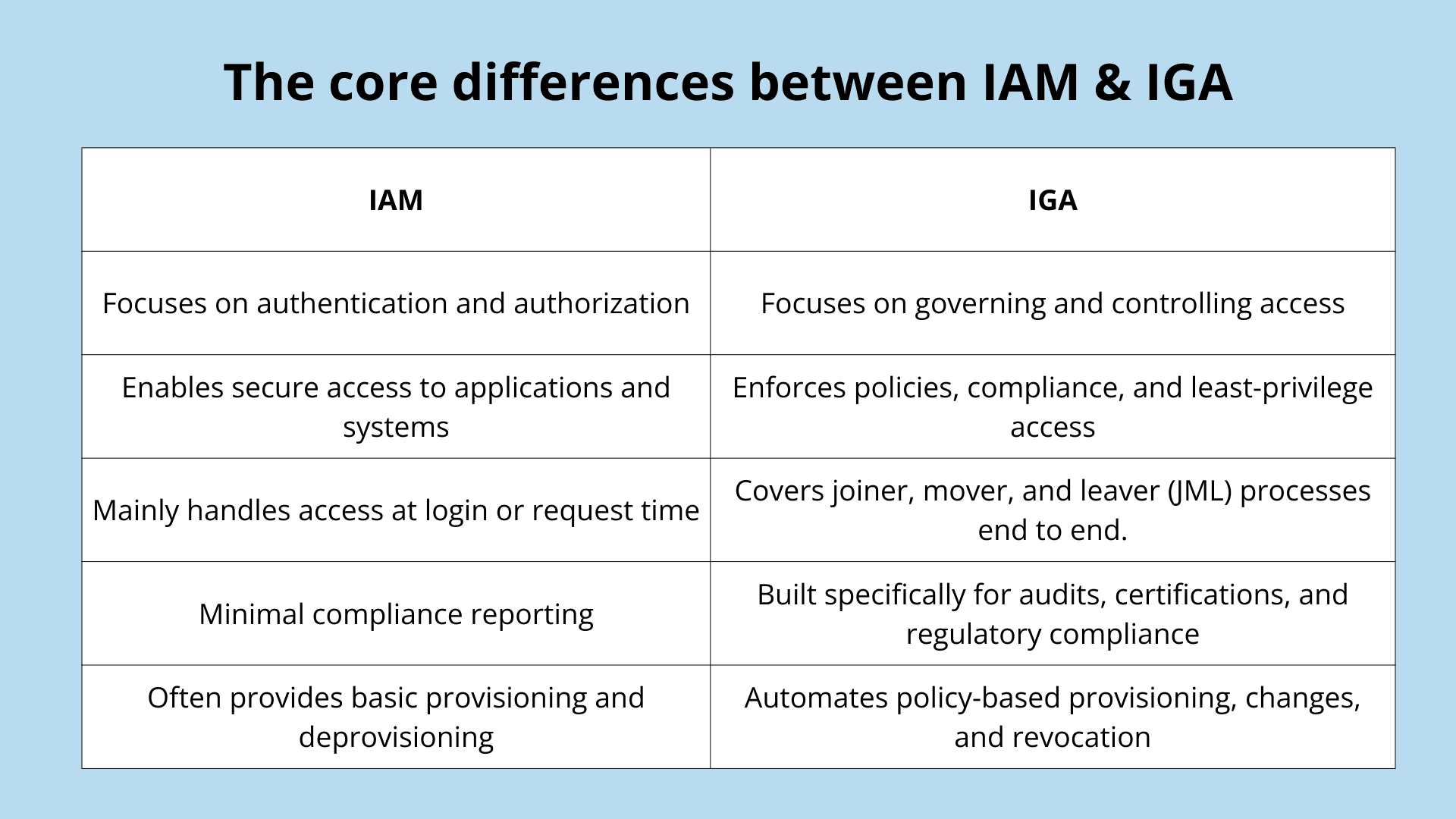
Identity and access are often used interchangeably, but IAM and IGA serve very different purposes. While IAM focuses on enabling secure access to systems and applications, IGA goes a step further by governing who should have access, why they have it, and for how long. Understanding the differences between IAM and IGA is essential for organizations looking to enforce least-privilege access, meet compliance requirements, and reduce security risk. The table below highlights the key distinctions between IGA vs IAM.
Manual identity management is often reliant on spreadsheets, email approvals, and raising help desk tickets. This process is time-consuming and highly error-prone when organizations grow at a rapid pace. It is a fragmented approach that becomes a security and operational liability in the long term.
According to CIOReview, automating IGA workflows has become non-negotiable for enterprises. It is the single most important factor in determining whether an IGA program will deliver value or become a burden for the enterprise. Without automation, complexity, cost, and manual effort will only lead to flaws in the governance model. Here’s how automation solves these challenges for enterprises.
According to a recent study, automation can reduce the chances of IGA implementation failure by 70-80%. Most of these failures happen due to manual approval workflows, which can lead to security lapses due to human errors. One missed approval, one orphaned account can lead to major security threats and compliance challenges for enterprises. With automation, these human errors can be reduced, and policies can be enforced strategically.
The complexity in identity management due to manual approval processes is a big challenge when implementing IGA. Managing access through data sheets and emails can complicate things when it is done for large scale enterprises. Automation addresses this issue by ensuring a standard approval workflow across the organization. It reduces dependency on approvals on people, improves approval time, and lowers the risk of errors.
Enterprises sometimes do not wish to go for IGA implementation thinking it would be costly. Automation helps in reducing this cost of ownership by minimizing manual intervention and reducing the need for administrative support. A study shows that many organizations report a median ROI of 150% within the first year and a payback period of 12 to 18 months. Furthermore, it reduces licensing costs by removing unnecessary entitlements and dormant accounts.
As organizations continue to grow in the digital landscape, manual governance cannot keep up with the speed of its scalability. With automation, IGA solutions can govern hundreds of applications, cloud platforms, and identities without any extra effort. Furthermore, it also ensures that any new systems, identities, and applications can be bought under governance control as soon as they are implemented.
Compliance and regulatory standards are dynamic, and to keep up with them manually is a challenge. Furthermore, they demand clear visibility into end-to-end access workflows, which is impossible when done manually. With automation, every access decision, every approval, review and revocation is documented and audit ready. It helps organizations to focus on governance consistently and not just during the audit season.
Choosing a suitable automation solution for your Identity, Governance and Administration (IGA) workflows is critical for your operational security. Here is a 5-point checklist that can help CIOs and CTOs in making the right decision.
1. Assess your current state and gaps in the existing workforce lifecycle. Audit it to find out where manual interventions are most common and what pain points must be addressed.
2. Prioritize the integration compatibility of the solution. A good solution should enable complete end-to-end integration between your HR systems, IdPs, identity governance and administration software, and third-party applications.
3. The ideal solution should also support policy-driven automation. This will help in streamlining access provisioning based on roles and attributes.
4. It should be secure and compliant. Ensure that it is SOC2 Certified and offers a detailed audit log.
5. Evaluate the complete cost of ownership. Consider factors like licensing fees, implementation time, customization requirements, and maintenance, as well as training requirements.
This approach aligns with Gartner’s recommended identity maturity, transitioning from siloed IAM processes into an integrated IGA + lifecycle automation framework. However, enterprises still struggle when it comes to the implementation of the right solution.
Hire2Retire is a unified suite of end-to-end workforce lifecycle automation solutions. It is a powerful, lightweight identity governance and administration solution that smoothly integrates with HR systems, IdPs, cloud infrastructure and third-party applications. It helps enterprises fill the critical lifecycle gaps in their fragmented and broken workforce lifecycle management. From onboarding to the employee’s exit, it helps in automation helps automate all processes, including identity provisioning, resource provisioning, and access provisioning.
This seamless flow simplifies operations for CIOs and CTOs struggling with growing workforce scale, internal policies, and compliance demands.
Workforce lifecycle gaps around the onboarding, role-change, and off-boarding of the employees are recognized as the primary barrier for effective identity, governance & administration processes.
For CIOs and CTOs, it has become imperative to establish a unified and automated identity, governance and administration foundation that can scale with their growing businesses. To grow in the competitive landscape of our digitalized world, Hire2Retire comes out as a perfect solution for enterprises today.
The four pillars of IAM are identity lifecycle management, access management, authentication, and authorization. Together, they ensure users are correctly identified, granted appropriate access, authenticated securely, and continuously managed across systems throughout their employment lifecycle.
Identity governance in IAM ensures that user access aligns with business policies, compliance requirements, and risk posture. It governs who gets access, why they need it, and for how long, using approvals, reviews, audits, and policy-driven controls.
Identity governance evolved from manual account administration and spreadsheet-based audits to automated IGA platforms. As enterprises scaled and regulations increased, governance became essential to control access, reduce risk, and maintain compliance across complex hybrid IT environments.
Cloud identity governance extends IGA principles to SaaS, cloud infrastructure, and hybrid environments. It provides centralized visibility, policy-based access control, and automated reviews across cloud applications, helping organizations manage identities securely at scale.
The purpose of identity governance and administration is to enforce least-privilege access, reduce security risk, and meet compliance mandates. Solutions like Hire2Retire automate access provisioning, approvals, reviews, and revocation across the entire identity lifecycle.

Abhishek Surtanya is a Marketing Manager at RoboMQ with 6+ years of experience. He is a B2B and SaaS content strategist specializing in content writing that drives engagement, lead generation, and SEO growth. He specializes in data-driven, conversion-focused content that establishes thought leadership and enhances brand visibility.
Abhishek Surtanya is a Marketing Manager at RoboMQ with 6+ years of experience. He is a B2B and SaaS content strategist specializing in content writing that drives engagement, lead generation, and SEO growth. He specializes in data-driven, conversion-focused content that establishes thought leadership and enhances brand visibility.