Are you sure that every user in your organization has the right level of access, no more or no less?
The reality is that most business owners are not, and this is mainly because they don’t have a structured Azure Identity Governance strategy to manage it. Organizations experience three common risks when they lack structured identity governance. These include excessive accessibility leading to a larger attack surface, compliance gaps, and inefficient manual processes.
Collectively, these issues increase operational expense, result in slower performance, and create security vulnerabilities. Azure Identity Governance is specifically designed to address these problems. It provides organizations with a structured, automated approach to manage who has access to what, when they have it, and why. This type of access management strategy can help enterprises maintain secure access to both their cloud-based and on-premises resources.
In this blog, we will give a brief overview of the key features of Azure Identity Governance, its real-world applicability, and the advantages of using it as part of your identity governance strategy. We’ll also find out how purpose-built solutions like Hire2Retire can help accelerate your identity governance strategy.
Azure Identity Governance (now called Microsoft Entra Identity Governance) is a cloud-based solution to ensure that the right people get the right access at the right time. It helps organizations better meet compliance and regulatory obligations, increase productivity, and enhance security.
Azure Identity Governance (AIG) is the answer to four key questions that boards of directors and chief information security officers (CISOs) should be asking today:
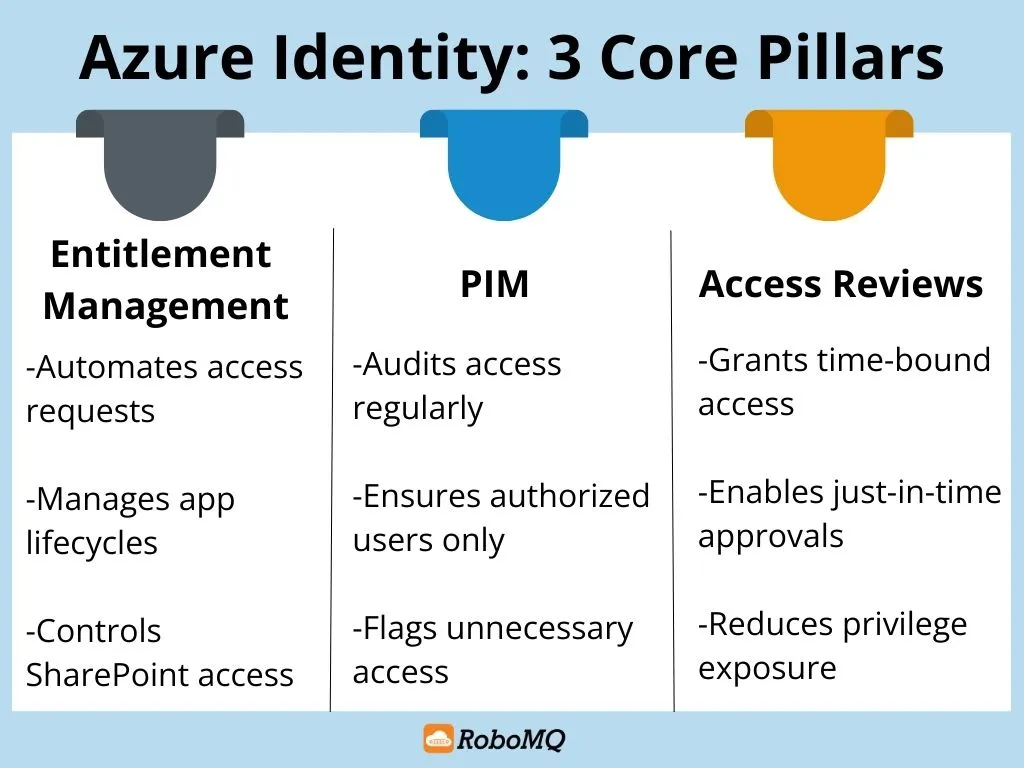
Azure Identity Governance gives businesses a way to organize and control how users, apps, and resources get access. It helps security and IT teams find the right balance between productivity and protection by combining automation with constant monitoring. The three main components are especially important to ensure that decisions are made consistently and clearly, aligning with the business goals.
Now that we have a basic understanding of Azure Identity Governance, let’s discover some of its core features.
Entitlement Management allows organizations to create and manage bundles of resources such as Microsoft 365 groups, applications, and SharePoint sites. Business owners then approve bundled resources, rather than IT, for user access via a self-service portal and expire automatically at the end of their period of use.
Primary Features of Entitlement Management are:
Privileged Identity Management (PIM) is one of the most impactful methods of managing Azure identities and governance. PIM allows businesses to replace ‘standing’ admin roles with scheduled/administered time-limited access, reducing the potential for attacks.
Primary Features of Privileged Identity Management are:
Access Reviews automate the routine auditing of security permissions for your applications and groups. This feature uses AI to automatically recommend access reviews directly in Microsoft Teams. This enables businesses to make fast, confident decisions about security permissions without having to possess a lot of technical expertise.
Primary Features of Access Reviews are:
Lifecycle Workflows automate all tasks related to an employee’s joining, changing, or leaving. They integrate with HR systems to automate processes like sending welcome messages, creating accounts, changing access and permissions.
Primary Features of Lifecycle Workflows are:
For a detailed look at how HR-driven automation works in practice, read this one out: HR to Active Directory Sync for Identity Governance.
To better understand its practical value, let’s explore some common real-world use cases of Azure Identity Governance.
When HR creates a new hire record in any HR system, Azure AD Identity Governance automatically sets up the correct accounts, applications, and group memberships. Access is turned off the same day an employee leaves. This closes one of the most common security holes in business settings. Companies that have automated this process report receiving up to 70% fewer IT tickets related to provisioning.
Companies can make access packages for outside users, like vendors, contractors, and partners, that have expiration dates and regular reviews of who has access. Access is taken away automatically when a project is over. There are no old accounts, no leftover risk, and no need to clean up by hand. This lets business leaders see and control who outside the company can access what and for how long.
Organizations can get rid of permanent administrator accounts completely with PIM. IT admins don’t have permanent admin rights. Instead, they get approved access for a set amount of time only when they need it, and every action is logged in a full audit log. Even if an admin account is hacked, the hacker does not get any new privileges. This one control makes the blast radius of a possible breach much smaller.
Microsoft Entra Identity Governance is different from many other IAM tools that only work in the cloud. It lets businesses manage applications that are hosted on-premises, like legacy directories, without needing separate tools for on-premises use. This is especially useful for companies that are halfway through moving to the cloud and must deal with hybrid environments. A single management framework makes sure that governance policies are the same in both environments.
It’s not enough to just pass an audit to meet compliance requirements. Businesses also need to demonstrate that they are actively manages access daily. Azure Identity Governance automatically creates access review records, enforces least-privilege policies, and keeps a detailed, traceable audit trail for all users and resources. Your compliance evidence is always up-to-date, accurate, and ready for an audit, regardless of whether your business follow SOX, HIPAA, ISO 27001, or GDPR. Your team doesn’t have to put it all together manually.
A lot of businesses have trouble with employees who have conflicting permissions, like someone who can both approve and raise a purchase order. With Azure Identity Governance, organizations can set up and enforce separation of duties policies right in access packages. This stops the same user from getting permissions that conflict with each other. This lowers the chances of internal fraud, breaking the rules, and audit findings before they happen.
Azure Identity Governance lays the groundwork. But how fast and deep organizations can implement it depends on how well it works with the HR systems that make decisions about your workforce. Hire2Retire, RoboMQ’s workforce lifecycle automation platform, is recognized as an emerging IGA provider by both G2 and Gartner.
It sits between your HR system and Microsoft Entra ID. The tool makes every HR event an official, real-time identity action. Hire2Retire connects with 25+ HR systems, including ADP, Oracle HCM, BambooHR, and more. Here’s how it bridges the gap between your Microsoft Entra ID and HR system in real-time.
Companies like Topgolf have successfully scaled their identity management from a few thousand employees to over 24,000 employees worldwide using Hire2Retire. For those looking to rapidly deploy workforce identity management without the complexity associated with traditional IGA solutions, Hire2Retire is a no-code solution where IT and HR teams can work together.
Businesses should focus on identity governance as an essential security and operational initiative. Azure Identity Governance provides tangible benefits to organizations in the areas of security, compliance, cost, and user experience.
An organization’s focus on identity governance leads to better security, lower operating costs, and increased business efficiency, while always delivering better user experiences.
Identity governance is crucial for modern businesses that want to keep sensitive information safe, stay in compliance, and control access on a large scale. Azure Identity Governance helps businesses automate access control, enforce policies that give users the least amount of access they need, and keep clear audit trails.
Hire2Retire speeds up this process by linking HR systems to Microsoft Entra ID so that identity lifecycle actions can happen automatically in real time. Are you ready to make identity management easier and cut down on manual work? Talk to our experts to find out how Hire2Retire can help your business get going.
You need a Microsoft Entra ID P2 license. You can get it as a separate add-on or as part of Microsoft 365 E5 or Enterprise Mobility + Security E5. P2 is needed for all full governance features, such as PIM, Access Reviews, and Entitlement Management.
The differences between Azure Identity Governance and Azure AD are significant. While Azure AD provisions users as well as allows for secure log-in to an application with provisioned access, Microsoft also recognises that there is more to managing identity in Azure than securing log-in.
Azure Identity Governance functions as the core identity management system within Microsoft Entra ID. Dedicated IGA platforms like Hire2Retire sit on top of that framework to add HR-system connectivity, no-code workflow automation, and real-time event-driven provisioning. The combination of these systems enables organizations to implement governance procedures that enforce their HR policies through operational methods.