It only takes one access gap to remind us how vulnerable everyday workflows really are – one delay, one mismatch, one missed update.
Imagine a new project is kicking off in your organization on Monday morning. The team is ready, the client is waiting, and the deadline is tight. But one key engineer can’t log into the project workspace. Their role changed last week, but IT never got the updated information. HR assumed the manager would inform IT; the manager assumed the HR system synced automatically; IT assumed the ticket would come in eventually. By the time the engineer gets access, half the day is gone, and the project is already behind schedule.
No immediate alarm. No major failure. Just a tiny delay caused by a simple lifecycle gap. But multiply that by every new hire, every internal move, every temporary assignment and every exit, and you start seeing the true cost of a broken employee lifecycle.
Most companies feel this pain every day. About 84% say their productivity drops because people don’t have the access they need, with 32% dealing with it daily and over 52% running into it at least once a week. When access management lags, everything slows down – projects get delayed, teams get frustrated, and leaders spend time fixing problems that shouldn’t exist in the first place.
Why Employee Lifecycle Management Is Failing in Most Organizations?
The employee lifecycle always seems straightforward when you map it out: bring someone in, give them the access they need, update it when their role changes, and switch it off when they leave. But real life never follows that clean, tidy sequence.
Employees don’t move in straight lines
Careers inside an organization aren’t linear. Someone might join today, shift teams within a month, split time across two departments for a special project, take a leave midway through the year, return with new expectations, and wrap up their employment by the next cycle.
Each of those transitions changes what they should access, who they report to, and which systems they truly need. It only takes one update that doesn’t make it to IT, or one system that doesn’t sync, to knock the entire identity chain out of alignment.
HR evolves in real time, systems lag behind
HR updates tend to be immediate: start dates, transfers, promotions, job code changes. But identity systems don’t always move in step. Some catch up in hours, others in days, and some not at all, without a manual push. That lag creates gaps where employees either can’t do their job or can still do jobs they’ve already moved on from.
Shared responsibility often means slow responsibility
HR, IT, managers, security, compliance, they each own a slice of the lifecycle, but no one truly owns the whole journey. When accountability is scattered, it’s easy for essential updates to slip, for access to linger, or for responsibilities to fall between teams. The result is a lifecycle managed in fragments rather than as a single, coherent flow.
Hybrid environments make the gaps even wider
Modern workplaces run on layers of cloud apps, on-prem systems, SaaS tools, shared service accounts and region-specific platforms. Even one employee might touch:
And lifecycle changes rarely propagate cleanly across all of them. That’s how an organization ends up with mismatched identities, access that doesn’t reflect reality, and workflows slowed down by issues that no one has time to untangle.
What do These Gaps Cost Organizations Every Day?
These gaps may look minor, but they ripple out into real consequences for teams, timelines and productivity. When access doesn’t keep up with people, it forces teams to pause, wait or work around the problem. And when it keeps happening, it slowly becomes the normal way of working, and that slows everyone down.
These issues may seem minor, but they end up affecting real work and real outcomes:
When the employee lifecycle doesn’t line up, everyday work slows down. But most organizations still don’t treat it as something that needs a real strategy behind it.
Why Automation Matters in Employee Lifecycle Management?
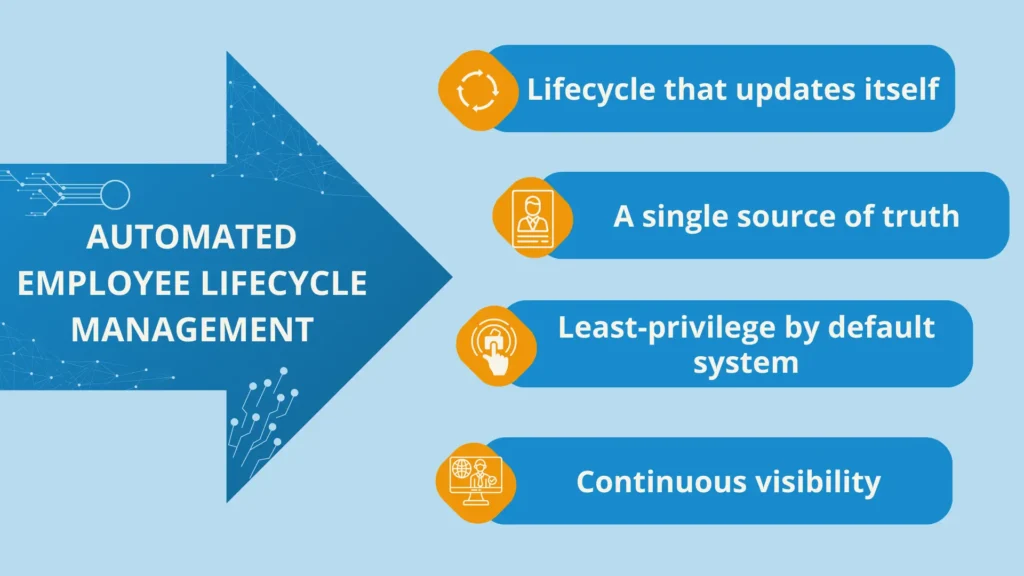
When these elements come together, lifecycle management stops being a series of hand-offs and becomes a predictable, governed flow.
How does Hire2Retire solve the Modern Employee Lifecycle Challenge?
Hire2Retire by RoboMQ is an Identity, Governance & Administration product that provides zero-touch automation of workforce identity, access and privileges from HR as the source of truth to identity systems for Joiner, Mover and Leaver (JML).
Hire2Retire takes the moving pieces of the employee lifecycle and ties them into one automated engine. Instead of waiting for inter-team coordination, it uses HR changes, the most reliable data point, to drive identity decisions across systems.
HR-driven provisioning and deprovisioning:
Hire2Retire listens to your HR system first, so every change in job title, department or employment status automatically triggers the right identity updates.
For example: when HR marks someone as “joining next Monday,” their accounts, email, and groups are ready before they arrive.
Access that adapts with employees:
Roles change fast. Someone may shift teams, support a project for three weeks or take on a temporary leadership role. Hire2Retire adjusts its access instantly – no tickets, no delays.
For example: Think of a marketer stepping in to help sales for a quarter; their access updates the moment their assignment changes.
Clean, accurate identity records:
Identity hygiene is often overlooked, but it’s where most governance issues start. Hire2Retire keeps records consistent across systems, preventing duplicates, outdated roles or mismatched attributes.
For example: It eliminates situations like an employee being listed as “active” in one system and “terminated” in another.
Governed offboarding:
When someone leaves, every connected system updates in real time – email, AD, SaaS apps, everything. No access lingers, which reduces risk dramatically.
For example: A contractor’s access shuts off the moment their project ends, not days later.
Operational visibility:
Hire2Retire gives HR, IT and compliance a clear, shared view of what happened, when it happened and why.
For example: If an auditor asks when an employee’s access was removed, you have the exact timestamp – no digging, no guesswork.
This creates a lifecycle that runs itself, not one that needs constant human intervention.
The Big Picture
When your lifecycle is aligned with your identity systems – and automated through platforms like Hire2Retire, your organization runs smoother, safer and faster.
If you’re looking to simplify lifecycle workflows and reduce operational friction, schedule a free demo of Hire2Retire and see it in action.
Frequently Asked Questions (FAQs)