Have you ever seen an employee leave your organization but still show up as “active” in one or more applications? It happens far more often than we admit, and it’s where identity governance quietly breaks.
The question is: how confident are you that every identity in your organization has the exact access they should – no more, no less?
Every growing organization has the same silent problem: people join, move, switch departments, take on temporary roles, leave, return, convert from contractor to full-time, or work across geographies. But while the workforce evolves instantly, access privileges don’t always follow the same rhythm. That gap is where identity governance breaks, leading to:
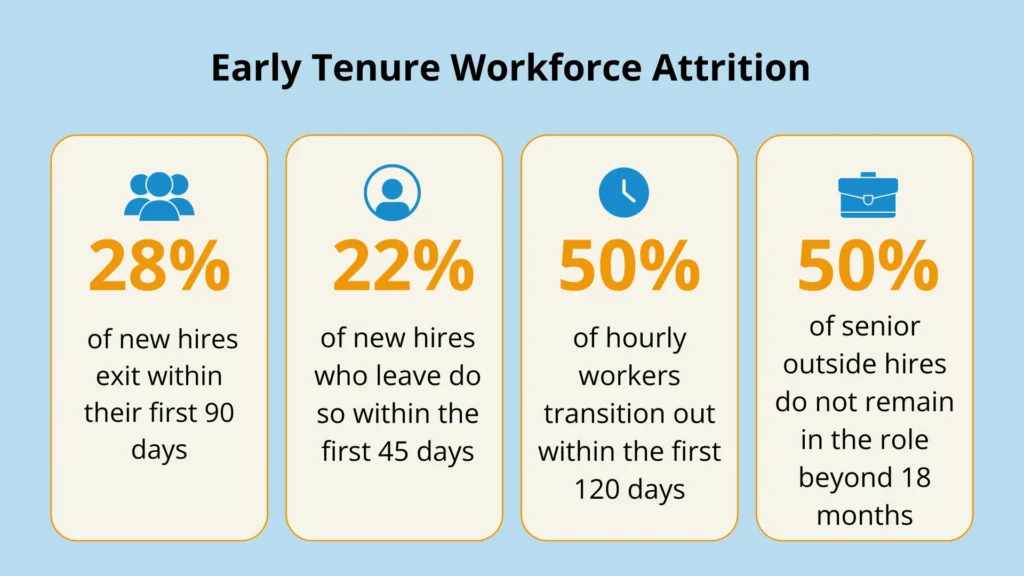
Employee movement in the first few months of employment is far more dynamic than most organizations anticipate. A simple look at early-tenure attrition patterns shows how quickly identities cycle through systems, often before governance workflows can catch up.
Traditional IGA solutions covered provisioning, access reviews, and certifications. Today, identity governance must go further by integrating automation, real-time data synchronization, lifecycle management, and analytics across HR systems, directories, and downstream business apps.
When many companies implemented IGA, the focus was on provisioning/deprovisioning and access reviews. But the enterprise identity landscape has changed over time: cloud applications, hybrid work, contractors, machine identities, APIs and service accounts. If your governance only touches the easy stuff (on-prem apps, static directories), you’re missing large parts of the risk surface.
Recent analysis shows that identity governance weakens substantially outside traditional user accounts, with DevOps environments covered at roughly 35% and service accounts at just 23%.
Operationally, this means:
In short, identity governance becomes fragmented, reactive, and costly.
Most organizations have well-written identity policies, but the real challenge lies in bringing those policies to life every day, for every employee, across every system. When access decisions still depend on manual tickets, email notifications, shared spreadsheets, or delayed inter-team communication, identity governance becomes reactive instead of proactive. That’s where gaps start forming.
When identity workflows aren’t automated, enterprises experience issues such as:
An effective IGA strategy must span the full lifecycle of an identity. That means aligning HR, IT, Security, and Compliance from the moment someone is hired – or engaged – until they leave, retire, or change roles. Here’s what that lifecycle view looks like:
This model flips identity governance from being a vault-check exercise into an operational, business-aligned process. Controlling who has access to what – across users, devices, applications – is the essence of the challenge.
Hire2Retire by RoboMQ is an Identity, Governance & Administration product that provides zero-touch automation of workforce identity, access and privileges from HR as the source of truth to identity systems for Joiner, Mover and Leaver (JML).
Here’s how a solution like Hire2Retire plugs into that lifecycle model and turns theory into execution:
HR-System Integration: Hire2Retire uses your HR system as the source of truth – meaning when an employee is onboarded, transferred or moved to exit, those changes drive identity workflows automatically.
Role-Based Access Control: Access is assigned via roles and attributes, reducing manual assignments and aligning with business logic (e.g., “Finance Manager” vs “Contractor – Project X”).
Automated Provisioning/Deprovisioning: When someone exits or moves, Hire2Retire triggers account termination or change; ensures access doesn’t linger.
Identity Hygiene & Governance Layer: Clean identity data means your IGA platform has accurate information; Hire2Retire helps eliminate orphaned accounts, stale entitlements, and misaligned privileges.
Audit & Compliance-Ready: The combined integration and automation reduce risk, cut audit prep time, and enable governance teams to focus on escalation rather than firefighting.
Haffner Energy, a clean-energy company with 1,200 employees, faced complex identity-and-access management challenges: manual joiner-mover-leaver (JML) workflows, extended leave not triggering access removal, and synchronization issues across their HR system (Paylocity) and Hybrid AD. After implementing Hire2Retire:
Haffner Energy’s journey shows that when identity governance is automated and aligned with the employee lifecycle, security, compliance, and productivity no longer compete, they reinforce each other. As enterprises continue to scale and diversify their workforce models, solutions like Hire2Retire make accurate, governed, and audit-ready access not just achievable, but sustainable.
If you think of identity governance as a checklist – access reviews, audits, certification once a year – you’re already behind. Modern enterprises demand identity governance that reacts in real time, aligns with HR lifecycles, integrates with business systems, and automates the operational plumbing. In that context, platforms like Hire2Retire are no longer optional, they’re foundational.
By shifting from check-the-box governance to lifecycle-driven identity governance, you reduce risk, support compliance, and enable productivity. And in doing so, you bring identity governance out of the shadows and into the business conversation.
Start your journey toward secure, automated identity governance. Book your free demo.
Identity governance breaks when employee movement outpaces manual access updates. Joiners, movers and leavers change daily, but access often lingers or updates late, creating mismatches and risk.
Legacy IGA models rely on periodic reviews and manual provisioning, which can’t keep up with cloud apps, hybrid work, contractors and rapid workforce changes. Modern environments need continuous, automated control.
Delayed deprovisioning leaves inactive accounts and outdated privileges across systems. These blind spots increase exposure during audits and elevate insider-risk potential.
Automation ensures access updates happen instantly when HR data changes, eliminating manual tickets, delays and errors. This keeps entitlements accurate across the entire worker lifecycle.
Hire2Retire automates joiner, mover and leaver actions by syncing HR data directly to identity systems. It ensures timely provisioning, clean deprovisioning and continuous identity hygiene across directories and apps.

Sujata Swarnim is a Marketing Enthuasiast with a majors in Marketing , working at RoboMQ. She thrives on connecting the dots, between people, ideas & opportunities - turning creative insights into meaningful impact & power brand stories.
Sujata Swarnim is a Marketing Enthuasiast with a majors in Marketing , working at RoboMQ. She thrives on connecting the dots, between people, ideas & opportunities - turning creative insights into meaningful impact & power brand stories.