Organizations operating under SOX, HIPAA, and GDPR face a common challenge: proving that access controls are continuously enforced, not just documented during audits. These regulations demand more than static policy; they require clear, audit-ready evidence that user access controls are functioning effectively at all times.
The IT team often manages provisioning tickets and email, tracks access in a spreadsheet, and runs access reviews within a limited time before audits. The problem is that identity governance compliance is hard to maintain, especially when the organization grows and the employee headcount increases.
Why? It’s because when these processes are done manually, they create gaps:
In this blog, we will cover what SOX, HIPAA, and GDPR compliance actually require from an Identity governance compliance standpoint. Also, how Hire2Retire by RoboMQ automates the controls that matter the most across all three regulatory frameworks.
The concept of identity governance compliance is critical in ensuring that organizations meet regulatory requirements while maintaining secure access controls.
Identity Governance and Administration (IGA) is the structured approach organizations use to manage user identities and access across systems. It ensures that access is correctly provisioned, regularly reviewed, and revoked when not required.
Organizations often confuse Identity and Access Management (IAM) with Identity Governance and Administration (IGA). But when it comes to SOX, HIPAA, and GDPR, auditors ask IGA questions, not IAM ones. So, it is important to understand the distinction between IAM and IGA.
A modern IGA solution covers the following areas:
| IGA Functions | What It Does | Identity Management Lifecycle | Creates, updates, and disables accounts based on employment status and role changes |
|---|---|
| Role-Based Access Control (RBAC) | Assigns access entitlements based on job function, department, and location |
| Access Reviews & Certifications | Periodically confirms if existing access rights are still appropriate, with documented outcomes |
| Audit Logging and Compliance Reporting | Maintains a structured record of all access changes, approvals, and reviews. |
According to a 2025 market analysis report by Grand View Research, access certification and compliance control (the governance layer) is the largest functional segment of the IGA market, accounting for 28.5% of the total IGA revenue. It is driven by the increasing emphasis on regulatory compliance (SOX, HIPAA, and GDPR) and risk mitigation across industries.
SOX (financial), HIPAA (healthcare), and GDPR (privacy) regulatory frameworks enforce identity and access controls in different legal contexts. However, they share the same technical control requirements: provable, role-based access control (RBAC), and lifecycle management.
The following brief outlines the intersection between identity governance compliance and these three major regulatory frameworks.
The Sarbanes-Oxley Act (SOX 2002) focuses on the integrity of financial reporting through accountability. It has two major mandates for IT teams in the finance industry:
SOX auditors look for “operating effectiveness” throughout the year. Organizations using IGA software like Hire2Retire reduce manual compliance efforts up to 80% by replacing spreadsheets with an automated, continuous reporting feature.
The Health Insurance Portability and Accountability Act (HIPAA) apply to businesses in the healthcare industry and associates who handle electronic protected health information (ePHI) for them. Under HIPAA, healthcare businesses need to assess:
The U.S. Department of Health and Human Services (HHS) has issued enforcement actions against healthcare organizations where former employees had active access after termination. Settlements can reach millions of dollars when organizations fail to prove that a detailed deprovisioning process exists.
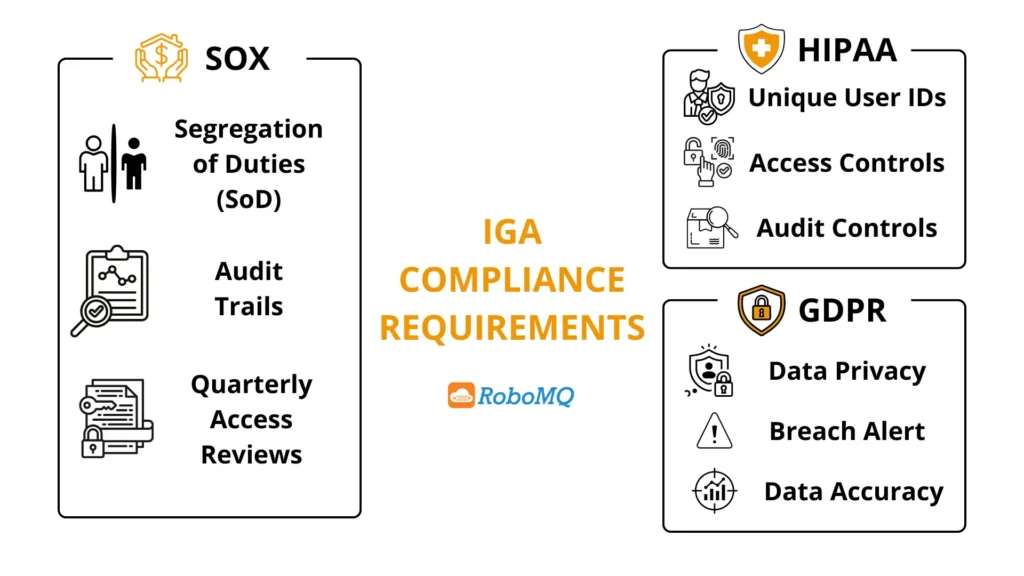
The General Data Protection Regulation (GDPR) applies to every business that processes personal information of EU residents, regardless of the organization’s location. GDPR does not use identity governance compliance terminology, but several of its foundational principles, like accountability, translate into access governance requirements.
Key articles that apply to access governance are:
Under the GDPR, the organization must be compliant and maintain the digital record to demonstrate it. Data authorities penalize organizations for a lack of documentation, even if there were no security breaches.
Across SOX, HIPAA, and GDPR, manual process gaps are the cause of compliance issues. More than being policy failures, these issues are process failures that happen between HR and IT.
At the time of new hiring, their record is first created in the HR systems. IT account provisioning happens afterwards, sometimes within the same day, other times several days later. During that window, new employees often use temporary accounts or shared credentials that are not uniquely traceable to them. This creates gaps in SOX audit trails, HIPAA’s unique identification requirements, and GDPR’s privacy requirements.
When an employee’s role changes, new access is provisioned for it. However, access from previous roles, departments, locations, and applications is rarely revoked during transition. Over time, this creates privilege creep where access entitlements reflect every role they have held rather than just their current position. This violates HIPAA’s minimum necessary standard, GDPR’s data minimization principle, and SoD conflicts under SOX.
During employee offboarding, the HR record is updated in one timeline, and IT deprovisioning happens on another. When an organization relies on manual processes, former employees can retain access to sensitive data and systems for days or weeks after their last working day. This is the most common access governance issue found in compliance audits under SOX, HIPAA, and GDPR.
Even if access provisioning and deprovisioning are handled correctly, the documented records might not exist correctly to satisfy auditors’ queries. IT ticket histories, spreadsheet-access review, and email chains do not produce timestamped, structured records that compliance audits require.
Hire2Retire is a lightweight Identity Governance and Administration (IGA) and employee lifecycle management platform by RoboMQ. It connects HR systems with identity platforms to automate provisioning, access updates, and deprovisioning based on HR data. It integrates more than 20 renowned HR systems, including SAP SuccessFactors, UKG Pro, Paylocity, ADP, and BambooHR.
That being said, Hire2Retire addresses identity governance compliance issues in the following ways:
In Hire2Retire, access entitlements are automatically derived from HR attributes (department, job title, location, employment type) rather than being manually assigned. The employee receives the accounts, group memberships, application licenses, and directory attributes that correspond to their role on their first day, without requiring IT tickets from HR.
As the provisioning event is logged with HR attributes, audit logs are created from the first moment of access provisioning. This closes the joiner gap and meets SOX, HIPAA, and GDPR compliance requirements of documented, role-based access provisioning.
When the HR system is updated to reflect a role change, Hire2Retire detects the change and updates access accordingly. New access required for the new role is provisioned. Accesses that no longer apply to the new role are revoked automatically. This keeps access aligned with the current role, so the IT team doesn’t have to handle audit review cycles manually. In this way, Hire2Retire addresses the mover gap and prevents privilege creep to comply with regulations.
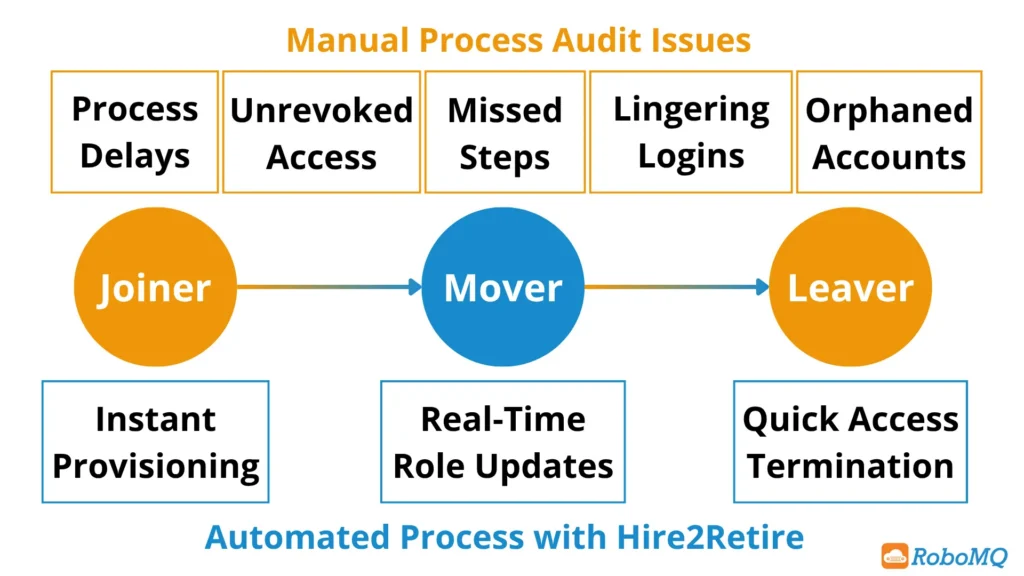
Similarly, in the case of termination, Hire2Retire automatically triggers deprovisioning whenever a termination event is recorded in the HR system. Accounts are disabled, group membership removed, application access revoked, and active sessions invalidated.
Hire2Retire also supports scheduled deprovisioning, allowing access to be revoked at a specific time on an employee’s last working day across different time zones. For immediate terminations, deprovisioning triggers within minutes of HR record updates. This removes the leavers’ gap and ensures no former employee has access to data or systems after their employment ends.
Hire2Retire logs every employee lifecycle event, providing full context on what changed, which HR event triggered the change, what the resulting access state is, and when each event occurred.
The audit trail provided by Hire2Retire is structured and queryable to answer SOX, HIPAA, and GDPR audit questions. Even review decisions are documented with timestamps and outcomes, producing records that auditors specifically look for when evaluating access governance.
Not all decisions can be fully automated. So, Hire2Retire integrates ITSM services like ServiceNow and FreshService to route access exceptions through documented approval workflows. When a request falls outside standard RBAC rules, it goes through a managed, recorded manual approval process. This ensures that the audit trail covers both automated and exception-based access decisions.
SOX, HIPAA, and GDPR all have different scopes and penalty structures, but they require the same foundation of identity governance compliance. These foundations include role-based access control, timely deprovisioning, periodic access reviews, and a complete audit trail.
Organizations manually managing these controls face a consistent challenge: gaps in compliance audits.
However, when access provisioning, updating, and deprovisioning are driven by HR events. The access state is continuously aligned with current employment data to keep audit trails.
For organizations using Hire2Retire, compliance becomes a byproduct of normal operations.
If you are also part of the organization that manages the employee lifecycle manually under SOX, HIPAA, and GDPR, the gaps defined in the post are worth addressing before an auditor identifies them.
Identity governance compliance refers to a set of controls that ensure user access to systems and data is accurate, documented, reviewed, and deprovisioned when no longer needed.
Hire2Retire enforces least-privilege access at provisioning, applies data minimization through RBAC rules, automates deprovisioning, and maintains a structured audit trail to help with GDPR compliance.
For standard termination, Hire2Retire can deprovision access at a scheduled date and time. To learn more about how Hire2Retire works, check out our video guide.
Identity governance addresses unique user requirements, minimum necessary access standards, access control standards, and audit controls standards to maintain HIPAA requirements.
Every business has different requirements and employee headcount, so try our ROI calculator to learn how much you can save with Hire2Retire.