Summary: User access lifecycle management is the process of controlling employee access to systems and applications from the day they join to the day they leave. When managed manually, it creates privilege creep, dormant accounts, compliance failures, and delayed offboarding. Hire2Retire solves this by automating the entire user access management lifecycle using your HR system as the single source of truth.
When you add a new employee to your organization, someone must create accounts for them, allocate permissions, and ensure they have access to all the necessary resources from day one. When they change roles, someone needs to make changes to their permissions. If an employee leaves the company, someone must delete the accounts across every system and application in use. And in most companies, “someone” refers to a human who manually performs the task using tickets.
The problem here is that user access lifecycle management is no longer a scalable task. It involves multiple systems, multiple processes that must happen at the same time, and countless events that occur simultaneously in an environment that’s constantly evolving.
Each manual step represents a potential point of failure, a user whose account is not deleted, or whose permissions are not changed, or a new hire who cannot work for three days after joining your company because they don’t have the necessary access. In this blog, we discuss in detail why manual user access lifecycle management doesn’t work, what the consequences are, and how Hire2Retire automates it entirely.
User access lifecycle management is the end-to-end process of managing employee access rights across every stage of employment, from onboarding through role changes to offboarding. The management should cover all systems, directories, applications, etc., with which the employee has contact and keeps up to date at every step in the process.
The most common lifecycle framework is the Joiner-Mover-Leaver framework. The joining event initiates user and access provisioning processes. Any moving events (promotion, transfer, change of department) necessitate access management changes that reflect the change of role of the employee. Finally, a leaver event results in access revocation.
Proper user access lifecycle management would mean that all employees have precisely the amount of access that is required by their current roles. However, when managed manually, the difference between ideal access rights in the system and actual user permissions increases with each unmanaged lifecycle event. Here’s how you can observe that phenomenon in practice throughout the entire JML process.
As organizations grow, managing user access manually becomes increasingly difficult, risky, and inefficient. Here are some key reasons why manual user access lifecycle management fails:
The security risks of poor user access lifecycle management are well documented. But the operational costs are just as significant and often less visible.
| Problem | Operational Cost | Security Cost |
|---|---|---|
| Delayed onboarding | Lost productivity on Day 1, poor first impression | Inconsistent access setup increases misconfiguration risk |
| Incomplete role change updates | Employees work with incorrect access for weeks | Privilege creep expands the attack surface |
| Missed offboarding | Unused licenses continue billing | Orphaned accounts become active attack vectors |
| No audit trail | Audit prep requires manual reconstruction | Compliance failures result in regulatory fines |
| Manual ticket dependency | IT team spends hours on repetitive provisioning tasks | Delays create windows of unauthorized access |
Every one of these costs compounds as the organization grows. A manual user access management lifecycle process that works, barely, for 100 employees becomes unmanageable at 500, and a significant liability at 1,000.
Hire2Retire by RoboMQ enables companies to handle user access from onboarding to offboarding by eliminating the need for manual effort. It works directly with your HR solution and uses employee data as the single source of truth for all decisions regarding user access. Regardless of whether you use Workday, ADP, SAP SuccessFactors, UKG, BambooHR, or any other HR solutions, Hire2Retire will provision, synchronize, and deprovision access based on employee record changes.
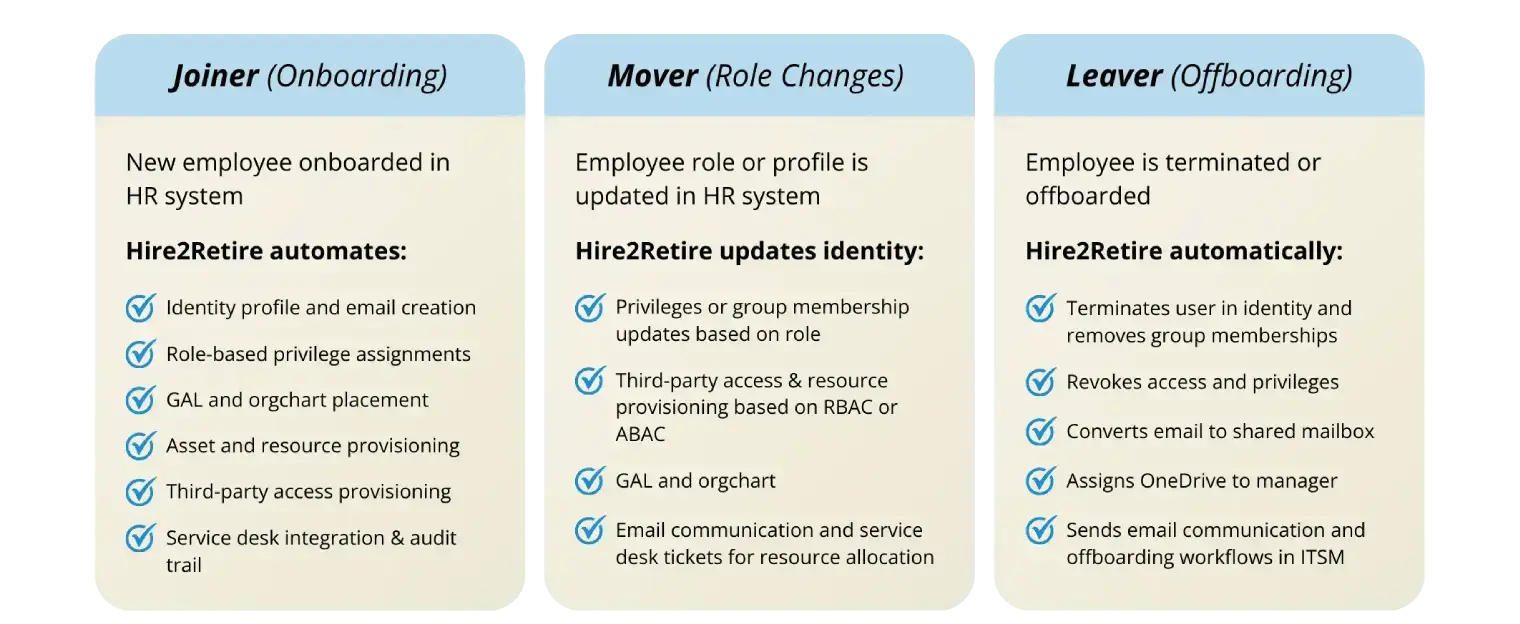
Hire2Retire automates the access process through all stages of an employee’s lifecycle. When a new hire is added to the HR system, Hire2Retire creates user accounts in Active Directory, Microsoft Entra ID, Google Workspace, Okta, and any connected systems, as well as assigns proper groups and application access rights before an employee’s first day at the company.
If an employee changes a job title, department, or location, then the system automatically adjusts user access based on new data in a profile. When an employee leaves the company, Hire2Retire deactivates users’ accounts, removes him/her from all groups, revokes licenses, and terminates active sessions in connected systems.
Hire2Retire uses Role-Based Access Control (RBAC) and Attribute-Based Access Control (ABAC). Access can be granted according to attributes like job title, department, geographical location, employment type, or other HR attributes. Administrators can create rules using simple logic and map those rules to directory groups, application roles, and software licenses. Changes made in employee information result in automatic changes in access privileges. Organizations find it easier to manage their least privilege access through this process.
Nothing slows down a new employee’s first day like waiting for access to the tools they need. Hire2Retire eliminates that delay by ensuring accounts, email, group memberships, and application access are fully provisioned before a new hire starts. Employees can log in and get to work on day one instead of waiting for IT tickets to be completed. With Hire2Retire, organizations have reduced manual onboarding effort by up to 90%, allowing IT teams to spend less time on repetitive tasks and more time on strategic initiatives that drive business value.
Hire2Retire’s Communication Hub automates employee communications by sending emails based on key lifecycle events. From welcome messages for new hires to notifications about role changes and offboarding communications, emails are sent automatically without requiring manual effort from HR or IT teams. Personalized templates can pull employee-specific information directly from HR and directory systems, ensuring every message is accurate, relevant, and up to date. By automating these communications, organizations can create a more consistent employee experience while reducing administrative workload and the risk of errors.
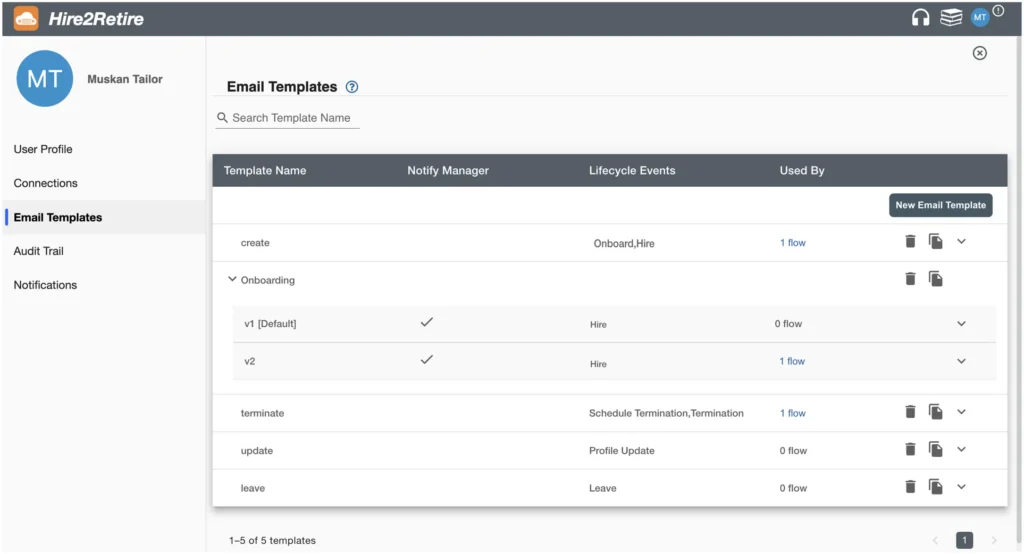
Even when access management is automated, many organizations still rely on service desk systems to maintain visibility and track employee-related IT activities. Hire2Retire integrates seamlessly with leading service desk platforms, automatically generating tickets when employees join, change roles, or leave the organization. Using REST-based connectors, the integration can be configured in just a few minutes without the need for custom development. This approach keeps IT workflows consistent and transparent while eliminating the time and effort required to create tickets manually. As a result, teams gain better visibility into employee lifecycle events without adding administrative overhead.
Hire2Retire goes beyond Active Directory and identity providers in extending user access lifecycle management. It covers applicant tracking systems, human resources platforms, and hundreds of other SaaS applications. With the help of SCIM integrations, businesses can automate the process of provisioning and deprovisioning from more than 300 applications from one workflow. This ensures that employees have proper access until they require it.
Each access request from Hire2Retire is logged automatically. Creation of accounts, changes to access rights, roles, groups, and deprovisioning operations are all automatically documented and timestamped with policy information. This allows easy tracking of who received access rights, when they were granted, and for what reason. As a result, a constant audit log is created for easy alignment with compliance projects such as SOC 2, ISO 27001, HIPAA, and many others without any extra effort.
Manual user access lifecycle management is no longer enough to keep pace with today’s workforce, growing application environments, and evolving security demands. When organizations rely on manual processes, delays in access provisioning, orphaned accounts, privilege creep, and compliance risks can quickly become ongoing challenges.
Hire2Retire automates the entire user lifecycle, provisioning, updating, and removing access based on real-time HR events. By eliminating manual tasks, organizations can onboard employees faster, strengthen security, and maintain audit-ready compliance with far less administrative effort.
The result is a more efficient, secure, and scalable approach to managing user access across the organization. Ready to modernize your user access lifecycle management? Schedule a demo and see how Hire2Retire can streamline onboarding, improve security, and simplify compliance from day one.
IAM represents the larger umbrella under which authentication, authorization, and access governance operate. The user access lifecycle management is just one aspect of IAM, where the concern lies in ensuring lifecycle access control of users from their hiring to when they retire. A complete solution for user access lifecycle management will take care of the automation in the lifecycle layer above your directory and IAM infrastructure.
Two of the most common consequences of poor access management include orphaned accounts and privilege creep. Orphaned accounts allow attackers entry using credentials belonging to a former employee. Privilege creep is when active employees have far more access than they need, thus increasing the potential damage that can be caused by an attack.
An effective user access lifecycle management platform like Hire2Retire supports time-bound access provisioning tied to contract end dates. Access is automatically revoked when the contract period closes, across all connected systems, without any manual follow-up. This prevents temporary workers from accumulating access that outlives their engagement.
HR updates are executed via Hire2Retire with nearly instant results. As soon as there is any information regarding termination entered in the integrated HR system, Hire2Retire immediately executes de-provisioning of the user from all integrated directories and systems, usually within a few minutes after any update to the HR system. This avoids any delays typical of the manual user lifecycle management process.