Over 70% of enterprises admit their employees retain system access even after leaving the organization.
Every employee journey leaves a digital footprint – logins, emails, shared folders, and dozens of connected tools. But what happens when those footprints don’t disappear when they should?
Nowadays, most Enterprises operate 5-10 systems, and most of them are not synced to each other, covering HR, payroll, IT directory, project tools, compliance, and even identity management. Since these systems don’t update each other in real time, when HR marks an employee as “resigned,” that update doesn’t always reach IT in time, which is why many organizations are turning to modern HR automation solutions to eliminate these delays.
In a world where talent is moving, roles are evolving, and the lines separating HR and IT are becoming murkier, the risk of manual workforce management is serious and growing fast. This is not just a security issue, but rather lost productivity, eroded employee experience, and mounting audit exposure.
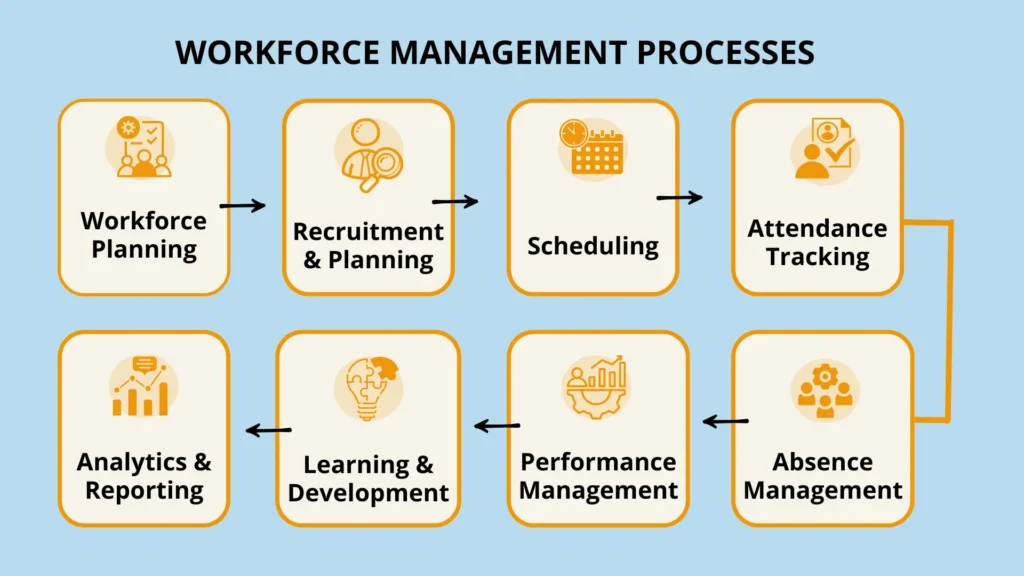
When your workforce lifecycle, from hire to retire, is fueled by 5-10 disconnected systems (HR, payroll, IT directory, compliance, and so on), the effects reach much further than a simple inconvenience. Because these systems don’t communicate with each other in real time, each step is an opportunity for risk.
More than 38% of organizations don’t have the ability to check if their previous workers used orphan accounts, while 15% know it happened, according to the industry analysis.
And this is what it is going to cost you:
When selecting a workforce management solution, we don’t just look for flash-in-the-pan dashboards or basic scheduling tools. Enterprises require a solution that interfaces people, processes and technology, one that can automate the full lifespan of an employee, ensuring compliance and scale.
Manual handovers between HR and IT are time-consuming and expensive. A new product should automate the joiner–mover–leaver process, from opening new accounts to changing permissions during internal migration, to immediately revoking access when someone exits.
Data lags, access to data becomes problematic, and compliance issues start to unravel if systems are disconnected from each other. Look forward to platforms that can match HR data (such as Workday, SAP SuccessFactors or ADP) to IT directories (such as Azure AD or Okta) in real time.
Access shouldn’t depend on signatures by hand and memory. Create roles, departments and job attributes once, and let the system automatically grant and revoke access. Role-based provisioning makes sure that employees have exactly what they need, which tightens security and reduces access sprawl.
Enterprises exist in a heavily regulated landscape, proving that “who had access to what and when” is no longer optional. Your solution should enable full visibility and audit trails, automate reporting and support you in fulfilling your compliance obligations under GDPR, SOX, HIPAA and ISO, free from manual effort.
If you have an expanding workforce across regions and departments, your system must scale without added complexity. A no-code interface enables HR and IT teams to design and update their own workflows, rather than having to rely on developer assistance.
The best workforce management solutions act as a link between HR and IT. Shared vision, common procedures and automated triggers reduce friction and build trust between teams. HR and IT are aligned with shared dashboards and integrated immediate updates, making sure every employee is supported from day one to their last day.
Every time someone joins, moves, or leaves a company, dozens of things need to be done in the backend, accounts are created, access is given or revoked, systems are updated, and records are synced. In most enterprises, this work still happens manually. HR updates the employee file on its own, IT requests tickets for account setup, and a compliance person records it all. It’s slow and error-prone, and it leaves big gaps.
That’s exactly what Hire2Retire fixes.
Hire2Retire links your HR system (such as Workday, ADP, or SAP SuccessFactors) with your IT directories (like Azure AD or Okta) and business apps. It automates the entire employee lifecycle, from onboarding, through role change, to offboarding, ensuring data, access, and systems stay perfectly in sync.
In today’s fast-moving enterprise environment, disconnected HR, IT, identity and access systems are a barrier to productivity, security and growth. Hire2Retire steps into that gap, automating the full employee lifecycle so HR, IT and business systems work as one.
Hire2Retire helps in:
In the beginning, we talked about how most enterprises use multiple systems for HR, IT, payroll, and compliance that do not sync with each other in real time, causing troubles including: new hires waiting for access, role changes going unnoticed, and ex-employees keeping their accounts active.
Hire2Retire solves that problem by connecting all these systems so they can work together automatically. When HR updates an individual employee record, all connected systems update in real time.
The result is a smoother, safer, and far more efficient workflow. Companies using Hire2Retire have seen onboarding become almost instant, HR and IT workloads drop by up to 90%, and access risks completely eliminated.
If you are also someone looking for a smart solution for your Workforce Management, book a free demo of Hire2Retire and experience the power of a smart workforce management tool today.
Most enterprises run 5-10 disconnected systems (HR, IT, payroll) that don’t communicate in real-time, preventing immediate updates when an employee’s status changes.
Costs include slow onboarding for new hires, unmanaged changes in roles, security issues from orphan accounts, and inconsistent audit trails for compliance.
It should provide end-to-end automation for the entire Joiner-Mover-Leaver (JML) lifecycle and offer real-time integration between HR data and IT access directories.
It reduces manual work for HR and IT by avoiding around 90% of the workload associated with employee lifecycle events like onboarding and offboarding.
A no-code interface allows HR and IT teams to easily design and update their own automation workflows, making the solution scalable without relying on developer assistance.

Sujata Swarnim is a Marketing Enthuasiast with a majors in Marketing , working at RoboMQ. She thrives on connecting the dots, between people, ideas & opportunities - turning creative insights into meaningful impact & power brand stories.
Sujata Swarnim is a Marketing Enthuasiast with a majors in Marketing , working at RoboMQ. She thrives on connecting the dots, between people, ideas & opportunities - turning creative insights into meaningful impact & power brand stories.