In today’s fast-paced enterprise world, companies are hiring well but still fail to deliver a smooth day one. New hires often face missing access, no email, and no clear starting point. The first experience your employee has with your company is often a reflection of the maturity of your onboarding workflow; when the process breaks, trust and productivity take a hit right away.
Only 12% of employees strongly agree their organization does a great job onboarding, as per Gallup, and about one in three new hires say their onboarding felt inconsistent or poorly structured. IT teams feel the weight of this too; access-related issues make up a significant share of helpdesk tickets in large enterprises, usually within a new hire’s first two weeks. And the productivity impact is unavoidable: companies lose 3–5 days of productive time per new employee due to delayed access and manual provisioning.
These delays lead to deeper security and compliance risks. In the rush to get new hires “up and running,” teams cut corners with time-saving tactics, temporary passwords, shared accounts, or just over-permission everyone. Credential-related issues are tied to over 70% of breaches, many of which stem from gaps created during onboarding or role-change events, according to the Verizon DBIR. Every missed step or manual workaround fuels identity sprawl, increases audit failures, and exposes systems to long-term risk.
This blog takes a deeper look at why onboarding breaks down, how real organizations feel the impact, and how a workforce-lifecycle automation solution like Hire2Retire — as part of a broader Hire to Retire Architecture — can help close these gaps end-to-end across the enterprise.
If you take a closer look inside most large organizations, the onboarding workflow often reveals more than just operational inefficiency. It exposes how scattered systems, siloed teams, and decades-old processes still shape the employee experience. HR carries the responsibility for getting new hires in the door, but IT controls the systems they depend on. Security is expected to enforce least-privilege access, yet it often has the least visibility into what permissions are being granted. Managers assume everything will “just work,” but they rarely see how many manual steps sit behind the scenes.
If you’ve ever worked in HR or IT at scale, these situations probably sound familiar:
1. HR updates the HRIS, but IT does not get the information on time.
Someone joined on Monday, but the ticket requesting access was raised on Friday evening. IT sees it only on Monday afternoon. The employee sits idle until the accounts are ready.
2. IT creates accounts, but no one knows the exact permissions the role needs.
The new hire receives a generic set of tools. Managers realize later that they’re missing Salesforce, Jira, or customer databases, resulting in a week of “Can you grant access?” emails.
3. Multiple teams approve access manually.
Finance needs to approve the ERP license. Sales Ops approves CRM access. Security approves VPN. If even one person delays, the whole workflow stalls.
4. No two employees have the same onboarding experience.
Modern enterprises often struggle to standardize access based on role, department, location, or reporting line.
Employees in the same role get different access. Shadow permissions accumulate. Audit failures increase, and none of this happens because teams are careless. It happens because the workflow is stitched together manually.
Enterprises employ a wide mix of roles, and each one requires a different set of tools, apps, and permissions. When provisioning depends on memory or manual coordination, it’s easy to miss a step or assign the wrong access.
Needs differ across countries, business units, and office locations. Local systems, regulations, and approval paths make onboarding complex, and manual workflows often fail to match these differences accurately.
HR systems store many changing details – job codes, locations, reporting lines, departments, and employment types. Even a small typo or delayed update can result in incorrect or missing access.
Most employees need access to identity platforms, communication tools, CRMs, ERPs, shared drives, internal portals, and more. Provisioning across multiple systems manually slows everyone down and increases error rates.
Employees move across roles, teams, and regions constantly. Access should adjust automatically, but manual processes often only add access and rarely remove it, leading to security gaps and audit findings.
Distributed teams rely fully on system access from day one. Without immediate access, work stalls, and quick “desk-side fixes” are no longer possible.
Large hiring waves, project ramp-ups, or seasonal staffing can overwhelm manual workflows, leading to long waits, incomplete setups, and disengaged new hires.
An automated onboarding workflow eliminates these bottlenecks by ensuring:
Hire2Retire by RoboMQ is an Identity, Governance & Administration product that provides zero-touch automation of workforce identity, access and privileges from HR as the source of truth to identity systems for Joiner, Mover and Leaver (JML). Learn more about how it transforms employee onboarding automation end-to-end.
Hire2Retire solves the onboarding problem at the root by removing the dependence on manual handoffs and making HR data the single source of truth that drives every downstream action. Instead of HR sending emails, managers raising tickets, and IT scrambling to provision access, the system turns every “hire” event in the HRIS into an automated, predictable workflow.
Organizations typically operate in disconnected ecosystems: Workday, ADP, or Dayforce on the HR side; AD, Entra ID, Okta, and dozens of business apps on the IT side. Hire2Retire connects these systems so that the moment HR marks someone as hired, all provisioning steps start instantly and reliably.
Hire2Retire delivers:
This reduces delays, cuts errors, and frees HR and IT from the most time-consuming part of employee lifecycle management.
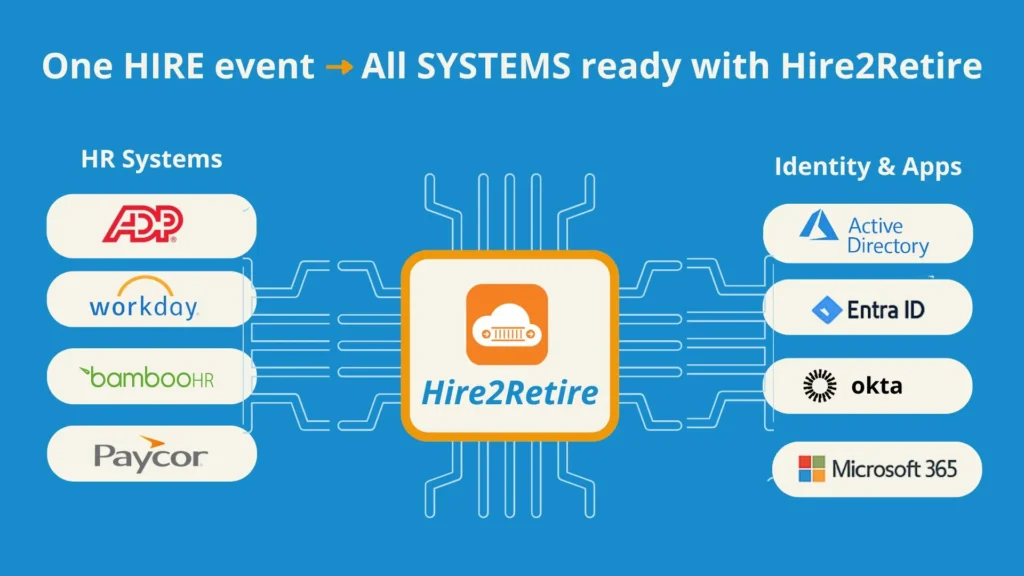
What Hire2Retire Enables Inside an Enterprise:
Most onboarding issues don’t come from a lack of effort; they come from processes that were never built for modern teams and fast growth. HR, IT, and security often work in separate systems, so each new hire sets off a long list of tasks that don’t always line up. When even one step relies on manual work, everything slows down. New employees wait, teams lose time, and small errors start to add up.
Hire2Retire removes the friction that usually slows down onboarding by directly connecting HR systems with identity and access platforms. Instead of relying on scattered updates or last-minute IT intervention, it creates one dependable workflow that runs quietly in the background. New hires walk in ready, teams stop chasing missing access, and leaders gain confidence that their processes can scale without adding complexity. Its no-code workflow builder also lets organizations update their onboarding logic as roles evolve or new tools are introduced without waiting on engineering cycles.
If you want onboarding to be easier, faster, and more secure, Hire2Retire is a strong solution. Reach out to our customer specialist to see how it can support your workforce from day one and beyond.
Because multiple teams, tools, approvals, and systems are involved, even one manual step can slow everything down or create errors.
It impacts confidence, productivity, and engagement, often making new hires feel stuck before they even begin.
Manual provisioning can lead to missing access, over-permissioned accounts, security gaps, and audit failures.
Automation removes waiting, back-and-forth communication, and human error by triggering access from HR data instantly.
It integrates with HR platforms and identity systems so that one HR update automatically provisions access across apps.

Sujata Swarnim is a Marketing Enthuasiast with a majors in Marketing , working at RoboMQ. She thrives on connecting the dots, between people, ideas & opportunities - turning creative insights into meaningful impact & power brand stories.
Sujata Swarnim is a Marketing Enthuasiast with a majors in Marketing , working at RoboMQ. She thrives on connecting the dots, between people, ideas & opportunities - turning creative insights into meaningful impact & power brand stories.