Organizations invest heavily in HR systems to manage employee data, yet most still struggle with disconnected workflows when it comes to executing employee lifecycle actions. Hiring, onboarding, role changes, and offboarding often require coordination between HR, IT, and business teams, which introduces delays and inconsistencies. This gap is where HR process automation tools become critical, but selecting the right solution requires a deeper evaluation than just feature comparison.
The real decision is not about automating HR tasks in isolation. It is about choosing a platform that can connect HR events to identity systems and IT infrastructure, ensuring that every workforce change results in immediate, accurate downstream execution.
HR process automation tools refer to platforms designed to streamline and execute repeatable HR processes with minimal manual intervention. These processes typically include onboarding workflows, employee data updates, internal approvals, and offboarding activities. While most organizations already use some form of automation, the depth and effectiveness of that automation vary significantly.
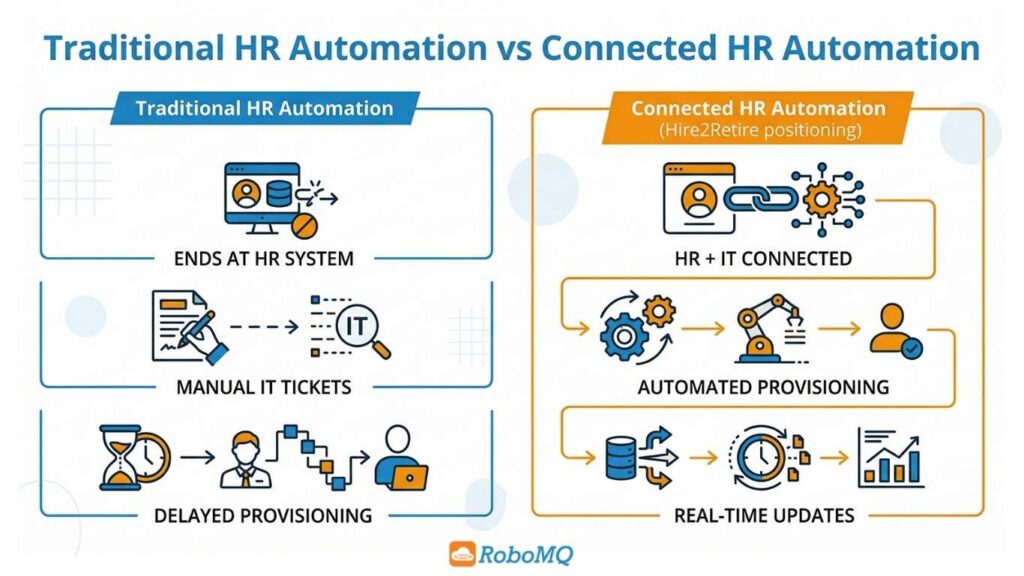
Traditional HR automation tools are primarily focused on improving internal HR efficiency. They automate document generation, approval chains, and record management, but they stop at the HR system. As a result, IT teams still need to manually provision accounts, assign access, and manage identity changes.
In contrast, more advanced automated HR software extends beyond HR operations and integrates directly with identity and IT systems. This enables a connected workflow where employee lifecycle events trigger real-time provisioning, access updates, and deprovisioning without requiring manual intervention.
Choosing the wrong platform often results in partial automation, where HR processes are streamlined but IT operations remain manual. This creates a false sense of efficiency while underlying operational challenges persist.
A report by Deloitte highlights that organizations adopting HR automation see improved workforce productivity and streamlined operations.
The right HR process automation tools eliminate these issues by creating a direct link between HR events and IT execution. This shift enables organizations to reduce onboarding time significantly, enforce consistent access policies, and maintain continuous compliance without increasing operational overhead.
Evaluating HR process automation tools requires a focus on how effectively they connect systems and automate identity lifecycle processes. Feature lists alone are not sufficient; the emphasis should be on execution depth and integration capability.
Event-driven automation is a critical capability. The system should detect changes in the HR platform, such as a new hire, role change, or termination, and automatically trigger downstream workflows. This ensures that provisioning and access updates happen in real time rather than relying on manual initiation or batch processing.
Integration is another key factor. The software must connect natively with HR systems as well as IT infrastructure such as Active Directory and cloud identity platforms. Without this integration, automation remains incomplete and requires manual bridging between systems.
User provisioning and deprovisioning must be fully automated. When a new employee joins, accounts should be created, groups assigned, and access granted automatically. Similarly, when an employee exits, access must be revoked immediately to prevent security risks.
Role-based access control is equally important. The system should assign access based on attributes such as role, department, and location, and dynamically update permissions when these attributes change. This ensures that users always have the right level of access without manual adjustments.
Data synchronization also plays a crucial role. Employee data changes should be reflected instantly across all connected systems to maintain consistency and avoid access discrepancies.
Many organizations implement HR automation tools expecting end-to-end efficiency, but most solutions are limited in scope. They automate HR workflows effectively but do not extend automation into IT systems. This results in continued reliance on manual provisioning processes and fragmented workflows.
The underlying issue is not the absence of automation but the lack of connected automation. HR systems act as systems of record, but they are not designed to execute identity lifecycle actions. Without integration into identity and access management processes, automation remains incomplete and fails to deliver meaningful operational or security improvements.
Hire2Retire addresses this gap by enabling event-driven identity lifecycle automation that connects HR systems directly to IT infrastructure. Instead of treating HR and IT as separate domains, it creates a unified workflow where HR events drive identity actions automatically.
When a change occurs in the HR system, Hire2Retire captures the event in real time and processes it based on predefined policies. It then executes provisioning tasks such as account creation, group assignment, and application access. As employee data evolves, the platform continuously updates access to reflect current roles and responsibilities. During offboarding, it ensures immediate deprovisioning, eliminating the risk of orphaned accounts.
This approach aligns HR automation with broader identity and access management strategies, enabling organizations to achieve both efficiency and compliance.
Selecting the right HR automation solution requires a structured evaluation approach that focuses on integration, scalability, and automation depth. Organizations should assess whether the platform supports real-time processing, adapts to complex organizational structures, and enforces consistent access policies.
It is also important to evaluate audit capabilities. The system should provide complete visibility into provisioning actions and maintain logs that support compliance requirements. Scalability is another critical factor, as the solution must handle growth in workforce size and organizational complexity without performance degradation.
A common mistake is selecting tools that are limited to HR workflows without considering their impact on IT operations. This leads to continued reliance on manual processes and reduces the overall value of automation investments.
Another issue is overlooking identity lifecycle management. Provisioning and deprovisioning are central to both operational efficiency and security, and failing to automate these processes creates long-term risks.
Organizations also tend to underestimate integration complexity. Choosing a solution that does not integrate seamlessly with existing systems results in additional overhead and fragmented workflows. Focusing solely on user interface or ease of use, without evaluating backend automation capabilities, can also lead to suboptimal outcomes.
Choosing the right HR process automation tools requires a shift in perspective from task automation to lifecycle automation. Organizations need solutions that not only streamline HR operations but also connect those operations to identity and access management systems.
Without this connection, automation remains incomplete and operational inefficiencies persist. With the right approach, organizations can transform HR events into real-time actions that improve productivity, reduce risk, and support continuous compliance.
Solutions like Hire2Retire enable this transformation by bridging the gap between HR systems and IT infrastructure, delivering measurable impact across the entire employee lifecycle.
It streamlines routine HR operations by automatically handling processes like employee onboarding, data updates, and offboarding, reducing manual coordination across teams.
They minimize reliance on IT tickets by automating repetitive tasks but still work in alignment with IT systems and policies to ensure proper access control.
No, it is valuable for any organization managing employee lifecycle changes, especially where manual processes create delays or inconsistencies.
Hire2Retire captures employee changes from HR systems and automatically executes corresponding identity and access updates across connected IT systems in real time.
Organizations choose it because it goes beyond HR workflows and ensures that every employee change is directly reflected in IT systems with consistent and policy-driven execution.

Nitesh Durgude is a marketing specialist with 6+ years of experience in the content industry and an engineering background. He specializes in SaaS and business-focused content, creating blogs and videos that simplify complex topics into practical, easy-to-understand insights.
Nitesh Durgude is a marketing specialist with 6+ years of experience in the content industry and an engineering background. He specializes in SaaS and business-focused content, creating blogs and videos that simplify complex topics into practical, easy-to-understand insights.