Every company depends on accurate employee information. HR stores the official records, and IT uses these records to create accounts, assign access, and keep systems secure. When this information does not sync properly, many problems begin to appear. Some are visible right away, like slow onboarding process. Others may remain concealed until the situation escalates to a severe security issue.
Poor HR data sync may seem small yet affect employee experience, system security, and the daily workload to HR and IT teams. This article will discuss what actually goes wrong when HR data does not sync properly, why orphan accounts occur, why gaps in access happen, what costs these certainly incur in real costs, and what can modern workplaces do to resolve the issue.
Although the data and technical side do require some integrations to work seamlessly, HR systems are the most significant repository of information about employees. They track when someone is hired, when someone is terminated, when someone is promoted, whether someone is a contractor or an employee, and so on. The IT systems need to know when to give an employee access and when to terminate that employee’s access.
When all of these intricate details are integrated and fungible, everything works perfectly. New hires are given their IT accesses on their start date, employees receive their accesses in a timely manner when positions change, and their accesses are terminated immediately after their exit from the company or organization. This is the ideal. Most workplaces do not reach this condition, mostly because HR and IT systems do not sync in an automated, complete, or proper manner.
While many organizations recognize that they have challenges in the direction of data, they may not fully understand how the small challenges can add up to be one large challenge. For example:
Even tiny mismatches create confusion. IT may not know which information is correct. wo systems may display two different versions of the same employee’s data. Any time this happens, it will become that much harder to maintain clean data. When this type of inconsistency occurs over months or years, it creates serious issues related to operations and security.
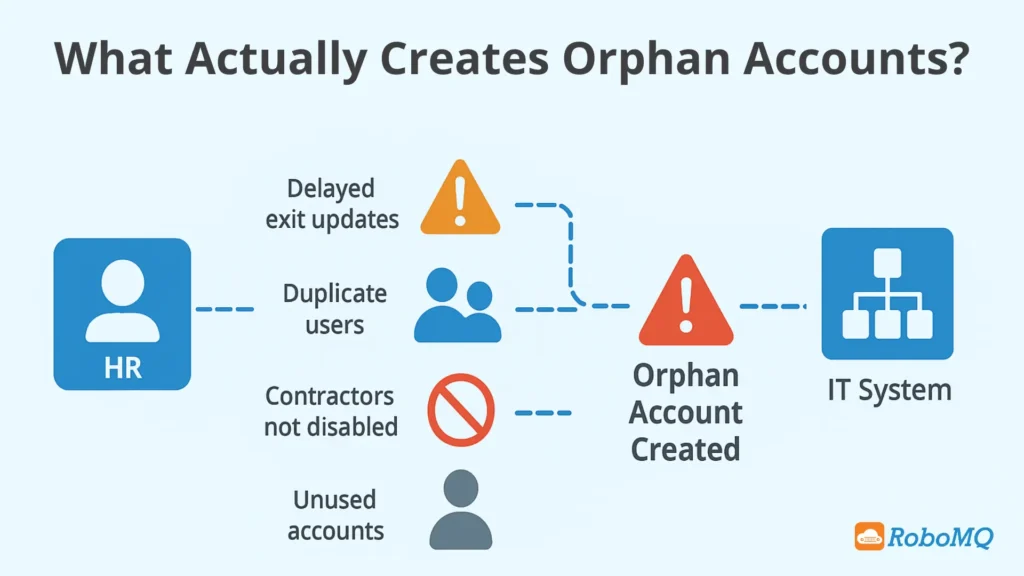
The biggest risk of poor HR data sync is the creation of orphan accounts. An orphan account is an account that remains active even though the person has already left the organization.
These accounts appear when:
Orphan accounts are one of the most common causes of data breaches in companies of every size. An industry report found that 64% of organizations struggle to even identify and remove orphaned or unused accounts, which shows how widespread this problem really is. A forgotten and unmonitored account can still access files, emails, shared drives, or even controls related to system administration.
As no one is monitoring these accounts, they become particularly easy points of entry for attackers. Even in the absence of a direct attack, orphaned accounts are a waste of software licenses and create confusion during audit. Companies often find dozens or even hundreds of unused accounts that should have been removed months ago.
When HR data is not updated properly, the entire access structure becomes unreliable. Here are some common situations that create security gaps:
When someone moves from one department to another, they should lose the access they no longer need. Without proper sync, old access remains active and builds up over time.
If an employee becomes a manager or switches teams, IT should know immediately. Delayed or missed updates lead to confusion about who has permission to approve requests or access sensitive information.
If Active Directory, email, HR, and application systems show different information, it becomes difficult to verify the correct profile.
Auditors need to understand who has access to what. If the access data is inconsistent, it is literally impossible to demonstrate that only the right people have access.
Sometimes old accounts retain extra permissions. This creates major risk because no one is tracking their activity.
Security always starts with correct data. If employee information is wrong or incomplete, even the strongest access controls fail.
Most companies do not realize how much poor HR data sync costs them until they take a closer look. The impact shows up in many different ways.
When you total the above elements, inadequate interaction of HR data can be a significant hidden cost.
Many companies continue to communicate employee changes via spreadsheets, email or ticketing system. These manual steps add human error & delays. Manual process scenarios include:
Manual work cannot scale and becomes impossible to manage as the organization grows. Automation is the only real solution.
A reliable HR data sync solution should offer:
When HR and IT stay perfectly aligned, the entire employee lifecycle becomes smooth and secure.
RoboMQ’s Hire2Retire platform is designed to handle all HR data sync challenges efficiently. It provides:
By enabling HR and IT to work off the same reliable data, many outcomes are achieved. New employees are granted access immediately, and ex-employees are denied access immediately. Security is enhanced. IT teams see a significant drop in workloads. Most importantly, organizations get peace of mind that their identity data is always accurate.
Inaccurate HR data sync affects almost every aspect of the employee lifecycle. It prolongs the onboarding process, presents hidden security risks, and adds unneeded workload to HR and IT teams. Orphaned accounts and inconsistencies with access levels are real problems that cannot go unchecked anymore.
Organizations need a reliable and automatic way to keep HR and IT systems in sync. Hire2Retire provides an easy, effective solution by maintaining accurate data, removing manual effort, and increasing security. Trustworthy HR data sync is not just a technical measure. It promotes confidence, safety, compliance, and creates a better employee experience.
HR data sync refers to the ability to keep employee information synchronized across all of your systems. If HR makes an update to a record, those changes should happen in the other systems, such as Active Directory, email, and applications, without delay. Employees should also receive the right access to all systems and data, at the right time.
An orphan account remains active, even when someone departs an organization. Orphan accounts are seldom monitored because no one is actively using them. A hacker will commonly leverage an orphan account to access a system without anyone noticing. Thus, they can be one of the easiest methods to breach the network of an organization.
When HR or IT teams rely upon spreadsheets, emails, or tickets to make a change to an employees’ data, mistakes and delays are inevitable. This could lead to the wrong access being created, missed employees when they leave the organization, or even accounts still being created, but shouldn’t have been in the first place.
Hire2Retire automates the entire employee lifecycle. It takes updates that occurred within HR systems and applies them to both Active Directory and Azure AD on-demand. The application creates new accounts, makes edits to existing accounts, and removes access for all departing employees all without human intervention.
Hire2Retire keeps employee data accurate and up to date at all times. This removes orphan accounts, prevents access from lingering after exits, and ensures employees only have the access they need. It gives organizations stronger control and better visibility into every user account.