Offboarding should be simple: someone leaves, and their access goes with them. But in most organizations, that’s not what actually happens.
On day one, visible accounts get disabled, and devices get collected, and then everyone assumes the risk is gone. In reality, this is where most identity gaps begin. Shadow accounts, forgotten SaaS logins, dormant entitlements, and contractor access all continue to live quietly in the background.
In this blog, we’ll explore why employee offboarding breaks down after day one, how delayed revocations turn into real security risks, the data that proves it’s a growing problem, and what a modern, automated offboarding process should look like.
The Data Mismanagement: Offboarding Is Where Identity Risk Peaks
Here’s what recent reports show:
47% of ex-employees retain active access to at least one company system after departure.
A 2024 survey of IT leaders found that 51% couldn’t confirm they deactivated all former employee accounts across SaaS and on-prem systems.
According to a global workforce study by ISACA, 54% of insider incidents involved former employees whose access was never fully revoked.
Gartner notes that by 2026, 75% of cloud security failures will stem from identity and permission mismanagement - offboarding being a top contributor.
This isn’t a small clean-up issue; it’s a systemic failure.
Why Day One Offboarding Gives Everyone False Confidence
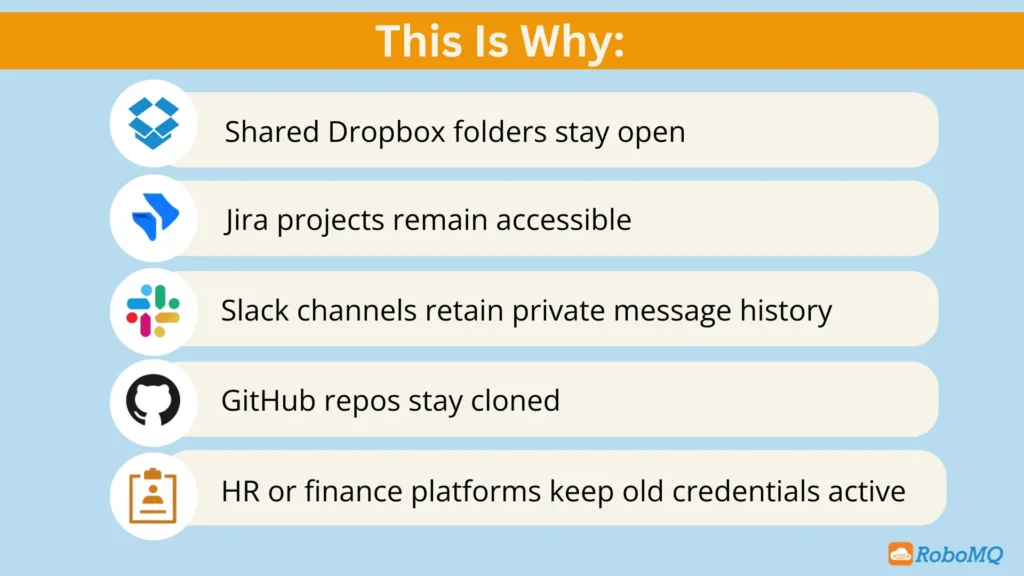
The real problem is that IT only ever sees a fraction of the access someone actually has. Beneath the obvious accounts are countless others – self-service SaaS tools no one tracks, shared team logins that never get rotated, API tokens tied to old workflows, contractor and vendor systems that live outside IT’s spotlight, legacy apps with no automated offboarding, physical badges that stay active, and mobile device tools that rarely get cleaned up.
When these access points aren’t mapped or governed, they don’t disappear when a person leaves. They just sit there, unnoticed and exploitable. This is how shadow access quietly survives long after offboarding is “complete.”
The Problem: Access Lives in Too Many Places to Shut Down Manually
Here’s the uncomfortable truth: Modern organizations work on far more software and systems than IT can manually manage.
The average mid-size company now uses 130+ SaaS applications. Enterprises often exceed 250+, and more than half of them are not connected to identity provider.
So even if IT disables the main identity directory, dozens of entitlements remain untouched – simply because no one knows they exist.
The more distributed your software is, the more offboarding becomes guesswork.
Real Incident: The Shopify Customer Data Exposure (2020)
In 2020, Shopify revealed that two former support employees accessed merchant transaction data after their employment ended. The company confirmed that the platform itself wasn’t breached; the problem was internal access that hadn’t been fully revoked. The employees were able to use old credentials to view order details from a number of merchants before Shopify detected the unusual activity.
No zero-day exploit, no complex attack chain – Just lingering privileges tied to accounts that should have been shut down completely.
It’s a clear reminder that offboarding isn’t just paperwork – it’s a security control. And when it’s treated like a one-day task instead of an ongoing structured processlifecycle, even trusted insiders can become accidental risk factors.
The Fix: Offboarding Has to Run Like a Lifecycle, Not a One-Time Ticket
Offboarding only works when it keeps going – automatic, consistent, and triggered by real HR updates, not someone remembering to file a request.
A proper offboarding process should:
Remove access as soon as HR marks someone as leaving, instead of waiting for IT to catch up
Shut down accounts across every system, not just the main directory
Clean up all kinds of access, including SaaS apps, shared tools, and building entry
Record what was removed and when, so audits aren’t a guessing game
Apply end dates for contractors and interns, instead of letting their access run indefinitely
Check for anything that slipped through, using regular automated reviews
The truth is, no team can do all this manually – not with the number of tools companies use today. Spreadsheets won’t save you. Basic provisioning won’t catch everything. Only lifecycle automation can keep offboarding clean, complete, and dependable.
Where Hire2Retire Makes Offboarding Actually Work
The part most teams struggle with is consistency. Hire2Retire by RoboMQ removes that friction by connecting HR data directly to identity workflows so offboarding becomes automatic and structured.
With Hire2Retire:
Offboarding triggers the instant HR marks an employee’s account inactive
All accounts, groups, licenses, and entitlements across systems are revoked
Contractor access ends automatically based on employment dates
Shadow accounts shrink because access can’t “survive” outside the lifecycle
Every action is logged with who, when, and why
It turns offboarding from a manual chase into a predictable, clean, repeatable process -minimizing the odds of lingering access turning into tomorrow’s breach.
Final Thoughts
Offboarding breaks not because teams are inattentive, but because modern workplaces move faster than traditional processes can handle. People use dozens of tools, roles shift constantly, and access spreads across systems. Nnobody remembers until something goes wrong.
Real security comes from removing every entitlement tied to a person – across SaaS, directories, groups, and devices automatically. That’s where platforms like Hire2Retire change the equation, because access updates aren’t dependent on someone remembering a checklist; they happen as part of the lifecycle itself.
See how seamless, automated offboarding actually looks. Book a free demo of Hire2Retire and experience identity cleanup that doesn’t depend on reminders, tickets, or luck.
Because offboarding often stops once visible tasks are done. While laptops are returned and main accounts are disabled, hidden access like SaaS apps, shared tools, and dormant permissions are rarely tracked or removed.
Commonly missed access includes self-service SaaS tools, shared team logins, API tokens, contractor systems, legacy applications, physical access badges, and mobile device management tools that aren’t tied to a central identity system.
Modern organizations use hundreds of applications, many of which aren’t connected to a central identity provider. Manually tracking and revoking access across all these systems is slow, error-prone, and nearly impossible to keep consistent.
Hire2Retire automates offboarding by linking HR updates directly to identity workflows. The moment HR marks someone as inactive, access across directories, SaaS apps, groups, and entitlements is revoked automatically and consistently.
Absolutely. You can book a free demo of Hire2Retire to see how automated, end-to-end offboarding works in real time and how it helps eliminate lingering access without manual effort.
Sujata Swarnim
Sujata Swarnim is a Marketing Enthuasiast with a majors in Marketing , working at RoboMQ. She thrives on connecting the dots, between people, ideas & opportunities - turning creative insights into meaningful impact & power brand stories.
Sujata Swarnim
Sujata Swarnim is a Marketing Enthuasiast with a majors in Marketing , working at RoboMQ. She thrives on connecting the dots, between people, ideas & opportunities - turning creative insights into meaningful impact & power brand stories.
Our website uses cookies. By continuing to browse the website you are agreeing to our use of cookies. For more information on how we use cookies and how you can disable them, please read our Privacy Policy. I Accept.