What Was the Problem?
As RAYUS Radiology expanded across the United States through acquisitions and organic growth, its identity lifecycle operations became increasingly complex and operationally constrained.
While workforce data was managed through ADP, identity provisioning across Active Directory and connected clinical systems struggled to keep pace with organizational scale and system load.
The organization faced several interconnected challenges:
At peak load, tens of thousands of identity events accumulated in backlog, resulting in delayed propagation across hybrid Active Directory environments.
In a healthcare environment where timely access to imaging systems directly affects diagnosis and patient care workflows, these inefficiencies created operational friction and governance concerns.
About RAYUS Radiology
RAYUS Radiology, formerly known as Center for Diagnostic Imaging, Inc., is a national subspecialty provider of advanced diagnostic and interventional radiology services headquartered in St Louis Park, Minnesota.
The organization operates more than 140 imaging centers across all 50 states, delivering MRI, PET/CT scans, interventional radiology procedures, vascular imaging, biopsies, and image-guided treatments.
With approximately 2,000 employees and 400+ affiliated radiologists, RAYUS plays a critical role in outpatient imaging and hospital-based diagnostic services across the U.S.
The organization also participates in over 150 clinical trial protocols and processes more than 75 million medical images annually, contributing to the advancement of precision and personalized medicine.
RAYUS is built on the philosophy of “brilliant medicine, brilliant team, and brilliant technology,” focusing on making radiology a foundational step in diagnosis and treatment planning.
Solution Overview
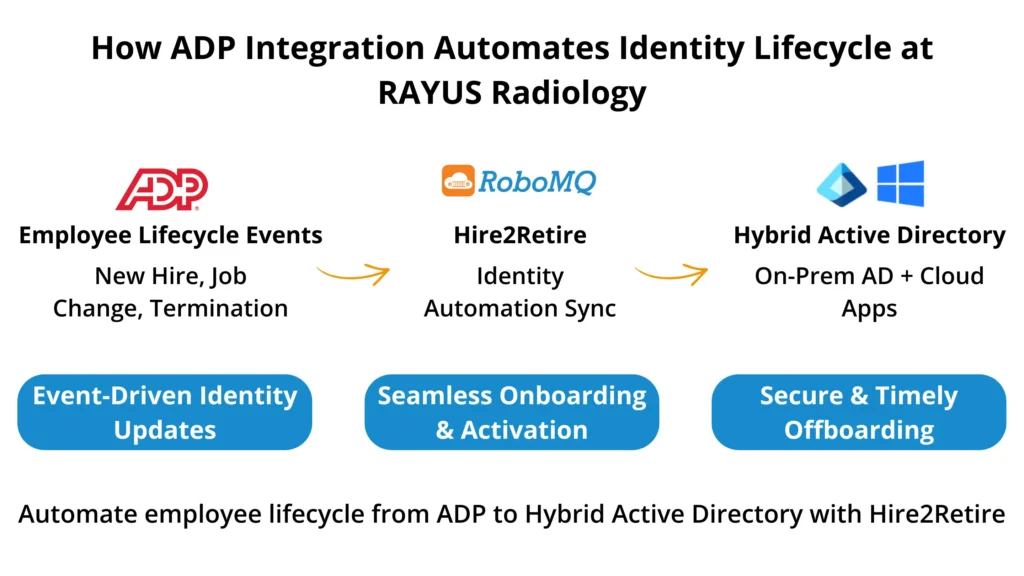
RAYUS Radiology implemented a hybrid identity lifecycle automation framework that directly connected workforce data from ADP to its Active Directory and cloud identity systems. The solution, powered by RoboMQ Hire2Retire, shifted identity management from batch-heavy processing to an event-driven automation model.
A key architectural improvement was the separation of onboarding and hire-day lifecycle events, ensuring pre-hire provisioning could occur without triggering duplicate approvals or conflicting workflows. The solution also reduced dependency on high-frequency API calls to Active Directory, improving system performance and reducing domain controller strain across distributed environments.
Implementation Approach
The implementation was delivered in phased stabilization and optimization stages to ensure safe migration and operational continuity. First, RAYUS transitioned from large batch-based HR file processing to more controlled event-driven identity flows, reducing backlog accumulation and improving processing predictability.
Next, onboarding and hire workflows were decoupled. Pre-hire accounts were created in a disabled state ahead of start dates, while activation and access enablement occurred independently on the hire date. This eliminated duplicate approvals and reduced operational confusion.
During early rollout, workflows were executed in supervised mode, allowing IT teams to validate identity actions before execution in Active Directory and reducing deployment risk. Special handling was introduced for rehire and contractor-to-employee scenarios to ensure existing accounts were reused instead of recreated, improving identity continuity and reducing duplication.
Finally, system optimizations reduced unnecessary API calls and improved processing efficiency across hybrid Active Directory infrastructure, easing load on domain controllers.
Business Impact
The transformation delivered measurable improvements across identity performance, governance, and operational efficiency:
Key Takeaway
RAYUS Radiology’s transformation demonstrates that identity challenges in large healthcare networks are rarely caused by a single system, but by misalignment between HR processes, identity logic, and infrastructure scale.
By restructuring lifecycle definitions, separating onboarding from hire execution, and reducing system strain from batch-heavy and API-intensive processing, RAYUS achieved a more stable and scalable identity foundation. The result is a unified identity model that improves operational reliability, reduces security risk, and better supports clinical workflows across a national healthcare network.
Want to learn more?
Ready to join the wave of companies automating their employee lifecycle management processes with Hire2Retire? Schedule a demo call with us today to see what Hire2Retire can do for your business.
RoboMQ is not affiliated, associated, authorized, endorsed by, or in any way officially connected with any of HR systems that it provides integration with and are mentioned in this case study. All product and company names are the registered trademarks of their original owners.
MORE CASE STUDIES